
How to Cite Multiple Authors A Guide to APA, MLA, and Chicago
December 28, 2025
Citing a work with multiple authors can feel like a moving target. The basic idea is to list each author in the order they appear on the source. For quick in-text citations, you’ll often use "and" for two authors (like Smith and Jones, 2023) or the trusty "et al." for three or more in styles like APA and MLA (Smith et al., 2023).
But the full reference list is where things get more detailed, and that’s where knowing the rules for your specific style guide really counts.
Why Accurate Citations Matter in Collaborative Research
Getting your citations right is about more than just appeasing a professor or an editor—it’s about academic integrity. Think of each citation as a nod of respect to the people who did the work. In today's research world, where team-ups are the norm, giving everyone their proper credit is just good scholarly practice.
It's also your best defense against accidental plagiarism. When you cite correctly, you draw a clear line between your own ideas and the research you’re building on. If you want a refresher, our guide on how to avoid plagiarism breaks it all down. This doesn't just protect you; it makes your own arguments stronger by showing they stand on a solid foundation of existing knowledge.
The Rise of Multi-Author Papers
Today's big research questions often demand large, interdisciplinary teams to solve them. Because of this, it’s not unusual to see papers with a dozen, or even a hundred, authors. This trend makes knowing the citation rules more important than ever.
In fact, one analysis of health-science articles found a major shift toward papers with many authors. It even noted that papers with 50 or more authors had much higher rates of self-citation than single-author papers. These kinds of trends are exactly why citation formats exist—to create a standardized system for giving credit where it's due.
This decision tree gives you a simple way to figure out which in-text format to use based on how many authors you're dealing with.
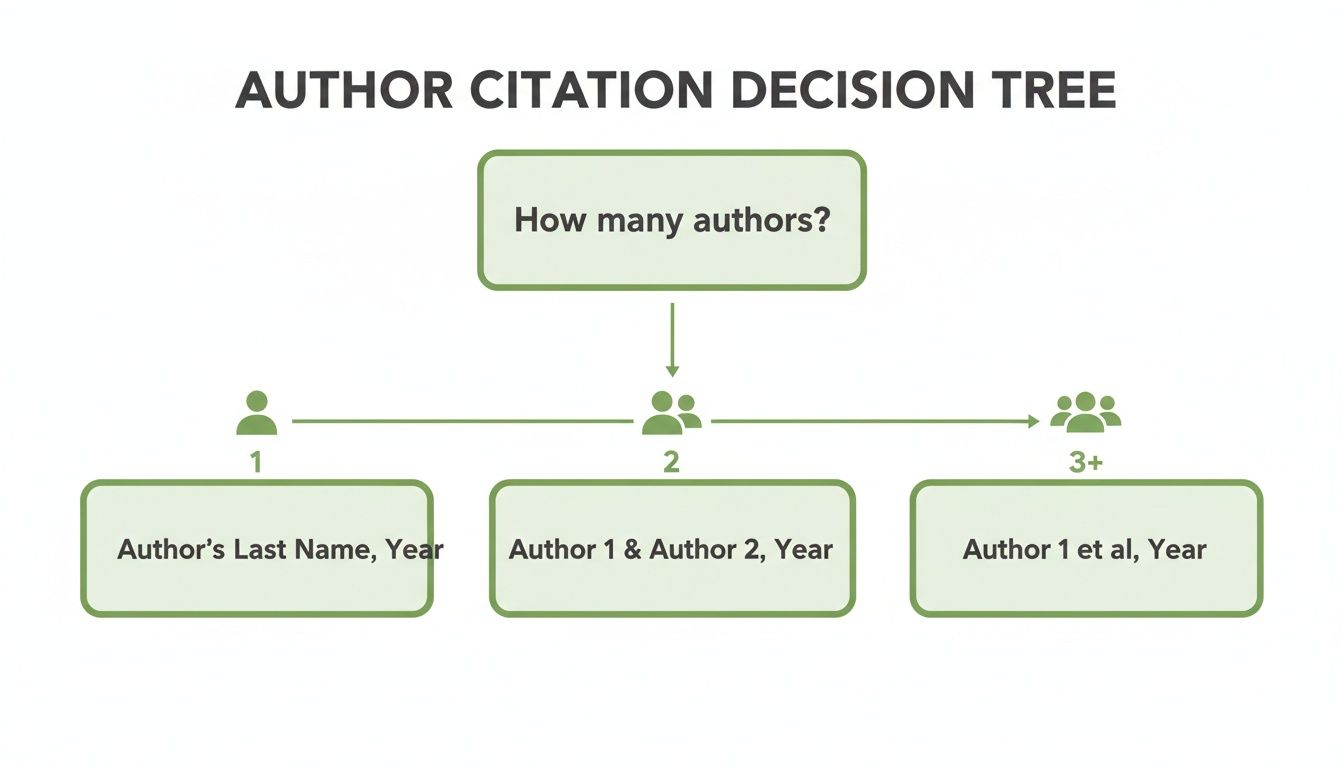
As you can see, the first question is always: "How many authors am I citing?"
Getting citations right is a fundamental skill. It demonstrates your attention to detail and your respect for the scholarly conversation you are joining. Each citation connects your work to a broader network of knowledge, making your research transparent and verifiable.
To really get a handle on the nuances across different academic fields, it's worth exploring guides on mastering research paper citation formats.
Quick Guide for In-Text Citations
To get you started, here’s a quick-and-dirty breakdown of the in-text citation rules for APA and MLA, which are two of the most common styles you'll run into.
| Number of Authors | APA Style (7th Ed.) | MLA Style (9th Ed.) |
|---|---|---|
| Two Authors | List both authors' last names, joined by an ampersand (&). Ex: (Smith & Jones, 2023) | List both authors' last names, joined by "and". Ex: (Smith and Jones 45) |
| Three or More Authors | List the first author's last name followed by "et al." from the first citation. Ex: (Smith et al., 2023) | List the first author's last name followed by "et al." Ex: (Smith et al. 45) |
This table is great for a quick reference, but just remember that the rules for your full reference list or works cited page are a bit more involved.
Citing Multiple Authors Using APA Style
If you're writing in the social sciences, you're almost certainly using the American Psychological Association (APA) style. It’s the gold standard, and its rules for citing multiple authors are all about making your work clear and easy to follow. Thankfully, the latest 7th edition of APA simplified things, especially for sources with long author lists.

Let's walk through exactly how to handle both your in-text citations (the quick mentions inside your paragraphs) and the full entries in your reference list. Getting this right is a non-negotiable part of producing professional, credible work.
APA In-Text Citations: Getting It Right
The whole point of an APA in-text citation is to quickly point your reader to the full source in the reference list without clogging up your sentences. The rules are pretty straightforward and change depending on how many authors you're dealing with.
If a source has just one or two authors, you’ll list both of their last names every single time you cite them. Simple. Just remember to use an ampersand (&) inside parentheses, but the word "and" when you weave it into a sentence.
- Parenthetical Example: Research shows a significant correlation between study habits and academic performance (Davis & Chen, 2021).
- Narrative Example: Davis and Chen (2021) found a significant correlation between study habits and academic performance.
For sources with three or more authors, the rule is even easier. From the very first citation, you just list the first author's last name followed by "et al." This is a big, time-saving change from APA 6, which made you list more authors on the first go-around.
- Parenthetical Example: Recent findings suggest that team dynamics play a critical role in project success (Williams et al., 2023).
- Narrative Example: Williams et al. (2023) explored the role of team dynamics in project success.
My Takeaway: The "et al." rule for three or more authors is a lifesaver. It keeps your writing clean and readable, especially if you’re citing the same multi-author study over and over. It's a practical nod to the fact that big research projects are often a team sport.
Formatting Your APA Reference List
While in-text citations are all about brevity, your reference list is where you lay out all the details. The formatting here needs to be precise.
First things first: always list the authors in the exact order they appear on the publication. That order usually signals their level of contribution, so it’s a big deal. The format for each name is always Last Name, F. M.
Works with Up to 20 Authors
If you have a source with two to 20 authors, you have to list every single one. No shortcuts here. Just separate each name with a comma and slip in an ampersand (&) right before the very last author.
Journal Article (Three Authors):
Jones, S. A., Miller, L. F., & Garcia, R. (2020). The impact of remote work on employee engagement. Journal of Applied Psychology, 105(4), 341–357.Book (Five Authors):
Edwards, B., Harris, J., Peterson, K., Robinson, M. S., & Carter, T. (2022). Advanced data analytics for modern business. University Press.
Works with 21 or More Authors
Ever seen a study with a massive author list? For these, APA has a space-saving rule. If a source has 21 or more authors, you list the first 19, then add an ellipsis (...), and finish with the very last author's name. No ampersand needed.
- Example (22 Authors):
Gilbert, A. A., Almeda, M. V., Banks, W. C., Bar-Anan, Y., Chan, M. K., Chen, X., Collins, P. A., Crawford, M. T., Frank, M. C., Goldstein, R. B., Howard, J. S., Lane, D. M., Martin, E. F., Norris, C. B., Park, J. H., Scott, A. T., Taylor, R. D., Vance, J. D., Watts, K. M., ... Zuniga, C. J. (2024). A large-scale study of psychological phenomena. Nature, 612(7939), 305–312.
This is a practical solution for those huge, collaborative studies you see in fields like physics or medicine. It gives credit where it's due without making your reference list a mile long. Master these rules, and you'll be able to handle any multi-author citation APA throws at you.
Navigating Multi-Author Citations in MLA Style
If you’re writing in the humanities—anything from literary analysis to art history—you’re probably living in the world of the Modern Language Association (MLA) style. The latest version, MLA 9th Edition, has its own way of handling multiple authors, and it's just different enough from APA to keep you on your toes.
Getting this right is about more than just rules; it’s about showing you’ve done your homework and are participating in a scholarly conversation.

Unlike APA's focus on the publication year, MLA really emphasizes the author and the specific page number where you found the information. This small difference speaks volumes about the humanities' focus on the text itself. Let’s see how that plays out in your paper, from the in-text citations to the final Works Cited page.
Handling In-Text Citations in MLA
MLA keeps its in-text citations clean and simple. Their main job is to point your reader to the exact source on the Works Cited page without cluttering up your sentence. The format you use depends entirely on whether you're citing two authors or a larger group.
If a source has two authors, you always list both of their last names, joined by the word "and." Never use an ampersand (&). This holds true whether the citation is in parentheses or woven into your sentence.
- Parenthetical Example: The analysis of Shakespearean sonnets reveals a complex metrical structure (Cole and Rodriguez 112).
- Narrative Example: Cole and Rodriguez argue that the metrical structure in Shakespearean sonnets is deeply complex (112).
Here's where things really diverge from APA. When a source has three or more authors, MLA simplifies things by using "et al." right from the very first mention. Just list the first author's last name, followed by "et al." and the page number.
- Parenthetical Example: Historical accounts from the period are often contradictory (Harris et al. 78).
- Narrative Example: As Harris et al. explain, historical accounts from the period are often contradictory (78).
A Quick Tip: I always double-check this: there's a period after "al" in "et al." but never after "et." It's an abbreviation of the Latin phrase et alia ("and others"), so the period signals it's a shortened word.
Formatting the Works Cited Page
Your Works Cited page is where you lay all your cards on the table, providing the full details for every source you've mentioned. Precision is everything here.
Just like with the in-text citations, the format changes based on the author count.
Sources with Two Authors
For a work by two authors, list them in the same order they appear on the title page. The first author is listed Last Name, First Name. The second author, however, is listed in the normal First Name Last Name format, with an "and" before their name.
Book Example:
Cole, David, and Maria Rodriguez. The Rhythm of the Sonnet. Princeton UP, 2022.Journal Article Example:
Jackson, Sarah, and Ben Carter. "Deconstructing Postmodern Narratives." Journal of Modern Literature, vol. 45, no. 2, 2021, pp. 88–104.
Sources with Three or More Authors
This is where MLA makes life wonderfully simple. If your source has three or more authors, you only list the first one, followed by a comma and the phrase "et al." That’s it. This is a huge contrast to APA, which makes you list up to 20 authors.
Here’s how it looks in practice:
Book Example:
Harris, Angela, et al. Voices of the Revolution: A New History. Oxford UP, 2020.Website Article Example:
Davis, Chloe, et al. "The Influence of Digital Media on Contemporary Art." ArtForum, 15 June 2023, www.artforum.com/digital-media-influence.
This streamlined approach keeps your Works Cited page clean and scannable, especially when you’re citing large, collaborative research projects. Stick to these guidelines, and you can confidently cite any multi-author source that comes your way.
Tackling Multiple Authors in Chicago Style
Chicago style is the trusted standard for many in the humanities—historians, artists, and literary scholars often live by it. But let's be honest, it can feel like learning two languages at once. That's because you have to choose between two distinct systems: Notes and Bibliography or Author-Date.
We'll walk through how to handle multiple authors in both. The main difference is where the citation lives. The Notes and Bibliography system uses footnotes or endnotes, while the Author-Date system relies on parenthetical citations, much like APA. The good news? The rules for handling multiple authors are pretty consistent once you pick a lane.
Notes and Bibliography In-Text Citations
When you're working with the Notes and Bibliography system, your in-text citations are tucked away as footnotes at the bottom of the page or as endnotes at the end of your document. The number of authors on a work changes how you format the note.
Two or Three Authors: For any work with two or three authors, you need to list all their names in the note. The very first time you cite a source, you'll use a "full note" with all the publication details. After that, you can use a shortened version.
- Full Note Example:
- Luc Leboeuf and Cathrine Brun, The Politics of Seeking Refuge (New York: Routledge, 2021), 45.
- Shortened Note Example:
- Leboeuf and Brun, The Politics of Seeking Refuge, 52.
- Full Note Example:
Four or More Authors: This is where Chicago makes things a little easier. If your source has four or more authors, just list the first author's name and follow it up with "et al." This rule applies right from the very first note—no need to list everyone out.
- Full Note Example:
- Jameson Davies et al., A History of Global Trade Networks (Cambridge: Cambridge University Press, 2019), 112.
- Shortened Note Example:
- Davies et al., A History of Global Trade Networks, 120.
- Full Note Example:
Insider Tip: I always create the full note first, then just copy and shorten it for subsequent citations. This saves a ton of time and prevents typos when I'm deep into writing and don't want to break my flow.
Formatting Your Bibliography
Your bibliography is the master list of every source you've referenced. The rules here are quite generous compared to other styles, giving you space to credit more contributors by name.
If a source has two or three authors, list them all. Just remember to invert the first author's name (Last Name, First Name). Everyone else gets listed in the normal First Name Last Name order.
- Example (Two Authors):
Leboeuf, Luc, and Cathrine Brun. The Politics of Seeking Refuge. New York: Routledge, 2021.
For works with four to ten authors, Chicago requires you to list every single one of them in the bibliography. This is a big difference from other styles and ensures each person gets full credit for their contribution.
- Example (Five Authors):
Davies, Jameson, Sarah Patel, Li Chen, Marcus Williams, and Elena Rodriguez. A History of Global Trade Networks. Cambridge: Cambridge University Press, 2019.
But what about a source with a dozen authors? When you come across a work with more than ten authors, Chicago has a special rule: list the first seven, then add an ellipsis and "et al." This strikes a practical balance between giving credit and keeping your bibliography from becoming unwieldy. These differences across citation styles aren't just arbitrary; they often reflect how collaboration works in different academic fields. If you're curious about why, you can find great insights on the citation effects of co-authorship.
The Author-Date System Approach
If your discipline leans toward Chicago's Author-Date system, your in-text citations will feel much more familiar if you've ever used APA. They appear right in the text, enclosed in parentheses.
Two or Three Authors: List all the authors' last names.
- (Leboeuf and Brun 2021, 45)
- (Patel, Chen, and Williams 2020, 88)
Four or More Authors: Just like in the notes system, you'll use the first author's last name followed by "et al."
- (Davies et al. 2019, 112)
The reference list entries for Author-Date are almost identical to the bibliography entries we just covered. There’s just one key difference: the publication year moves up to sit right after the authors' names.
- Example (Five Authors):
Davies, Jameson, Sarah Patel, Li Chen, Marcus Williams, and Elena Rodriguez. 2019. A History of Global Trade Networks. Cambridge: Cambridge University Press.
Solving Tricky Citation Scenarios
Knowing the basic rules for citing multiple authors is one thing, but academic writing has a knack for throwing curveballs. You'll eventually run into situations that don't quite fit the standard templates. This is your troubleshooting guide for those tricky cases that can make even experienced writers pause.
We're going to tackle the common problems that pop up—like what to do when different author groups shorten to the same "et al." citation, or how to handle multiple articles from the same authors published in the same year. Getting these edge cases right ensures your citations are not just correct, but perfectly clear.
When Authors and Years Collide
One of the most frequent mix-ups happens when you're citing a few different works from the same author (or group) published in the same year. Let's say you're referencing two studies by Jones, Ali, and Chen, both from 2023. Just writing (Jones et al., 2023) creates a dead end for your reader. Which study are you talking about?
The fix is simple: you add lowercase letters to the year.
In your reference list, you'd first alphabetize these same-year entries by the title of the work. The first one gets an "a" (2023a), the second a "b" (2023b), and so on.
- (Jones et al., 2023a) now points to their study on cognitive development.
- (Jones et al., 2023b) clearly refers to their separate paper on social learning.
This small detail makes a huge difference, steering your reader to the exact source you intended.
Untangling Ambiguous "Et Al." Citations
Here's another classic headache: two different sources shorten to the exact same in-text citation. This is common when the first authors happen to share a last name.
For instance:
- Source 1: Jones, Smith, Williams, and Davis (2022)
- Source 2: Jones, Carter, Evans, and Rodriguez (2022)
In APA, both of these would normally shorten to (Jones et al., 2022), which is obviously confusing. The solution is to write out just enough names to make the two citations distinct.
You’d simply cite them as (Jones, Smith, et al., 2022) and (Jones, Carter, et al., 2022). Problem solved. The ambiguity is gone.
Accuracy in these situations is more than a formatting rule; it’s an ethical obligation to correctly attribute ideas. Misattributing a source, even accidentally, can distort the scholarly record and misrepresent individual contributions. For a deeper dive, our guide on how to paraphrase without plagiarizing offers related insights on academic integrity.
Citing a Group or Corporate Author
Sometimes, your "author" isn't a person at all. It might be an organization, a government agency, or a company. Think of reports from the World Health Organization or market analysis from Google. In these cases, you just treat the organization's full name as the author.
- In-Text Example (APA): Recent reports show that global health initiatives have made significant progress (World Health Organization, 2023).
- Reference List Example (APA): World Health Organization. (2023). Global health report 2023. https://www.who.int/example-report
If the organization has a common acronym, you can introduce it with the first citation to save space later. For example: (National Institute of Mental Health [NIMH], 2021). From then on, you can just use (NIMH, 2021). It keeps your text tidy while being perfectly clear.
This is especially important because so much high-impact research is a team effort, making proper attribution vital. In fact, research shows that evaluators are increasingly using nuanced metrics that account for co-authorship. Learn more about the findings on citation patterns.
Common Questions About Citing Multiple Authors
Even when you've got the basic rules down, a few tricky questions about citing multiple authors always seem to pop up. Think of this section as your go-to FAQ for those nagging uncertainties—the kind that can stop you mid-sentence.
We're going to tackle the practical, real-world scenarios that often leave even seasoned writers scratching their heads.

From figuring out what "et al." actually means to cramming multiple sources into one parenthesis, these tips will help you handle these situations like a pro. Let's clear up the confusion so you can get back to what matters: your writing.
What Does "Et Al." Actually Mean?
"Et al." is just a handy scholarly shortcut. It’s short for the Latin phrase et alia, which translates to "and others." It’s used for one simple reason: to save space and keep your in-text citations from becoming a ridiculously long list of names.
Don't worry, using it doesn't erase the contributions of the other authors. It’s just a formatting convention. The complete author list always appears in your full bibliography or reference list, where everyone gets their due credit.
When you use it depends on the style guide:
- APA 7 & MLA 9: Use "et al." for any source with three or more authors.
- Chicago (Notes-Bibliography): You'll switch to "et al." for sources with four or more authors.
How Do I Cite Multiple Sources in the Same Parenthesis?
It happens all the time—you make a point that’s backed up by several different studies. Instead of cluttering your paragraph with a chain of separate citations, you can group them cleanly into a single set of parentheses.
The trick is to separate each source with a semicolon.
The order you put them in depends on the style you're following.
- In APA style, you alphabetize them by the first author's last name. It looks like this: (Carter, 2021; Davis et al., 2019; Smith & Lee, 2022).
- In MLA style, you still use semicolons but typically just list the author's name and the page number: (Carter 45; Smith and Lee 112).
This little trick makes your writing flow better while still showing the depth of your research.
My personal rule of thumb? I try to stick to three sources max in one parenthetical citation. If an idea is supported by more than that, I’ll either break up the sentence or build it into a literature review. It just keeps the text from feeling bogged down.
Does the Order of Author Names Matter?
Yes. It matters a lot. You must list authors in the exact order they appear on the original publication.
This isn’t just a random formatting rule. In academia, the author order is a big deal—it usually signals who did the most work. The first author is typically the person who led the research and writing, while the last author is often the senior researcher or principal investigator who oversaw the whole project.
Messing with that order in your citation is a serious academic misstep because you’re misrepresenting who did what. Always, always double-check that your reference list perfectly matches the source.
What if I’m Citing a Chapter from an Edited Book?
This is a classic point of confusion. When you're using a single chapter from an edited collection, your in-text citation should always point to the author of the chapter, not the editors of the book. The editors get their credit in the full reference list entry.
So, your in-text APA citation would simply look like this: (Lee, 2021).
The reference list is where you'll connect all the dots, showing the relationship between the chapter author and the book's editors:
- Lee, C. (2021). The art of storytelling. In B. Carter & D. Evans (Eds.), Modern communication strategies (pp. 88–104). University Press.
This method ensures you're giving credit to the right person for the specific ideas you’re borrowing. If you need a refresher on the basics, you can check out our detailed guide on how to cite sources in a research paper.