How to Cite Sources in a Research Paper A Practical Guide
December 9, 2025
When you're writing a research paper, citing your sources comes down to two things: a quick in-text citation right where you use the information, and a full entry in your bibliography at the end. Getting this right is a non-negotiable part of academic writing, whether you're using APA, MLA, or Chicago style.
Why Citing Sources Correctly Is a Big Deal
Let’s be honest, nobody loves building a bibliography. It often feels like the last, annoying hurdle you have to clear before you can finally submit your paper. But learning how to cite sources in a research paper is about so much more than just following a bunch of rules. It’s the very foundation of credible academic work.
Proper citation is what separates a strong, well-supported argument from a messy pile of unproven claims.
Think of it as a professional courtesy. When you credit the thinkers, researchers, and writers whose work you’re building on, you’re stepping into a larger scholarly conversation. You're showing you’ve done your homework and that your argument stands on a solid foundation of knowledge. This simple act instantly boosts your credibility and shows respect for the work of others.
It’s All About Trust and Authority
Every citation you add is a breadcrumb for your reader. It gives them a map to follow your research journey, which lets them:
- Verify your information: They can easily check your sources to see if you're representing the information accurately.
- Explore the topic further: Your reference list becomes a goldmine for anyone who wants to dig deeper into the subject.
- Understand the context: Citations show how your work fits into the bigger picture—whether you’re supporting, challenging, or expanding on what others have found.
Without that trail, your arguments just don't have the same weight. You’re basically asking your reader to take your word for it, and that’s just not how research works.
Proper citation isn't just about staying out of trouble; it’s about building a foundation of trust with your audience. It proves you've engaged deeply with the material and are contributing to an ongoing scholarly dialogue.
The Consequences of Getting It Wrong
On the flip side, the fallout from poor citation can be pretty serious. The most obvious risk is plagiarism, which can lead to a failing grade, suspension, or even expulsion. And that’s just in school. Out in the professional world, a reputation for intellectual dishonesty can follow you for years.
But it goes deeper than just plagiarism. Messy or inconsistent citations just look sloppy. It signals a lack of attention to detail that can make your entire paper seem less reliable.
This is a core part of demonstrating not just what you know, but your commitment to ethical scholarship. To get a better handle on this, you can explore the principles of what is academic integrity and why it's the bedrock of all credible research.
Decoding the Major Citation Styles: APA, MLA, and Chicago
Stepping into academic writing often feels like learning a new language, especially when you run into a wall of acronyms: APA, MLA, and Chicago. Choosing the right one isn’t about personal preference—it's dictated by your field of study. Each style has its own internal logic, prioritizing different pieces of information to meet the needs of its audience.
Knowing which style to use is the first real hurdle. Think of it this way: an art history paper and a psychology study need to highlight different things. One might elevate the author’s name to the top, while the other puts the publication date front and center to signal how current the research is.
This infographic really gets to the heart of why these details matter, boiling it down to the core pillars of good citation: credibility, context, and trust.
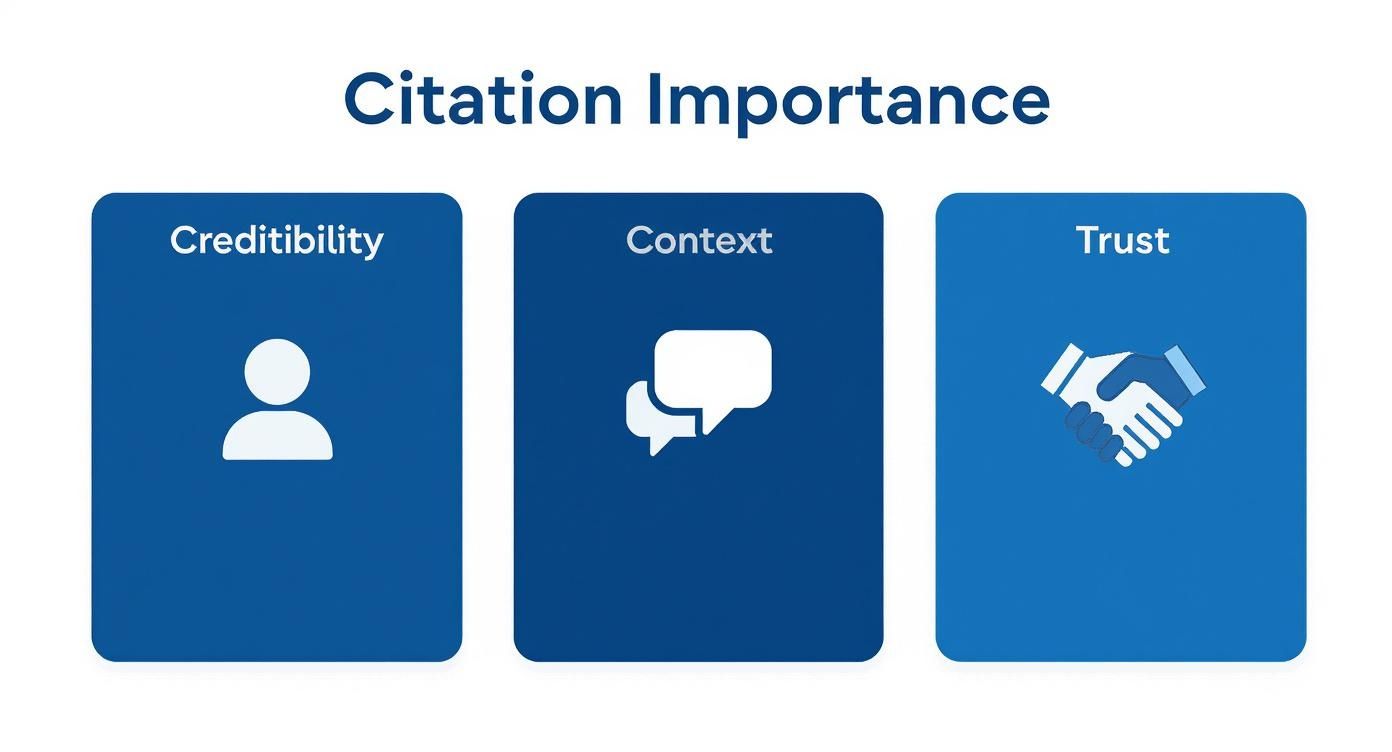
Ultimately, every citation you make validates your work, connects it to a bigger academic conversation, and shows your reader you’ve done your homework.
APA Style: The Language of the Sciences
The American Psychological Association (APA) style is the standard in the social sciences, education, psychology, and business. Its defining feature? A heavy emphasis on the date of publication. In fields where research moves at lightning speed, knowing when a study was published is everything.
An in-text citation gets straight to the point: author and year.
- Example In-Text Citation: (Smith, 2023)
In the reference list at the end, the date is placed right after the author's name. This simple design choice helps researchers scan a bibliography and immediately gauge if the sources are up-to-date. You’ll also notice APA uses initials for the author's first and middle names and sentence case for article titles.
- Book Example: Smith, J. D. (2023). Theories of modern psychology. University Press.
- Journal Article Example: Doe, A. B. (2022). The impact of social media on adolescent behavior. Journal of Youth Studies, 45(2), 112–125.
- Website Example: Johnson, C. (2024, May 15). Understanding cognitive biases. Simply Psychology. https://www.simplypsychology.org/cognitive-biases.html
This focus on timeliness isn't just an academic quirk; it reflects global research trends. While science is becoming more international, studies show that sources from established hubs like the U.S. are cited far more frequently, shaping the direction of the conversation. If you're curious, you can read the full research on global citation behaviors to see how these patterns play out.
MLA Style: The Standard for the Humanities
The Modern Language Association (MLA) style dominates the humanities—we're talking literature, arts, philosophy, and languages. Unlike APA, MLA puts the spotlight squarely on the author. The core idea here is that you're engaging in a direct conversation with a specific author's text, so their name is king.
The in-text citation is wonderfully simple, just the author's last name and a page number.
- Example In-Text Citation: (Smith 42)
This format points your reader to the exact location of the information in the original work. The bibliography, which MLA calls a "Works Cited" list, features full author names and uses title case for both book and article titles. The publication date is less important and usually appears later in the entry.
- Book Example: Smith, John David. Theories of Modern Psychology. University Press, 2023.
- Journal Article Example: Doe, Alicia B. "The Impact of Social Media on Adolescent Behavior." Journal of Youth Studies, vol. 45, no. 2, 2022, pp. 112-25.
- Website Example: Johnson, Chloe. "Understanding Cognitive Biases." Simply Psychology, 15 May 2024, www.simplypsychology.org/cognitive-biases.html.
A quick tip for spotting MLA: look for "pp." to denote page ranges in journal articles and the inclusion of a clean URL (without "https://") for web sources.
Chicago Style: The Flexible Historian
The Chicago Manual of Style (CMOS) is the powerhouse for history, fine arts, and some social sciences. It’s known for its flexibility, offering two distinct systems for writers to choose from.
- Notes and Bibliography: This is the one you’ll see most often in the humanities. It uses numbered footnotes or endnotes for citations right in the text and a full bibliography at the end.
- Author-Date: This system feels a lot like APA and is the preferred choice in the sciences.
With the Notes and Bibliography system, you’ll see a little superscript number in the text that corresponds to a note at the bottom of the page (a footnote) or at the end of the paper (an endnote).
- Example In-Text Citation: Smith argues that these theories have evolved.¹
The note itself provides the full citation the first time a source appears. If you cite it again, you can use a shortened version. The bibliography entry looks similar but has slightly different punctuation.
- Footnote Example: ¹John David Smith, Theories of Modern Psychology (Chicago: University Press, 2023), 42.
- Bibliography Example: Smith, John David. Theories of Modern Psychology. Chicago: University Press, 2023.
Historians love this system because it’s perfect for citing tricky sources like archival materials and it keeps the main text clean and readable. Plus, you can add little comments or extra context directly in the notes.
Quick Comparison of Major Citation Styles
To really see how these styles stack up, it helps to put them side-by-side. This table breaks down the most common differences you’ll encounter.
| Feature | APA (7th ed.) | MLA (9th ed.) | Chicago (17th ed.) |
|---|---|---|---|
| In-Text Citation | (Author, Year, p. #) | (Author Page#) | Superscript number¹ leading to a footnote/endnote |
| Reference List | References | Works Cited | Bibliography |
| Author Names | Last Name, F. M. | Last Name, First Name Middle Name | Last Name, First Name Middle Name |
| Dates | (Year). Placed after the author. | Year. Found near the end of the citation. | Year. Found near the end of the citation. |
| Titles | Sentence case for articles. | Title Case and "Quotation Marks" for articles. | Title Case and "Quotation Marks" for articles. |
Getting the right style and sticking with it is more than just a box to check. It signals your attention to detail and your respect for the academic conversation you're joining. It makes your work look professional, credible, and ready to be taken seriously.
When and What You Need to Cite
Deciding whether to add a citation can sometimes feel like a judgment call, but it’s a critical part of academic writing. The rule is actually pretty simple: if the idea, fact, or phrase didn't originate with you, you need to give credit where credit is due. This goes way beyond just slapping quotation marks around a sentence you copied.
This isn’t just about avoiding trouble; it’s fundamental to how scholars communicate and build on each other's work. Citations are so powerful they can reveal major trends in academic influence. One analysis of 26 million scientific papers found that between 2000 and 2015, the top 1% of scientists saw their share of total citations jump from 14% to 21%. It just goes to show how every single citation contributes to the bigger picture of scholarly credit.
The "Must-Cite" Checklist
Think of this as your go-to mental checklist. If what you're writing falls into any of these categories, it's a clear signal to add a citation.
- Direct Quotations: The most obvious one. If you use someone's exact words, they must be in quotation marks and cited immediately. No exceptions.
- Paraphrased Ideas: When you rephrase someone's idea in your own words, you still have to cite the original source. Just changing a few words around doesn't make the idea yours.
- Summaries of an Argument: Summarized a book chapter or the main point of a journal article? You need to credit that source.
- Specific Data and Statistics: Any numbers, data points, or stats you didn't collect yourself need a citation. This includes everything from survey results to economic data.
- Unique or Little-Known Facts: If you include a fact that isn't common knowledge, show your reader where you found it. This builds trust.
- Images, Graphs, or Charts: Visuals aren't freebies. Anything you didn't create yourself must be credited to its original source, just like text.
Getting this right means you have to evaluate information sources effectively to ensure you're building your argument on solid ground. It’s a foundational research skill.
What About Common Knowledge?
This is where things can get a little fuzzy. "Common knowledge" refers to information so widely known and accepted that it doesn't need a citation. But what actually qualifies? It often depends on your field.
The rule of thumb for common knowledge is this: If you found the same undisputed fact in five or more independent sources, it's likely safe to consider it common knowledge. If you're unsure, it's always better to cite.
Let's break it down with a few examples.
What is considered common knowledge?
- History: The fact that the Declaration of Independence was signed in 1776.
- Science: The basic principle that Earth revolves around the Sun.
- Literature: The detail that William Shakespeare wrote Hamlet.
These are foundational, undisputed facts. No one's going to challenge you on them.
What is NOT common knowledge?
- History: A specific historian's interpretation of why the Declaration was signed when it was. That’s an argument, not a universal fact.
- Science: The results from a new study identifying an exoplanet with specific atmospheric conditions. That’s fresh information from a particular research team.
- Literature: A scholar's unique theory about Hamlet's psychological state. This is a specific critical analysis that needs to be credited.
Ultimately, your goal is to draw a clear line between your original thoughts and the work you're building on. This ethical boundary is the bedrock of academic integrity. For a deeper dive, our team put together some practical tips for avoiding plagiarism that can help you write with confidence.
Mastering this distinction will not only keep you in the clear academically but also make your own unique contributions stand out. When in doubt, just add the citation. It strengthens your credibility and shows respect for the work that came before you.
How to Weave Citations Seamlessly into Your Writing
Knowing the technical rules of citation is one thing. Actually making those citations flow naturally in your writing is a whole different ballgame. A perfectly formatted parenthetical citation can still feel clunky if it keeps tripping up the reader. The real goal is to integrate your sources so they strengthen your argument, not just feel tacked on.
Learning how to cite sources effectively is as much about style as it is about rules. Instead of just dropping a citation at the end of a sentence, try using signal phrases to introduce the source smoothly. This is a simple trick that guides your reader, letting them know an idea from another author is coming.
Use Signal Phrases to Introduce Sources
Signal phrases are just short introductory clauses that name the author or source before you present their information. Think of them as a bridge between your voice and your source's voice, which makes your writing feel much more dynamic.
Here are a few ways you could phrase it:
- "As Dr. Alistair Finch argues in his latest study..."
- "According to recent findings published by the Pew Research Center..."
- "Smith contends that this approach is fundamentally flawed..."
- "In her groundbreaking book, Jones explores the concept of..."
Getting creative with your verbs—like "argues," "notes," "claims," or "suggests"—also adds a layer of nuance. It subtly tells the reader your own take on the source material, whether you're presenting it as hard fact or just one point of view.
Vary Your Citation Placement
One of the most common mistakes I see is ending every single sentence with a parenthetical citation, like (Smith, 2023). It’s technically correct, but the pattern gets repetitive fast and makes your writing feel stiff and mechanical. The fix is simple: just vary where and how you place them.
You have two main options for your in-text citations:
- Narrative Citations: Here, you name the author directly in your sentence. This approach is great for emphasizing the expert behind the idea, especially when their authority really matters to your point.
- Example: Finch (2022) discovered a significant correlation between the two variables.
- Parenthetical Citations: With these, you place the author's name and date in parentheses, usually at the end of the sentence. This keeps the focus squarely on the information itself, not the person who wrote it.
- Example: There is a significant correlation between the two variables (Finch, 2022).
Pro Tip: Don’t stick to just one style. Alternate between narrative and parenthetical citations to keep your rhythm fresh. Use a narrative citation when you want to put a spotlight on an expert's name, and a parenthetical one when you want the data to speak for itself.
Paraphrase with Precision and Purpose
Weaving in sources isn't just about dropping in quotes. In fact, strong academic writing relies far more on solid paraphrasing—restating an author’s idea in your own words while giving them full credit. It shows you've actually understood the material, not just copied it.
For instance, instead of quoting a long, dense sentence, you can summarize its main point and just follow it with a citation. This keeps your voice in the driver's seat. Learning how to paraphrase without plagiarizing is a crucial skill, and it ensures your work is both original and properly attributed.
A good paraphrase almost always fits more smoothly into a paragraph than a block quote, letting your argument flow without a hitch.
Using Technology to Manage Your Citations
Manually tracking dozens of sources for a research paper is an open invitation to stress and silly mistakes. Who wants to spend hours juggling books, articles, and websites, trying to get every last comma and period right?
Thankfully, there's a much smarter way to work. Citation management tools can automate nearly the entire process, saving you a massive headache.
Think of these powerful (and often free) programs as your personal research assistant. They give you a central hub for all your sources, saving you hours of painstaking work and helping you master how to cite sources in a research paper more efficiently.
Why You Really Need a Citation Manager
At their core, citation managers like Zotero, Mendeley, and EndNote solve the biggest organizational nightmare in academic writing. Forget about that messy document full of links or that stack of highlighted articles. These tools build a clean, searchable library of all your research materials.
But their real magic comes from how they connect with your browser and word processor. With just a single click, they can:
- Grab source information automatically. Pulling directly from websites, library databases, and online journals, they capture the author, title, publication date, and DOI. No more manual typing.
- Organize everything for you. You can use tags, folders, and notes to group sources by project or theme. This makes finding exactly what you need, right when you need it, incredibly simple.
- Generate citations and bibliographies instantly. Just click where you need a citation, and the tool inserts it in the correct format—APA, MLA, Chicago, you name it. It then builds your reference list as you write.
This screenshot from Zotero shows just how easy it is. You can see the Zotero icon in the browser's toolbar, ready to capture a source.
One click on that icon saves the webpage's metadata directly into your library, as you can see in the application window. This seamless capture is the first step toward building a perfect, error-free bibliography.
Choosing the Right Tool for You
While there are plenty of great options out there, most students and researchers start with one of the big three. They all share core features but have a few key differences that might make one a better fit for your personal workflow.
| Feature | Zotero | Mendeley | EndNote |
|---|---|---|---|
| Cost | Free (Open-Source) | Freemium | Paid |
| Best For | All-around use, humanities, and social sciences | STEM fields, PDF management, and collaboration | Large institutions and professional researchers |
| Key Strength | Unmatched flexibility and community support | Strong PDF reader with annotation tools | Advanced features and extensive journal support |
For most undergrad and grad students, Zotero is the perfect place to start. It’s completely free, open-source, and surprisingly powerful. Mendeley is a solid competitor, especially if your research involves reading and annotating a ton of PDFs. EndNote is more of an enterprise-level tool, often provided by universities for faculty and serious researchers.
Think of a citation manager as your "source memory." It remembers every single detail so you can focus on what actually matters—building a strong argument. Making the switch from manual citations to a tool like Zotero is one of the biggest productivity boosts any writer can get.
A Quick Walkthrough: Adding a Source
Let's say you've just found a fantastic journal article online. Here’s how simple the process is with a tool like Zotero.
- First, get set up. Download the Zotero application and add its connector to your web browser (like Chrome or Firefox).
- Find your source. Go to the article's page in your library database or on the publisher's website.
- Click the Zotero icon. You'll see an icon in your browser bar change to look like a small article or book. Click it.
- Watch the magic happen. Zotero instantly pulls all the bibliographic data—author, title, journal, volume, pages, date—and saves it to your library. It often even downloads and attaches the PDF of the article if it's available.
Once that source is in your library, you can open your Word or Google Docs document, put your cursor where the citation needs to go, and use the Zotero plugin to pop it in. The tool handles all the formatting, letting you stay focused on your writing.
Tricky Citation Questions You'll Probably Ask
Even when you feel like you have a handle on the rules, you're going to hit a weird citation problem. It happens to everyone. You’ll find a source that doesn't fit the neat little templates, and you'll get stuck.
Let's walk through some of the most common tricky situations so you know exactly what to do.
How Do I Cite a Source I Found Inside Another Source?
This is a classic. You're reading a great article by Jones, and she quotes a mind-blowing study by Smith. You absolutely want to use Smith's idea, but you haven't actually read Smith's original work. This is what we call a secondary source citation.
The golden rule is to always, always try to track down the original source—in this case, Smith's study. But sometimes that's just not possible. Maybe it's out of print, behind a ridiculous paywall, or in a language you don't speak. In that case, you have to credit both. You need to be transparent that you found Smith's work through Jones.
Here’s how to handle it in the major styles:
- APA: Your in-text citation looks like this: (Smith, as cited in Jones, 2021). In your reference list, you'll only include the entry for Jones, since that's the source you actually read.
- MLA: It's a similar idea: (qtd. in Jones 125). Just like with APA, your Works Cited list will only have the Jones article.
This little move keeps you honest and shows your reader the exact trail you followed to get the information.
What if a Source Has No Author or Date?
It happens all the time. You find a fantastic online report or webpage, but there’s no author's name or publication date in sight. Don't sweat it—the citation styles are built for this.
When there's no author:
The citation just starts with the title of the work instead of a name. For an in-text citation in APA, you'd use a shortened version of the title in quotation marks.
- Example (APA In-Text): The data showed a major shift in online behavior ("Understanding Market Trends," 2022).
- Reference List Entry: The entry in your bibliography would then start with "Understanding Market Trends."
When there's no date:
This one's even easier. You just pop in the abbreviation "n.d.," which stands for "no date."
- Example (APA In-Text): One report claimed these numbers have been on the rise for years (Johnson, n.d.).
A source with no author or date should make you pause. Take a second to evaluate its credibility. While it's sometimes fine (like on certain government or organizational sites), anonymous and undated sources can be a red flag. Always ask yourself why that information is missing.
Is It Possible to Cite Too Much?
Yes. One hundred percent, yes. While you absolutely must give credit where it's due, over-citing can be just as distracting as not citing enough. When you cram a parenthetical citation into every single sentence, a couple of bad things happen:
- You drown out your own voice. Your paper starts to read like a long list of what other people said, with none of your own analysis weaving it all together.
- You kill the flow. Those constant interruptions make your paragraphs clunky and hard for a reader to get through.
Here's a good rule of thumb: Cite when you first introduce an idea or piece of data from a source. If you spend the next few sentences discussing and analyzing that same point from that same source, you don't need to keep repeating the citation.
Learning how to cite sources in a research paper is a balancing act. Your work should feel like a conversation between your ideas and your sources, not just a monologue from them.
Ready to transform your AI-generated drafts into polished, human-like text? Natural Write helps you refine your writing to bypass AI detectors and achieve a natural flow. Get started for free and elevate your content at https://naturalwrite.com.