So, you need to write a policy brief. The real challenge isn't just presenting the facts; it's about crafting a short, persuasive document that can actually convince a busy, influential person to act. It’s a unique blend of research, advocacy, and sharp communication, all packed into a few pages.
Your brief has to present a compelling argument backed by solid data, but most importantly, it needs to offer clear, actionable recommendations.
What Is a Policy Brief and Why Does It Matter?
Think of a policy brief as a strategic tool, not an academic paper. Its entire purpose is to bridge the gap between complex research and decisive, real-world action. You're essentially a translator, taking dense data and expert analysis and turning it into a clear, persuasive story for people who can make change happen—but have almost no time to read.
The goal is simple: influence. Whether you’re fighting for better public health funding, proposing new environmental regulations, or making a case for educational reform, your brief must grab the reader, convince them the issue is urgent, and show them that your solution is the most viable path forward.
The Anatomy of Persuasion
A truly effective policy brief does more than just list facts. It weaves them into a narrative that guides the reader logically from a problem to a solution. The best ones are designed to be scanned, letting a decision-maker absorb the critical takeaways in just a few minutes.
What makes one brief land on a desk and another end up in the bin? It often comes down to these core traits:
- Audience-Centric: It’s written in their language, addressing their specific concerns and priorities.
- Evidence-Based: Every claim is backed by credible data, research, or real-world case studies. No fluff.
- Problem-Focused: It crisply defines a specific problem and makes a compelling case for why it needs immediate attention.
- Solution-Oriented: It doesn't just admire the problem; it offers clear, practical, and feasible steps to solve it.
A policy brief fails if it only informs. Its true success is measured by its ability to persuade and mobilize. It’s the difference between a reader saying, "That's interesting," and a reader saying, "We need to do something about this."
Brevity and Clarity Are Non-Negotiable
In a world overflowing with information, being concise is a superpower. Major organizations like the World Bank and the UN depend on briefs to convert research into tangible policy. And the evidence is clear: decision-makers overwhelmingly prefer short, plainly written documents they can digest in 10 minutes or less.
This means you have to be ruthless. Cut the jargon, use direct language, and keep the entire brief under 2,000 words. If you're interested in the research behind this, you can explore the insights on developing effective policy briefs to learn more.
Before we dive into how to build one, let's look at the key pieces you'll be assembling. This table gives you a quick roadmap of what a strong policy brief contains.
Core Components of an Effective Policy Brief
| Component | Purpose | Key Characteristic |
|---|---|---|
| Title | Grab attention and state the core issue immediately. | Compelling and concise. |
| Executive Summary | Provide a 1-minute overview of the entire brief. | Self-contained and persuasive. |
| Introduction | Set the stage and establish the problem's urgency. | Engaging and problem-focused. |
| Evidence/Analysis | Support your argument with credible data and facts. | Data-driven and clearly presented. |
| Recommendations | Propose clear, actionable solutions. | Specific, feasible, and targeted. |
| Conclusion | Summarize the argument and end with a powerful call to action. | Memorable and action-oriented. |
Each of these components plays a critical role in building a persuasive argument. In the sections ahead, we’ll break down exactly how to craft each one.
Defining Your Audience and Core Objective
Before a single word hits the page, the real work of writing a policy brief begins. Success doesn’t start with your data or your brilliant solution; it starts with knowing exactly who you’re talking to and what you need them to do. A powerful argument that misses its audience is just noise.
Think about it this way. Say your topic is urban food deserts. If you're writing for city council members, you’ll want to talk about zoning laws, economic incentives, and budget allocations. But if your brief is for a community health foundation, you’d shift your focus to public health data, childhood nutrition, and grant opportunities. Same problem, completely different angles.
Who Are You Trying to Persuade?
Figuring out your reader goes way beyond their job title. You have to get inside their world. What are their priorities? What do they already know about your issue? What political or organizational pressures are they under? This is the bedrock of a brief that actually gets results.
To get a clear picture of your reader, ask yourself:
- What's on their plate right now? A legislative aide wrestling with a budget crisis won't have time for a costly new program unless you can convincingly frame it as a long-term money-saver.
- How much do they know? Are you writing for a subject matter expert who will dig into technical data, or a generalist who needs the 10,000-foot view in plain English?
- What are their political realities? Knowing what shapes their decisions—public opinion, party loyalty, key constituents—helps you frame your recommendations in a way that resonates with their world.
The first step is always to get crystal clear on who you're trying to reach. A great guide on this explains how to identify your target audience for genuine connection.
Sharpening Your Purpose into a Single Objective
Once you know your audience, your next job is to define your core objective with laser focus. A fuzzy goal will always lead to a weak brief. Are you sounding an alarm, comparing a few different solutions, or pushing for one specific action? Vague goals like "raise awareness" just don't cut it.
Your objective is the most important sentence in your entire planning process. It should answer this question: "After reading this brief, what is the one thing I want my audience to think, feel, or do?"
For instance, instead of a goal like "improve local recycling," a much sharper objective is: "Persuade the city's sanitation committee to approve a pilot program for curbside compost collection in three districts by the next fiscal quarter."
This kind of clarity drives every single choice you make, from the evidence you select to the specific recommendations you propose. You can dive deeper into the nuts and bolts of a strong https://naturalwrite.com/blog/what-is-audience-analysis.
Ultimately, taking the time for this foundational work is what turns a simple report into a strategic tool for change. It’s the difference between a brief that gets read and one that gets acted on.
Structuring Your Brief for Maximum Impact
Let's be realistic: an effective policy brief isn't read from start to finish. It’s scanned. Policymakers and their staff are always short on time, so your document’s structure has to do the heavy lifting, guiding their eyes straight to the most critical information. A logical, easy-to-follow flow builds confidence and makes your argument far easier to absorb.
Think of yourself as an architect. Each section must support the others, creating a solid structure that walks the reader from understanding the problem to championing your solution. If any part feels weak or out of place, the whole argument can come crashing down.
The very first step is the foundation for everything else: know exactly who you're talking to and what you need them to do.
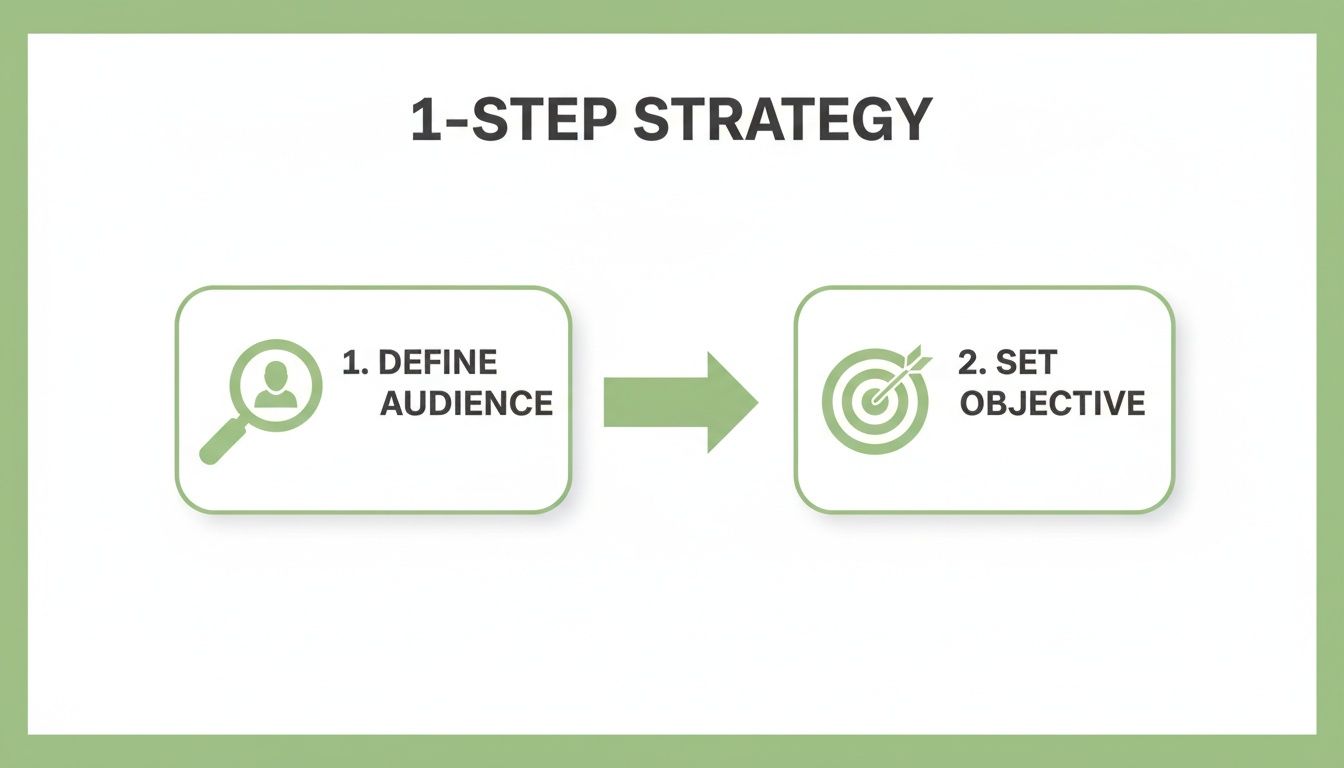
This simple idea—a clear audience and a sharp objective—is what ensures every single part of your brief serves a strategic purpose.
The Power of a Compelling Title
Your title is the gateway. It's often the first and only thing a busy policymaker sees, so it has to do more than just state the topic. It needs to scream urgency and relevance in a single glance. A weak title gets your brief shuffled to the bottom of the pile; a strong one buys you a few precious seconds of their attention.
Ditch the vague, academic-sounding titles. Instead, go for an action-oriented or solution-focused headline that frames the issue perfectly.
- Weak Title: An Analysis of Urban Green Space Deficits
- Strong Title: Greener Blocks, Healthier Cities: A Plan to Increase Park Access in Low-Income Neighborhoods
See the difference? The second title immediately tells the reader the problem (park access), the target area (low-income neighborhoods), and the goal (a plan for healthier cities). It’s a complete pitch in under 15 words.
The Executive Summary Is Your Brief in Miniature
If a policymaker only reads one part of your document, this is it. The executive summary isn’t just an introduction; it’s a complete, standalone synopsis of your entire argument. It absolutely has to be powerful enough to persuade all on its own.
A great executive summary presents the problem, your most convincing evidence, and your final recommendations in one digestible block of text, usually right at the top of the first page. For a deeper dive, our guide on how to write an executive summary offers more detailed strategies.
Your executive summary must answer three questions in under 200 words: What is the problem? Why does it matter now? What should we do about it? If it can't do that, the rest of your brief might as well not exist.
Framing the Problem for Immediate Urgency
Right after the summary, you need to set the stage by clearly defining the problem. This isn't just about listing facts; it's about building a compelling case for why this issue demands immediate action. Use a mix of data and human-centered storytelling to connect the problem directly to the policymaker's constituents and responsibilities.
For our urban green space example, you wouldn't just say, "Some neighborhoods lack parks." You'd frame it with impact: "In District 5, over 40,000 residents, including 12,000 children, live more than a 15-minute walk from the nearest public green space—a deficit directly linked to higher local rates of asthma and childhood obesity." That kind of specificity creates undeniable urgency.
Presenting Evidence That Persuades, Not Overwhelms
This is where you bring in the proof. The trick is to be selective. Don't drown your reader in a sea of data. Instead, hand-pick the most compelling statistics, case studies, or expert findings that directly support your core argument.
Visuals are your best friend here. They make complex data easy to digest.
- Simple Bar Charts: Perfect for comparing outcomes between different groups (e.g., respiratory illness rates in neighborhoods with and without parks).
- Maps: Great for visually representing geographic disparities (e.g., highlighting "park deserts" in a district).
- Call-Out Boxes: Use these to feature a powerful statistic or a short, impactful quote from an expert.
Your goal is to build a logical, evidence-based bridge that leads seamlessly to your proposed solutions. These principles of clarity are just as vital when learning how to write a compelling creative brief.
Crafting Actionable and Viable Recommendations
And now, the payoff. Your recommendations must be specific, actionable, and politically feasible. Vague suggestions like "increase green space" are totally useless. A strong recommendation provides a clear roadmap.
Think of each one as a concrete step the policymaker can take. For maximum clarity, structure them as a numbered or bulleted list.
- Reallocate $500,000 from the city's beautification fund to finance three new "pocket parks" on designated vacant city-owned lots in District 5.
- Amend municipal code 14.2 to streamline the permitting process for community gardens and urban farming projects.
- Launch a public-private partnership program to incentivize local businesses to fund the maintenance of new and existing park spaces.
This level of detail proves you’ve thought through the practicalities. You're not just offering an idea; you're handing them a real plan. By structuring your brief this way, you respect the reader’s time and guide them logically toward your conclusion, making your case nearly impossible to ignore.
Writing and Designing for Persuasion

This is where the rubber meets the road. You’ve got your research and your recommendations, but how you package them makes all the difference. Persuasion lives in the details of your writing style and visual design, turning a dry report into a document that demands action. Your mission is to make complex ideas feel simple, urgent, and impossible for a busy policymaker to ignore.
Remember who you're writing for. Legislative aides, department heads, and community leaders are smart, but they're also generalists juggling a dozen different issues. They don’t have time to decipher academic jargon or hunt for the main point in a dense paragraph. Your job is to do the heavy lifting for them.
Ditch the Jargon and Write with an Active Voice
The quickest way to get your brief tossed aside is to sound like an academic journal. Your writing has to be direct, confident, and incredibly clear. This starts with swapping out passive, convoluted sentences for a strong, active voice.
Using an active voice doesn’t just make your writing more energetic; it assigns clear responsibility. Instead of saying, "It is recommended that funding be allocated," you write, "We recommend the committee allocate funding." See the difference? It’s a subtle shift that makes your point feel more direct and authoritative.
Let’s look at a real-world example:
- Before (Passive & Jargony): "The implementation of evidence-based pedagogical interventions has been shown to result in enhanced educational outcomes for at-risk student populations."
- After (Active & Clear): "Proven teaching methods help students in at-risk communities succeed."
The second version gets the point across in half the words and with twice the impact. If you want to dig deeper into making your arguments stick, our guide on persuasive writing techniques is a great resource.
Let Visuals Tell the Story
Persuasion isn't just about what you say—it's about what you show. Good design is your secret weapon. It guides your reader’s eye, highlights your most crucial evidence, and makes complex data digestible in a single glance.
A well-designed chart can communicate in three seconds what might take three paragraphs to explain. In the high-stakes world of policy, that kind of efficiency is gold.
Think of design elements as strategic tools. Headings and subheadings break up long stretches of text, making the document scannable. Bullet points make lists easy to follow. A well-placed call-out box can elevate a killer statistic that drives your argument home. You want a document with enough white space to feel approachable, not a wall of text that feels like homework.
Creating Charts and Graphs That Actually Work
When it comes to data visualization, less is more. Your charts and graphs should spotlight a single, crucial finding—not overwhelm the reader with every data point you've collected. Aim for a high “data-to-ink ratio,” a classic design principle that means stripping away all the visual clutter. Get rid of the extra gridlines, 3D effects, and busy backgrounds that don’t add to the story.
This isn’t just my opinion; it’s a best practice confirmed across countless policy toolkits. These guides consistently show that visual design can dramatically improve how a brief is received and trusted. They stress that charts should focus on clear trends—like rising unemployment or demographic shifts—because the audience needs to grasp the core message in seconds.
Here are a few practical tips for choosing the right visual:
- Bar Charts: Perfect for comparing quantities across different groups.
- Line Graphs: The best way to show a trend over time.
- Pie Charts: Use them sparingly to show parts of a whole, and only when you have a few distinct categories.
And please, always give your visual a clear, descriptive title that spells out the main takeaway. Instead of a generic title like "Asthma Rates," use something like "Asthma Rates in District 5 Are Double the City Average." Now, even if someone only glances at the chart, they get the point.
To keep your design sharp and focused, here's a quick cheat sheet.
Policy Brief Design Do's and Don'ts
The table below offers a few simple rules of thumb to make your brief more readable and persuasive.
| Element | Do | Don't |
|---|---|---|
| Headings | Use clear, descriptive headings to guide the reader. | Write vague or overly academic headings. |
| Whitespace | Leave ample margins and space between paragraphs. | Cram text together, creating a "wall of text." |
| Call-Outs | Pull out 1-2 powerful statistics or quotes. | Overuse them on every page, reducing their impact. |
| Color | Use a limited, professional color palette for emphasis. | Use distracting, bright colors or too many shades. |
By pairing crisp, active writing with clean, strategic design, you create a document that doesn’t just inform—it persuades. You make it easy for a decision-maker to see the problem, trust the evidence, and ultimately, adopt your solution.
Polishing Your Draft and Getting It Seen
So, you’ve wrestled with your argument, backed it up with solid evidence, and laid out some razor-sharp recommendations. It feels like you're at the finish line, but the truth is, this next part is just as critical. A brilliant policy brief is just a document until it lands in the right hands and actually sparks a conversation.
Let's talk about turning your hard work into something that not only looks professional but also gets seen and taken seriously. This isn't just about a quick spell-check; it's about making sure your message is undeniable.
The Non-Negotiable Fresh Pair of Eyes
You've lived and breathed this document for hours, maybe even days. At this point, you're too close to it. Your brain will automatically fill in the blanks, glide right over typos, and read what you meant to say, not what’s actually on the page.
That's why you absolutely have to get another person to read it. A trusted colleague, a mentor, or another expert in the field can be your secret weapon. They'll catch the awkward phrasing, the undefined jargon, and the tiny logical leap you completely missed. Think of it as your final quality control before your brief steps out into the world.
When you hand it over, ask them to zero in on a few key things:
- Is the main point crystal clear from the get-go?
- Does the argument actually persuade you? Is the evidence convincing?
- Does this sound like it was written for the intended audience?
Citing Sources to Build Credibility
This isn't an academic paper, but your credibility hinges on showing your work. Proper citations prove you've done your homework and ground your entire argument in fact, not just opinion. The trick is to do it without cluttering the page and distracting your reader.
Forget about messy in-text citations. The cleanest method is a simple endnotes or references page at the very end. This keeps the body of your brief scannable and easy to read, while still giving curious readers a trail to follow if they want to dig deeper into your sources.
Just pick a consistent format—APA is common, but clarity is more important than dogma—and be sure to include a direct link to the source whenever you can.
My favorite pro-tip: Use your sources strategically. Citing respected government reports, well-known institutions, and peer-reviewed studies doesn't just back up a claim; it aligns your work with established authorities. It’s a subtle but powerful way to build trust.
Crafting a Strategic Distribution Plan
You've polished the document. Now for the moment of truth: getting it to the people who matter. Don't just blast it out to a generic email list. That's a one-way ticket to the spam folder. Your outreach needs to be personal, targeted, and smart.
First, build a short, specific list of who needs to see this.
Who to Target:
- The Decision-Maker: This is the elected official, agency head, or executive who can actually make the final call.
- The Gatekeeper: Their chief of staff, policy advisor, or senior aide. Often, this is the most important person to convince, as they control the decision-maker’s calendar and flow of information.
- The Influencer: Think of a respected community leader, a journalist who covers this beat, or another expert who can amplify your message.
With your list in hand, it's time to write the cover email. Make it short. Seriously, keep it incredibly brief. The subject line should be direct and tell them exactly what they're getting, like: "Policy Brief: Plan to Increase Park Access in District 5."
The email itself should have three simple parts:
- The Hook: Start with a single sentence on the problem and why they should care about it.
- The Solution: Tell them your brief offers 3 actionable recommendations to solve it.
- The Ask: Attach the brief and ask for a quick 15-minute call to walk them through the key findings.
Finally, think about timing. A frantic Monday morning or a checked-out Friday afternoon are dead zones. I've always had the best luck sending things mid-week, when people have settled into their workflow. This last strategic push is what separates a document that gets filed from a document that starts a movement.
Frequently Asked Questions
Even with the best guide, a few questions always come up when you’re deep in the writing process. Let's get into some of the common sticking points that can make all the difference between a good policy brief and a great one.
How Long Should a Policy Brief Be?
Think short. Really short. The sweet spot is typically 4 to 8 pages, which usually comes in under 2,000 words.
Remember, you're writing for some of the busiest people on the planet. Research consistently shows that if they can't get the gist in 10 minutes or less, they're likely to set it aside. Your job is to make a powerful, comprehensive case without a single wasted word.
What Is the Most Important Section of a Policy Brief?
Without a doubt, it’s the Executive Summary. It’s the first thing your reader sees, and frankly, it might be the only thing they read in full. You have to make it count.
Treat your executive summary like a one-minute elevator pitch. It needs to live on the first page and clearly lay out the problem, your core findings, and your top 3-5 recommendations. It has to stand completely on its own.
How Do I Handle Opposing Viewpoints or Counterarguments?
Don't ignore them—address them head-on. Acknowledging counterarguments actually makes your brief stronger and more credible. The best place to do this is within your evidence or analysis section.
You can frame it by saying something like, "While some have suggested X, the data indicates..." This shows you've done your homework and considered all the angles. Then, pivot back to your evidence to demonstrate why your recommended path is the most effective. This builds trust and makes your final recommendations feel robust and well-vetted.
Struggling to make your AI-drafted text sound more human? Natural Write can help you refine your policy brief's tone, ensuring it reads with clarity and authority while bypassing AI detection tools. Polish your draft in one click.