To write great website copy, you have to start with the people you’re writing for. It's all about deeply understanding their world and then showing them exactly how you can make it better. This isn't about creating generic customer profiles; it's about uncovering their real-world problems and motivations. That's the bedrock of any copy that actually works.
Build Your Foundation on Audience Insight
Before you even think about writing a headline, the real work begins. Amazing website copy isn’t born from clever wordplay; it’s born from empathy. You need to get inside your ideal customer's head, figure out what keeps them up at night, and listen to the exact words they use to talk about their struggles.
Skipping this research is like building a house without a blueprint. Sure, you might end up with four walls and a roof, but it won’t be a place anyone actually wants to live. Getting this right means mastering website and content writing for strategic, audience-focused content from the very beginning.
Go Beyond Basic Demographics
Forget those dusty, generic personas that list age, location, and income. To write copy that genuinely connects, you have to dig into psychographics—the why behind what your audience does.
What are their biggest headaches in your industry? What have they already tried that didn't work? What would their dream solution do for them? The answers to these questions are pure gold, giving you the raw material for copy that hits home on an emotional level. You can get a deeper look at this process in our guide on what is audience analysis.
This simple framework shows how you can turn raw audience knowledge into a message that truly lands.
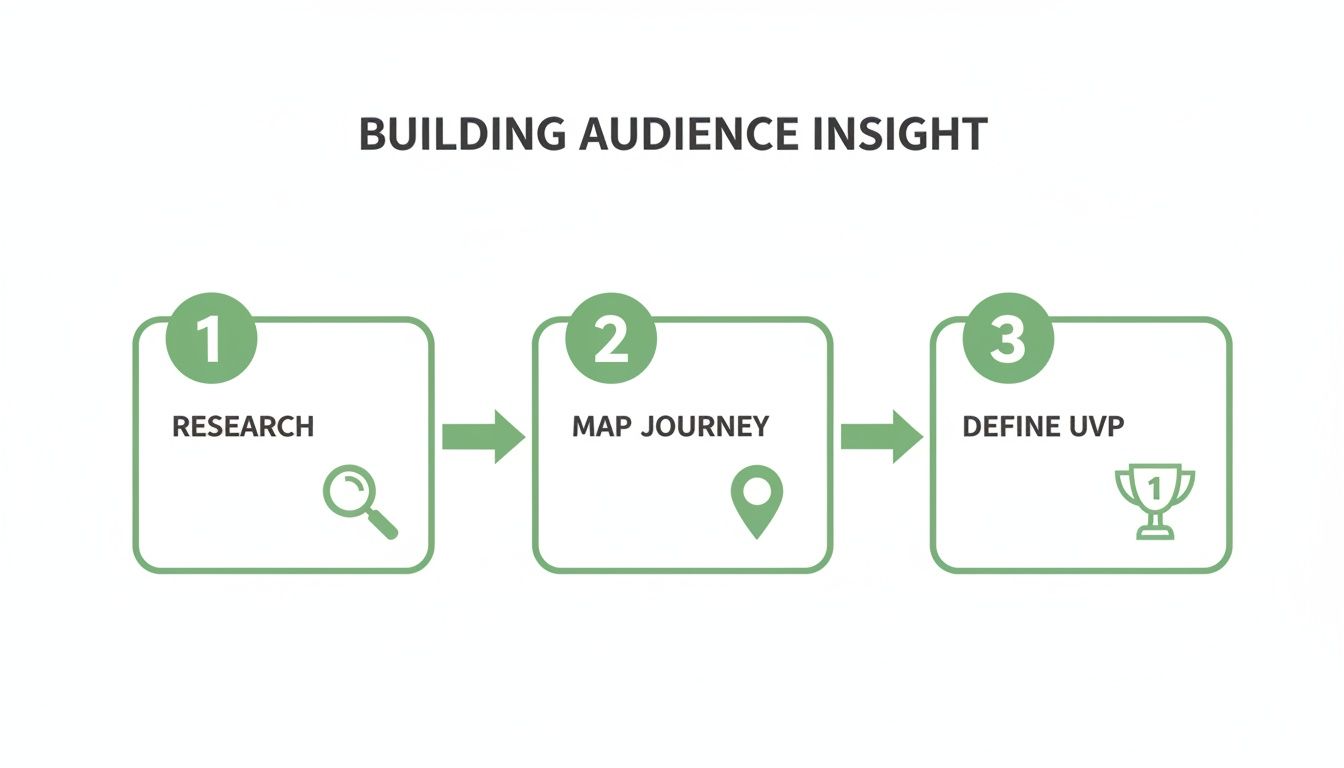
It’s all about transforming research into a sharp value proposition. This ensures every word you write is built on a solid, strategic footing right from the start.
Define Your Unique Value Proposition
Once you have that deep understanding of your audience, you're ready to nail down your Unique Value Proposition (UVP). A UVP isn't just a catchy tagline. It’s a crystal-clear promise that explains how you solve a customer's problem, what specific benefits they'll get, and why you’re the obvious choice over everyone else.
Your UVP is the heart of your message. It should immediately answer a visitor’s silent question: "What’s in it for me?"
For instance, a generic value prop might be, "We sell accounting software." An audience-focused UVP sounds more like this: "Effortless accounting software for freelancers that saves you 10 hours a month on bookkeeping." See the difference? It’s specific, targeted, and highlights a real, tangible benefit.
And this isn’t just theory—it gets results. Compelling, audience-focused copy can multiply site traffic by 7.8 times and dramatically boost brand recall. This impact is a big reason why the copywriting industry is projected to hit $48.89 billion by 2032. This foundational work makes sure every single word serves a purpose: to connect with your audience, persuade them, and ultimately, get them to act.
Writing Headlines That Actually Get Read
Let's be blunt: you have about three seconds to grab someone's attention. Your headline is the bouncer at the door of your website. If it’s weak, nobody gets in to see how great the party is. The rest of your beautifully crafted copy might as well not exist.
The goal here isn't just to be clever. It's to create a powerful one-two punch with your headline and sub-headline that makes your ideal visitor think, "Finally! Someone gets it." That immediate connection is what keeps them on the page.

The stakes are incredibly high. A staggering 80% of visitors never make it past the headline. That means only 20% of your audience reads the rest of your copy. Think about that for a second. Your headline is doing almost all of the heavy lifting.
Headline Formulas That Work
Staring at a blank screen is the worst. So, don't. Instead of trying to pull a brilliant headline out of thin air, start with a proven formula. These are less like rigid rules and more like battle-tested frameworks that tap into basic human psychology.
I've seen these work time and time again. They provide a solid starting point for getting your message across clearly and persuasively.
| Formula Type | Structure | Example |
|---|---|---|
| The "How To" | How to [Achieve Desired Outcome] Without [Common Pain Point] | How to Double Your Traffic Without Paying for Ads |
| The "Question" | Are You [Struggling with a Problem]? | Are You Still Manually Tracking Your Expenses? |
| The "Benefit + Time" | [Achieve a Specific Benefit] in [Specific Timeframe] | Create a Professional Logo in Under 5 Minutes |
| The "Social Proof" | Join [Number] of [Audience Type] Who [Achieved a Result] | Join 10,000+ Marketers Who Read Our Newsletter |
What I love about these formulas is they force you to be direct and put the customer first. They automatically shift your focus from what your product is to what it actually does for someone.
From Vague to Valuable
The quickest way to kill a headline is with vague, fluffy language. Specificity is what makes a headline connect. It’s the difference between a forgettable statement and a compelling solution.
Let’s look at a real-world example of this in action.
- Before: Powerful Project Management Software
- After: The All-In-One Project Tool That Keeps Your Team on Track and Under Budget.
See the difference? The "before" is a label. It's generic and could describe a hundred different tools. But the "after" speaks directly to the pains of a project manager—keeping people aligned and not blowing the budget. It’s not just a description; it’s a solution.
A great headline doesn't just describe; it promises a better future. It paints a picture of life after the problem has been solved.
You won't nail it on the first try, and that's okay. The real magic happens when you start testing. For a fantastic look at how small copy tweaks can drive big results, check out this homepage banner copy test case study. It’s a perfect example of why you should never stop iterating on your hero copy. Continuous refinement is how you turn that prime real estate into a machine that works for you.
Writing Body Copy That Persuades and Guides
Alright, your headline did the heavy lifting—it stopped the scroll. Fantastic. But now the real work begins. The rest of your page, the body copy, has to deliver on that initial promise. This is where you shift from grabbing attention to earning trust and gently guiding your visitor toward taking that next step.
You've got their attention, but they're still skeptical. Your job now is to prove you understand their world and have a real solution to a real problem they're facing. This isn't a sales pitch; think of it more like a helpful, reassuring conversation.

A Simple Framework for Your Argument: PAS
One of the most powerful and reliable copywriting formulas out there is Problem-Agitate-Solution (PAS). It’s effective because it follows the natural way our brains process problems, making your message feel intuitive and compelling.
Here's how it breaks down:
- Problem: Start by hitting on the exact pain point your visitor is feeling. Use the words they’d use. Something like, "Tired of spending your entire Monday formatting reports?" immediately connects.
- Agitate: Now, don’t just leave the problem there—twist the knife a little. Remind them why it's so frustrating. "That's hours you could be spending on strategy or, you know, leaving the office on time. Instead, you're stuck wrestling with spreadsheets."
- Solution: Once they're nodding along, feeling that frustration, you swoop in with the answer. "Our tool automates your reporting in minutes, giving you your day back."
See how that works? You build empathy first. By showing you genuinely get their struggle, you earn the trust you need for them to believe in your solution.
Stop Selling Features, Start Selling Benefits
This is one of the most common mistakes I see on websites: a laundry list of features. A feature is what your product has ("256-bit encryption"). A benefit is what the customer gets from it ("Keep your client data safe and secure with military-grade encryption").
Nobody buys a drill because they want a drill. They buy a drill because they want a hole. Always write about the hole.
Try this simple exercise. List your top features. For each one, ask yourself, "So what?" until you land on a core human need.
- Feature: 24/7 customer support.
- So what? I can get help anytime I need it.
- So what? I won't be left hanging if I run into a problem at a critical moment.
- Benefit: Get peace of mind knowing our team is here for you, day or night.
That small shift in perspective makes all the difference. It connects your product to an outcome your customer actually cares about.
Build Trust with Social Proof
You can tell people you’re the best all day long, but it’s a thousand times more powerful when someone else says it for you. That's social proof, and it's your secret weapon for overcoming skepticism.
Weave these elements right into your body copy, not just at the bottom of the page:
- Testimonials: Short, punchy quotes from happy customers that highlight a specific result.
- Case Studies: A quick "before and after" story of how you helped a specific client succeed.
- Client Logos: A simple bar showing logos of companies you’ve worked with, especially if they’re recognizable.
- Hard Numbers: Specific figures like, "Trusted by over 15,000 small businesses."
There's a reason the global copywriting services market was valued at a whopping $25.29 billion in 2023 and is projected to hit $42.22 billion by 2030. Businesses are waking up to the fact that clear, benefit-driven copy gets results. Take a look at listicles—they often pull in 80% more views than standard articles simply because they're easy to scan. You can dig into more copywriting stats in this report on Blogging Wizard.
The takeaway for your website copy is clear: break up your text. Use bullet points and short paragraphs to keep people engaged and moving down the page.
Balancing SEO Needs with a Human Voice
Great website copy has to pull off a tricky balancing act. It needs to speak the language of search engines so they’ll rank you, but it also has to connect with the actual human beings who land on your page. This is where so many businesses stumble. They get obsessed with keywords, and their copy ends up sounding stiff, awkward, and completely unnatural.
The secret isn’t to stuff keywords everywhere. It's to find that sweet spot where clarity for Google meets a persuasive, authentic voice for your reader. Think of it this way: SEO isn't about gaming the system. It's about deeply understanding the questions your audience is asking and then proving you have the best answer.
Finding Keywords That Actually Mean Something
Long before you write a single word, your SEO work should start with keyword research focused on user intent. It’s easy to get fixated on keywords with huge search volumes, but that’s a rookie mistake. If a keyword drives a ton of traffic but doesn't align with what your page offers, people will bounce immediately. That sends a terrible signal to Google.
So, instead of just chasing big numbers, dig deeper to find phrases that reveal what a person is really looking for.
- Informational Intent: They want knowledge. Think "how to write website copy."
- Navigational Intent: They’re looking for a specific place. For example, "Natural Write blog."
- Commercial Intent: They’re in research mode, comparing options. Something like "best AI writing humanizer."
- Transactional Intent: They’re ready to take action. This is your "sign up for Natural Write free" crowd.
When you target keywords that match your page's goal, you attract people who are genuinely looking for what you provide. You're not just optimizing for an algorithm; you're helping a potential customer solve a real problem.
Weaving Keywords in Without Sounding Like a Robot
Okay, you've got your list of primary and secondary keywords. Now what? The key is to integrate them naturally. My go-to method is to write the entire first draft for a human reader, completely ignoring the keywords. Then, I go back and edit with SEO in mind.
If you try to force-feed keywords into every other sentence from the start, you’ll end up with a mess.
Your primary keyword should feel like a natural part of the conversation, not a billboard interrupting it. If a sentence sounds clunky when you read it aloud, it needs to be rewritten.
For a deeper dive into the technical side of things, our complete guide explains how to optimize content for SEO, covering all the on-page elements like titles, meta descriptions, and header tags. The big takeaway is to place keywords in those high-impact spots without ever making the copy awkward for a human to read.
Humanizing AI-Generated Drafts
Let’s be honest, AI writing tools are incredibly useful for getting past the blank page. They can spit out a structured draft in seconds. But that draft often lacks a soul. It can be generic, repetitive, and just… flat. This is where a skilled writer makes all the difference.
Think of AI as your apprentice, not the final author. A solid workflow looks something like this:
- Get a base draft: Feed the AI your topic, keywords, and who you're writing for.
- Inject your brand's voice: Is your brand witty? Authoritative? Super friendly? Rewrite the AI’s generic sentences to sound like you.
- Add real stories: Weave in a quick, relevant anecdote or a specific client win. Nothing connects like a real story.
- Polish the flow: Chop up those dense AI paragraphs. Add transition phrases. Make sure the copy has a rhythm that pulls the reader along.
This is how you turn a robotic draft into copy that connects. You take the structural framework from the machine and build a truly human experience on top of it—creating content that both Google and your customers will love.
Nailing Your Calls-to-Action and Microcopy
You’ve done the heavy lifting—you’ve connected with your audience, built trust, and laid out a compelling argument. But now comes the moment that truly matters: getting them to act. A powerful Call-to-Action (CTA) is what turns a passive browser into an active customer.
This is where so many websites fall flat. After all that work, they end with a weak, hesitant button. Vague phrases like "Submit" or "Click Here" are massive missed opportunities. The best CTAs are clear, confident, and use strong verbs that promise a real benefit.
Writing CTAs That Actually Work
Your CTA's job is to eliminate all friction and doubt. It should feel like the most natural, obvious next step for the visitor. Forget generic commands and focus instead on the value they're about to receive.
For instance, which of these feels more motivating?
- Weak: Download Now
- Strong: Get My Free Marketing Plan
The second one works so much better because it’s not just an order; it’s a promise. It reinforces the value and uses possessive language (“My”) to give the user a sense of ownership before they’ve even clicked. Learning the art of the ask is a huge part of writing great copy, which is why we break it down in our guide on what is a call-to-action.
A great CTA doesn't feel like a command. It feels like an invitation to a better outcome.
You can also experiment with a bit of urgency or exclusivity, as long as it feels genuine. Phrases like “Get Instant Access” or “Claim Your 20% Discount” are effective because they imply immediate value and a fleeting opportunity, nudging people to act now instead of putting it off.
Here’s a quick look at how you can transform your CTAs from forgettable to effective.
High-Impact vs Low-Impact CTA Examples
| Goal | Low-Impact CTA (Generic) | High-Impact CTA (Specific & Benefit-Driven) |
|---|---|---|
| Generate Leads | Submit | Get My Free Consultation |
| Drive Sales | Buy Now | Add to Bag & Get Free Shipping |
| Grow Email List | Subscribe | Get Weekly Marketing Tips |
| Book a Demo | Learn More | See It in Action: Book a Demo |
The difference is clarity and value. The high-impact examples tell the user exactly what they're getting and why it's worth it.
Don’t Forget the Little Things: The Power of Microcopy
It’s not just about the big, bold buttons. The tiny bits of text that guide users through your site—the microcopy—can have a massive impact on their experience.
This includes things like instructional text in form fields ("Enter your name"), helpful error messages, and reassuring confirmation notes. Think about a password field that says, "Must be at least 8 characters with one special symbol." That’s smart microcopy. It answers a question before the user even has to ask, which prevents frustration and reduces the chance they'll just give up.
Good microcopy is the quiet, helpful voice that makes your website feel thoughtful and human. It’s an essential part of writing website copy that truly serves your audience from the first headline to the final click.
Common Questions About Writing Website Copy
Even with a solid game plan, you're bound to run into a few questions when you get down to the actual writing. Let's tackle some of the most common ones I hear from clients and in workshops.

Should I Write the Copy Before or After the Design?
This is the classic chicken-or-egg question in web development, but my answer is always the same: copy first. Your words are the message. The design should be built to amplify that message, not cram it into pretty boxes.
When you start with the copy, you’re forced to get crystal clear on your value proposition, who you're talking to, and what you want them to do. This clarity becomes the blueprint for your designer, allowing them to create a visual flow that supports your argument. Trying to shoehorn your message into a pre-existing design almost always weakens it.
How Do I Know If My Website Copy Is Actually Working?
You can't just write, publish, and hope for the best. Guessing isn’t a strategy. You need to look at the data to see how people are really responding to your words.
Here are the metrics I always keep an eye on:
- Conversion Rate: This is the big one. Are people signing up, making a purchase, or filling out your form? If not, your copy isn't doing its primary job.
- Bounce Rate: If people land on your page and leave right away, it’s a red flag. A high bounce rate often means your headline and opening sentences failed to hook them.
- Time on Page: Are visitors sticking around long enough to read what you've written? A low average time on page can signal that your copy isn't engaging or is hard to scan.
- Heatmaps: I love using tools like Hotjar for this. They create visual maps showing where people click and how far they scroll, giving you direct insight into which sections are grabbing attention and which are getting skipped.
The best copywriters aren't just writers; they're relentless testers. Your first draft is simply a starting point. Real success comes from watching user behavior and iterating on your message.
What’s the Real Difference Between B2B and B2C Copy?
While the core principles of good writing apply to both, the mindset and tone shift dramatically depending on whether you’re writing for a Business-to-Business (B2B) or Business-to-Consumer (B2C) audience.
B2C copy usually plays on emotion, social proof, and personal identity. Think of a brand selling sneakers—they aren't just selling shoes; they're selling a feeling, a community, an aspirational lifestyle.
B2B copy, however, has to speak the language of logic, ROI, and efficiency. You're not appealing to an impulse buy. You're building a business case for a considered purchase, showing how your solution will save them money, make their team more productive, or reduce risk. It’s all about proving value for their bottom line.
Ready to turn those robotic AI drafts into copy that genuinely connects? Natural Write is designed to humanize your text with one click, making it more engaging and clear while flying past AI detectors. You can polish your website copy for free at https://naturalwrite.com.