
To get truly inspiring work from a creative team, you need to hand them a crystal-clear creative brief. This isn't just about listing tasks; it's about crafting a focused document that defines your project's purpose, audience, core message, and what success actually looks like. Think of it as the strategic roadmap that gets everyone—from the client to the copywriter—on the same page, preventing those painful, budget-draining revisions down the line.
Why A Great Creative Brief Is Your Most Valuable Asset
Before we get into the "how-to," let's be clear: a creative brief is not administrative busywork. It's the strategic bedrock of your entire project. I’ve seen projects go off the rails time and time again simply because there was no single source of truth to guide them. A solid brief prevents that chaos.
In any fast-paced creative project, this document is what keeps the team rowing in the same direction. It aligns strategists, designers, writers, and clients on the most critical goals from the very beginning. This alignment isn't just a nice-to-have; it's what separates successful projects from the ones that fizzle out.
The Strategic Blueprint For Success
I always tell my teams to think of a creative brief as the architectural blueprint for a building. You wouldn't start pouring a foundation without one, right? You'd end up with a mess that's unstable and doesn't serve its purpose. A brief does the same job for creative work, ensuring the final product isn't just pretty, but genuinely effective.
Getting this strategic alignment right from the start pays off in several huge ways:
- Clarity on the End Goal: It forces all the key players to agree on what a "win" looks like before a single pixel is pushed or word is written.
- A More Efficient Process: When your team knows exactly what they're aiming for, they can work faster and with more confidence.
- Freedom to Create: A great brief defines the problem, not the solution. It sets the guardrails, giving creatives the freedom to explore the best way to solve the challenge.
- Objective Feedback: It gives you a clear set of criteria to measure the work against. Feedback becomes less about "I don't like it" and more about "Does this solve the problem we outlined?"
Backed By Data: The Brief's Impact Is Undeniable
This isn't just my experience talking. Research from the Association of National Advertisers (ANA) found that 82% of clients and 79% of agencies rated a “tight brief with clearly defined objectives” as the number-one factor for effective creative work. On the flip side, a bad brief was named the biggest obstacle. The data is clear: a well-written brief directly fuels performance.
A creative brief is the most important document in advertising. It is the foundation upon which all great work is built. It is the contract between the client and the agency, the roadmap for the creative team, and the yardstick by which success is measured.
Ultimately, a brief is what connects a creative idea to a real business goal. It’s a non-negotiable part of any serious content strategy, ensuring everything you create has a clear purpose. Learning how to write a design project brief that gets results is a fundamental skill that pays dividends on every single project.
The Building Blocks of a Powerful Creative Brief
Alright, let's move past the theory and get our hands dirty. This is where the real work begins. A truly great creative brief isn't just a document you fill out; it's a strategic playbook where every single section has a job to do.
Think of it this way: each component, from the business challenge to the competitive landscape, is a question you must answer with absolute clarity. Your goal is to give your creative team everything they need to knock it out of the park, leaving nothing to chance.
The whole process really boils down to this: a solid brief leads to a team that's perfectly aligned, which in turn delivers measurable results.
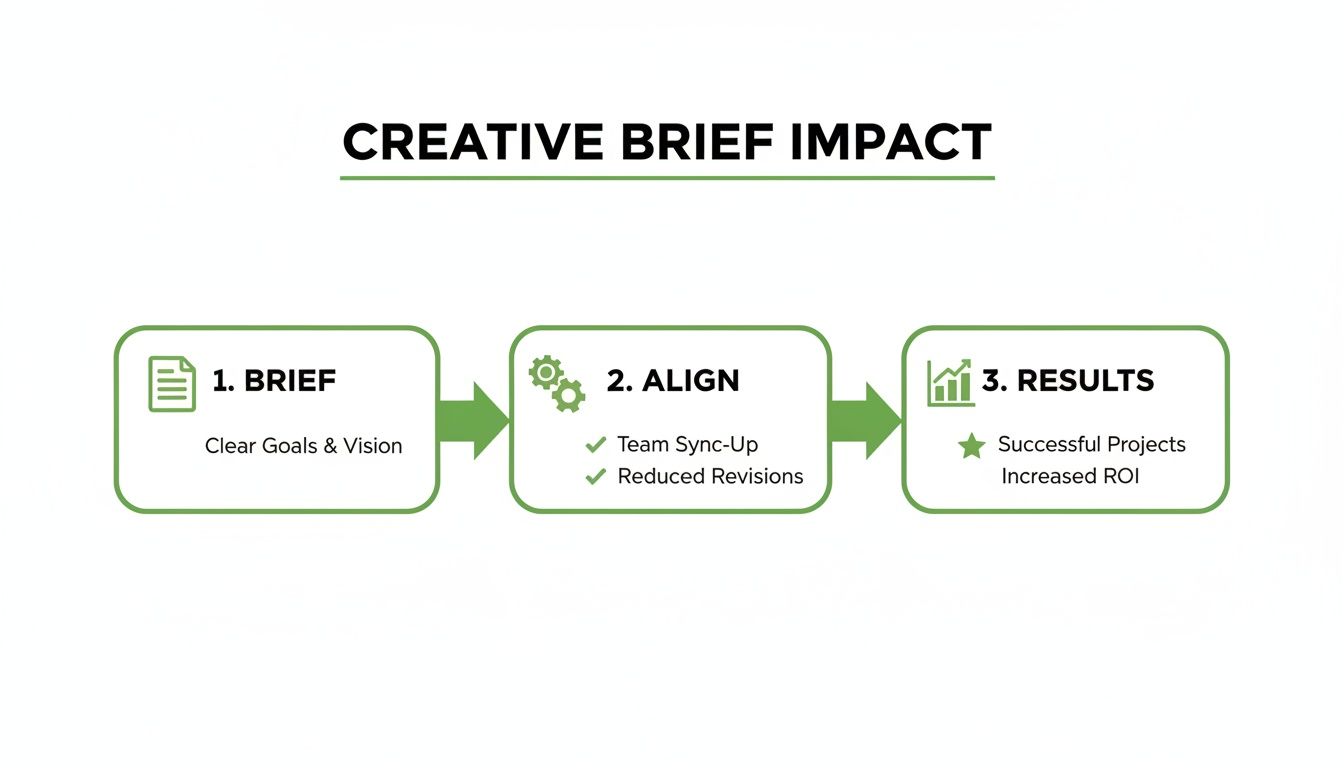
This visual just hammers home the point: the quality of your input directly dictates the quality of the final output. Get the brief right, and you’re setting everyone up for success.
Framing The Business Problem
First things first, every brief must answer the most fundamental question: Why are we doing this? And I don't mean "we need a new ad campaign." I'm talking about the real business problem that’s making this project necessary.
A vague goal like "increase brand awareness" is a one-way ticket to generic, forgettable work. You have to get specific.
- Are we losing market share to a new, aggressive competitor?
- Is a key product suddenly underperforming with a specific demographic?
- Did our brand perception take a hit after a recent event?
For instance, a coffee shop’s brief could state the problem like this: "Our weekday morning sales have tanked 15% in the last quarter because a new competitor opened two blocks away, and our current messaging isn't giving people a reason to stick with us." Now that is a tangible problem a creative team can sink their teeth into.
Your job is to define the problem, not dictate the solution. Give your team the "what" and the "why," then get out of the way and let them figure out the "how."
Defining What Success Looks Like
Once you've laid out the problem, you have to paint a clear picture of what victory looks like. And it needs to be measurable. Without concrete metrics, you’re stuck in a nightmare of subjective feedback loops where nobody wins.
So, instead of saying "we want more engagement," define the key performance indicators (KPIs) that actually matter to the business.
Examples of Actionable KPIs:
- Drive 7,000 new app downloads within the first month of the campaign launch.
- Generate 500 qualified sales leads from the new landing page in Q3.
- Boost organic search traffic to our core blog content by 20% over the next six months.
These aren't just goals; they're a finish line. This is how a brief transforms from a simple request into a powerful tool for driving real business outcomes.
Articulating The Core Message
This is it—the single most important idea you need to communicate. If your audience only remembers one thing, what will it be? Your core message has to be simple, singular, and ridiculously compelling.
So many briefs fall apart right here because they try to say everything at once. The result? A muddy, confusing mess. A new financial planning app shouldn't try to be "easy, powerful, secure, and for everyone." That's just noise.
Instead, a killer core message might be: "BiggyBank makes managing your money feel as simple as sending a text." That single thought gives the creative team a laser-focused target to aim for. This message should always tie back to your larger strategy, which is a key part of developing consistent what is brand messaging.
Setting The Tone Of Voice
The tone of voice is all about how you deliver your message. It’s the personality, the vibe. Are you an authoritative expert or a witty, playful friend? The tone has to feel authentic to your brand and connect with your specific audience.
Don’t just throw adjectives out there. Give your team descriptive words and, even better, show them what you mean with clear do's and don'ts.
| Tone | Do Say | Don't Say |
|---|---|---|
| Playful & Witty | "Your wallet's new best friend." | "Utilize our financial management solution." |
| Empathetic & Supportive | "We're here to help you take control." | "Achieve superior fiscal discipline." |
| Authoritative & Direct | "The smartest way to invest your money." | "Maybe you should think about investing?" |
A simple table like this acts as a set of guardrails, making sure the final work sounds unmistakably like you.
Detailing Deliverables And Technical Specs
This is the nitty-gritty, and it’s non-negotiable. This section removes all guesswork about what, exactly, the creative team needs to produce. Being vague here is a recipe for endless, costly revisions down the road.
Get painfully specific with your list of deliverables.
- Formats: Name every single one (e.g., JPG, PNG, MP4, PDF).
- Dimensions: List the exact pixel dimensions for all digital assets (e.g., 1080x1080 for Instagram, 1200x628 for Facebook).
- Channels: Spell out where each asset will live (e.g., Instagram Stories, email newsletter, YouTube pre-roll).
- Quantity: State the exact number needed (e.g., three unique video ads, five static social media graphics).
A crystal-clear list of deliverables shuts the door on scope creep and helps the team plan their resources accurately. It's the final, practical checklist that ensures your brilliant idea becomes a set of tangible assets, ready to go. By mastering these building blocks, you’ll write a creative brief that doesn’t just inform—it inspires.
Defining Your Audience With Precision And Empathy

If your creative brief has a beating heart, this is it. A brief is only as strong as its audience insight, which makes this the single most critical component you’ll write. Vague descriptions like “millennials aged 25-35” are a fast track to generic, ineffective creative that connects with no one.
The real work is to move beyond flat demographics and craft a vivid "pen portrait" of your ideal customer. This means digging into the why behind their behavior and telling a compelling human story. Your creative team needs to feel like they truly know this person.
Moving Beyond Demographics
Demographics give you a starting point, but they don't reveal motivation. Think about this classic example: King Charles and Ozzy Osbourne share nearly identical demographic traits. They're both wealthy British men, born in the same year, and are both fathers. But could you imagine marketing to them in the same way? Of course not.
This illustrates perfectly why a data-driven brief has to be built on a detailed consumer portrait. As Global Web Index research shows, true understanding comes from analyzing behaviors and attitudes, not just age or location. In fact, "quality consumer insights into the target audience" rank just behind clear objectives as a key driver of effective creative.
To get this right, you need to answer a few core questions about your audience:
- What are their daily struggles? Think beyond the obvious. What are the small, nagging problems your product or service can solve?
- What truly motivates them? What are their deepest aspirations, fears, and desires that drive their decisions?
- Where do they spend their time? Understand their digital habits, the communities they belong to, and the influencers they trust.
Gathering Actionable Insights
So, where does this rich, empathetic data come from? It's a lot more accessible than you might think. You don't need a massive research budget to start painting a clearer picture of who you're talking to.
A great place to start is with your existing resources. Your customer service team, for instance, is a goldmine of information about customer pain points and questions. Social listening tools can also reveal candid conversations about your brand and competitors, offering unfiltered insights.
When you're ready to dig deeper, mastering the art of asking strategic open-ended questions in surveys or interviews is key for unearthing profound insights that raw quantitative data alone just can't provide.
The goal isn't just to describe your audience; it's to understand them. Empathy is the bridge between a good idea and a great one. Give your creative team the gift of genuine human insight.
Crafting The Pen Portrait
Once you have your data, it's time to synthesize it into a narrative. This is where you transform raw information into a human story your creative team can actually connect with. Don't just list facts—bring the person to life.
Give them a name, a job, and a personality. Describe a day in their life. What’s the first thing they do in the morning? What podcasts do they listen to on their commute? What’s the one thing that keeps them up at night? For a more detailed walkthrough of this process, check out our guide on https://naturalwrite.com/blog/what-is-audience-analysis.
Here’s a quick comparison to show you what I mean:
| Vague Description | Vivid Pen Portrait |
|---|---|
| "Busy moms, 30-40, living in suburbs." | "Meet Sarah, a 34-year-old project manager juggling two kids under six. She feels constantly behind, fueled by lukewarm coffee and the guilt of never having enough time. She dreams of a simple way to organize her family’s chaos so she can finally have five minutes to herself." |
This level of detail is what allows a designer or copywriter to step into Sarah’s shoes. They’re no longer creating for a faceless demographic; they’re solving a problem for a real person. This empathetic connection is what fuels resonant, memorable, and—most importantly—effective creative work.
Learning From Real-World Creative Briefs
Theory is great, but seeing a powerful creative brief in action is where the real lightbulbs go off. A brief isn't just a form to fill out; it's the strategic launchpad for a breakthrough idea. When you deconstruct iconic campaigns, you can see how their genius was there from the very beginning, right in the brief.
The best briefs I've ever worked with always zero in on a sharp, specific problem. They dig deeper than generic business goals to uncover a real human truth or a cultural tension. That’s what gives a creative team fertile ground to play in.
The Old Spice Reinvention
Remember "The Man Your Man Could Smell Like"? That campaign completely turned around a brand many people had written off as their grandfather's aftershave. The brilliance wasn't just in the hilarious, fast-paced commercial—it was embedded in the strategy of the creative brief itself.
A deep dive into the campaign reveals a killer insight about a dual audience. The brief had to speak to women, who were often the ones buying body wash for their partners, but it also had to appeal to men's aspirational side. This wasn't just about selling a product; it was about repositioning Old Spice as a modern, confident choice.
By targeting two different groups in one clever swoop, the brief unlocked a creative solution that was both funny and wildly effective. You can explore more campaign breakdowns like this to see how strategic briefs drive success.
The takeaway here is simple but crucial: Your brief must clearly define who you are really talking to and what you want them to feel—not just what you want them to do.
The Spotify Wrapped Phenomenon
Every year, Spotify Wrapped becomes a cultural moment, and it all starts with a smart brief. The problem they were solving wasn't just "how do we get people to re-subscribe?" It was something far more interesting: "How can we turn personal listening data into a shareable story that makes our users feel celebrated?"
The brief for Wrapped probably focused on a few key things:
- The Core Insight: People love seeing data about themselves, and they love sharing things that reflect their unique identity.
- The Mandate: Don't just give them stats. Create a personalized, story-driven experience that feels like a gift.
- The Goal: Turn passive listeners into active brand advocates by giving them something cool to post.
This shift in focus transformed a simple data report into a viral marketing machine. The brief didn’t ask for an end-of-year summary; it demanded an event. It's a perfect example of how a brief can frame a challenge in a way that sparks a truly innovative, platform-defining idea.
Putting This Into Practice
Seeing these examples is inspiring, but the real goal is to apply these principles to your own projects. Whether you're launching a major marketing campaign, kicking off a freelance branding project, or handling an internal announcement, the fundamentals don't change.
To give you a running start, we've put together a few downloadable templates designed for these common situations. They’re built to prompt the kind of strategic thinking we saw in the Spotify and Old Spice examples.
| Brief Type | Key Focus Area | Downloadable Template |
|---|---|---|
| Digital Marketing Campaign | Defining specific KPIs, channel strategy, and a single, clear call to action. | [Link to Digital Campaign Template] |
| Freelance Branding Project | Capturing the brand's essence, competitive landscape, and desired tone of voice. | [Link to Freelance Branding Template] |
| Internal Comms Initiative | Clarifying the key message for employees, the desired change in behavior, and how to measure success. | [Link to Internal Comms Template] |
Think of these templates as your starting point. The real magic happens when you use them to dig deep into the specifics of your project, audience, and goals. Combine these practical tools with the inspiration from world-class campaigns, and you’ll start writing briefs that don't just assign work—they ignite it.
Common Creative Brief Pitfalls and How to Avoid Them

Even with the best intentions, a creative brief can go sideways fast. I've seen it happen countless times. Knowing what not to do is just as important as knowing what to include. Certain mistakes can derail a project from the get-go, leading to confusion, wasted hours, and work that just falls flat.
Think of this as your field guide to common brief-writing blunders. Spotting these ahead of time lets you steer clear of the chaos and keep your project on the path to success.
The "Kitchen Sink" Brief
This is probably the most common mistake I see. The brief becomes a dumping ground for every random piece of company info imaginable—endless product history, competing messages, contradictory goals. It's overwhelming. The result? A creative team that's completely paralyzed, with no clue what to focus on.
The magic of a great brief is its focus. Force yourself to decide on the one single thing you want your audience to remember. If you try to say everything, you'll end up saying nothing at all.
The Overly Prescriptive Brief
On the flip side, you have the brief that dictates the creative solution. Instead of outlining the problem, it spells out the exact ad, headline, or imagery to use. This approach doesn't just stifle creativity; it kills it.
Your role is to explain the "what" and the "why," not the "how." You're there to set up the strategic guardrails, then give your team the freedom to find the best way to get there.
A brief should be a map, not a set of turn-by-turn directions. It shows the destination and key landmarks but lets the driver—your creative team—find the best route.
Relying on Vague Jargon
Corporate buzzwords are the mortal enemy of a clear brief. Phrases like "leverage synergies" or "enhance brand resonance" sound important but are often meaningless. They mean different things to different people, paving the way for misinterpretations and work that completely misses the mark.
Don't just say you want to "be more engaging"—get specific. A simple way to sharpen your thinking is to apply the SMART goals framework to your objectives:
- Specific: What, exactly, do you want to accomplish?
- Measurable: How will you track success with real numbers?
- Achievable: Is the goal actually realistic with the resources you have?
- Relevant: Does this objective connect to the bigger business goals?
- Time-bound: When does this need to be done?
For instance, "Increase engagement" transforms into, "Achieve a 5% click-through rate on our new email campaign by the end of Q3." This kind of clarity isn't just a nice-to-have; it's what enables a creative team to do their best work.
Failing to Get Stakeholder Buy-In
A brief written in a vacuum is a recipe for disaster. If key stakeholders haven't seen, understood, and agreed to the brief before it lands on a creative's desk, you're just asking for painful feedback loops and endless revisions down the line.
The brief isn't just for your creative team; it's a contract that aligns everyone involved in the project. Circulate the document for review and get a formal sign-off from every decision-maker before a single piece of creative work begins. This one step can save weeks of headaches and ensures everyone is rowing in the same direction from day one.
Frequently Asked Questions About Creative Briefs
You've learned how to build a creative brief, but the real world always throws a few curveballs. Getting a project from a document to a delivered reality involves navigating some common hurdles. Let’s walk through the questions that almost always come up once the theory is put into practice.
Think of this as the troubleshooting guide for turning a great brief into a project that doesn't get stuck in limbo.
How Much Information Is Too Much?
This is the classic tightrope walk. You need enough detail to give clear direction, but dump in too much and you create the dreaded "kitchen sink" brief that nobody wants to read. If you're pushing past two pages, it's time to start cutting.
The goal here is inspiration, not a dissertation.
- Stick to the core insight. What’s the single most important thing the creative team needs to know to solve the problem?
- Set the guardrails. Clearly define the non-negotiables—budget, timeline, mandatory brand elements. These are the lines they can't cross.
- Link out, don't paste in. Your brief isn’t the place for pages of market research. Instead, provide links to shared folders with brand guidelines, audience personas, or competitor analysis for those who want to dig deeper.
A great brief is a focused map, not an encyclopedia. If a piece of info doesn't directly help the team understand the what or the why, it probably belongs in an appendix, not the brief itself.
How Do I Get Stakeholder Buy-In?
A creative brief without stakeholder approval is a recipe for disaster. Getting everyone aligned before a single design is mocked up is the single best way to avoid painful, soul-crushing revisions down the road.
Don't just email the brief into the void and hope everyone reads it. You have to be more proactive.
Treat the brief like a contract. Schedule a formal kickoff meeting and walk every key decision-maker through it, section by section. This forces a real conversation and surfaces any hidden disagreements or confusion right away.
Your creative brief isn't just a document; it's an agreement. When a stakeholder signs off, they're agreeing to judge the final creative work against the objectives in that brief—and nothing else.
This simple step transforms the brief from a flimsy guideline into your best defense against subjective feedback later on.
Can I Use A Shorter Brief For Smaller Projects?
Absolutely. In fact, you should. It's inefficient to write a massive, in-depth brief for a single social media post. For smaller, quicker tasks, a "brief-lite" is the way to go.
Even for a quick-turnaround project, you still need to cover the essentials. A condensed brief should always include:
- The Objective: What does this one thing need to accomplish? (e.g., "Drive traffic to the new landing page.")
- The Key Message: What is the one thing we absolutely have to say? (e.g., "Our 24-hour flash sale is now live.")
- The Deliverables: What are the exact specs? (e.g., "One 1080x1080px Instagram graphic and one 9:16 Story version.")
Skipping a brief entirely, no matter how small the task, is asking for trouble. A quick, condensed version ensures even the smallest creative jobs are on-brand and strategically sound.
Feeling good about your brief but want to make sure the final copy is polished and human? Natural Write can help. Our free tool refines AI-generated text into natural, engaging writing that sounds like it came from a real person. Polish your drafts in a single click and ensure your message truly connects. Give it a try at https://naturalwrite.com.