

How to Write a Position Paper That Makes a Real Impact
December 12, 2025
Writing a position paper isn't just about stating your opinion. It’s about taking a firm, defensible stand on a hot-button issue and backing it up with cold, hard evidence.
You have to choose a controversial topic, nail down an assertive thesis, and then build a rock-solid argument designed to win over the people who matter. Think of it less like an essay and more like a strategic tool for making your voice heard.
What a Position Paper Actually Is
At its core, a position paper is a persuasive argument grounded in fact. It’s not like a standard research paper where you might explore a topic from a neutral distance. Here, the entire point is to advocate for a specific viewpoint.
Imagine you're making a case in a courtroom. Your opinion is the verdict you’re fighting for, and the evidence is how you prove it. This is why it’s such a critical skill in any field where influence is the name of the game.
The whole document hangs on one powerful idea: your thesis. Every single thing you write, from the first word of the introduction to the final period, must serve to reinforce that central claim. That intense focus is what gives a great position paper its power.
The Core Purpose and Impact
So, why bother writing one? A position paper is your ticket to influencing policy, shaping public opinion, or making a dent in a big academic debate. It's a formal, structured way to enter a conversation with a well-reasoned stance.
The best ones don't just shout opinions into the void. They compel readers to see an issue from a new perspective by blending logic, evidence, and a smart use of rhetoric. Honing your persuasive skills is everything. You can learn more about what rhetoric is in writing to really sharpen your edge.
This format is especially crucial in competitive arenas like Model United Nations (MUN).
In the world of MUN, position papers have been a cornerstone since the early 1980s. Today, with over 500,000 students participating annually across 100+ countries, mastering this format boosts debate success rates by up to 40%. Teams with data-rich papers are known to advance 1.5 times more often in major circuits.
Key Components to Understand
Before you even think about writing, you need to get familiar with the basic building blocks. Each piece has a specific job to do in constructing your argument.
This table breaks down the essential elements that form the foundation of any effective position paper.
| Component | Purpose | Example |
|---|---|---|
| A Debatable Issue | Provides the conflict; there must be at least two valid sides. | "Should cities implement congestion pricing to reduce traffic?" |
| A Clear Position | States your main argument concisely. This is your "what." | "Congestion pricing is an equitable and effective solution..." |
| Supporting Evidence | Proves your point. This is your "why." | Case studies from London, traffic data, economic impact reports. |
| Counterarguments | Shows you've considered all angles and strengthens your credibility. | Acknowledging concerns about the impact on low-income commuters. |
| Rebuttal | Disproves the counterargument and brings the focus back to your stance. | Citing data that shows revenue can fund public transit for those same groups. |
Knowing these components inside and out is the first step. A well-crafted position paper showcases your critical thinking, proves you know your stuff, and gives you a powerful platform to advocate for change.
Building the Foundation for Your Argument
A truly persuasive position paper is won long before you type the first word. The real work happens in the planning stage, where you dig in, pick your battle, and forge a rock-solid thesis. If you skip this strategic groundwork, it's like building a house on sand. The whole thing is destined to collapse.
Your first move is to choose a topic that’s genuinely debatable but also narrow enough to tackle. Something huge like "climate change" is a non-starter. Instead, get specific. An angle like, "Should small-scale nuclear reactors be the primary green energy investment for urban centers?" creates a clear, arguable battleground.
A debatable issue needs at least two valid, competing sides. If everyone already agrees, you don't have a position—you just have a fact. That's why topics with clear pros and cons, backed by different data sets or ethical frameworks, are where the magic happens.
Choosing a Defensible Topic
The best topics often spring from current events, ongoing academic debates, or professional controversies. Think about issues that get people talking but also have a body of evidence you can pull from. For instance, arguing for the mandatory regulation of AI-generated art is timely, contentious, and full of potential evidence you can use to build your case.
This isn't a new idea. Historically, the need for well-defined positions is rooted in diplomacy. After World War II, the newly formed United Nations required member states to submit formal positions on key issues. The same principle applies today, whether you're in a classroom or a boardroom. You need a topic with real substance.
Think about the health effects of coffee. Years of conflicting studies provide fertile ground for an argument. A landmark Harvard study that tracked 90,000 women for 30 years found that daily coffee drinkers had a 20% lower risk of diabetes—a stat that directly challenged earlier health warnings.
Crafting a Powerful Thesis Statement
Once you have your topic, it's time to craft your thesis statement. Think of this single sentence as the North Star for your entire paper. It isn't a question or a simple fact; it’s an assertive, specific claim that you'll spend the rest of the paper proving.
A weak thesis might say, "AI in art is a complicated issue." A strong one gets right to the point: "The unregulated use of generative AI in creative industries threatens the livelihoods of human artists and requires immediate ethical and legislative oversight." See the difference? The second one gives you a clear direction and something to actually defend.
This simple diagram shows how the entire process flows from that initial thesis.
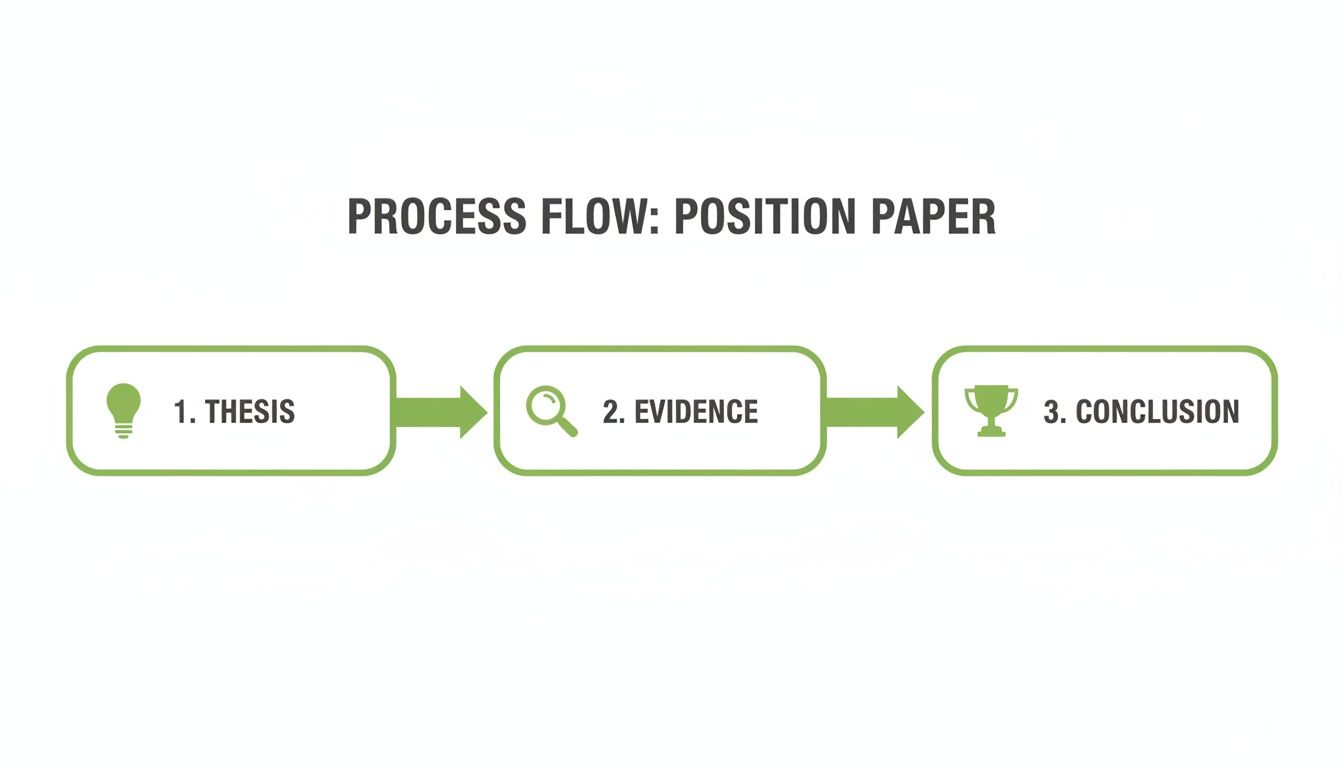
As you can see, your thesis is the starting point for everything that follows—from gathering evidence to drawing your final conclusions. For a deeper dive, check out our guide on how to write a thesis statement.
Outlining Your Logical Structure
With your thesis locked in, the final foundational step is building an outline. This is your blueprint. It ensures every paragraph has a purpose and keeps your argument moving forward. Don't think of it as a rigid cage, but as a map that keeps you from getting lost in the weeds.
A standard outline for a position paper usually looks something like this:
- Introduction: Hook the reader, give them some background context on the issue, and then hit them with your powerful thesis statement.
- Body Paragraphs (Your Evidence): Dedicate each paragraph to a single supporting point. Lead with a topic sentence, present your evidence (data, expert opinions, case studies), and clearly explain how it backs up your thesis.
- Counterargument & Rebuttal: Acknowledge a valid point from the other side. Then, systematically take it apart with your own logic and evidence. This shows you've considered all angles and your position is still the stronger one.
- Conclusion: Summarize your main points without just repeating them word-for-word. Restate your thesis in a new, more confident light, and leave the reader with a final thought-provoking statement or a call to action.
By investing time in these three foundational steps—choosing a focused topic, crafting a sharp thesis, and mapping out a logical structure—you’re setting yourself up to write a paper that doesn’t just state an opinion, but actually changes minds.
Finding and Using Evidence That Persuades
Your thesis is the engine of your position paper, but credible evidence is the fuel that keeps it running. Without strong, well-integrated proof, your argument is just another opinion floating in the void. This is where you graduate from basic searches and become a sharp researcher, finding sources that don't just fill space but actively win over your reader.
A truly powerful argument isn't built on a single, killer statistic. Instead, it’s a carefully woven tapestry of different types of information, creating a convincing story that supports your position from every angle.
Knowing Your Sources
First thing's first: you need to understand the landscape of evidence out there. Not all sources are created equal, and knowing what to use—and when—is a core skill for writing a paper that gets taken seriously. The two main buckets you'll be working with are primary and secondary sources.
- Primary Sources are the raw materials. Think original documents, firsthand accounts, raw data sets, interviews, and historical records. A scientist's lab notes or the actual text of a new law are perfect examples.
- Secondary Sources are one step removed. They analyze, interpret, or discuss information from primary sources. This includes scholarly articles, news analysis, and books that pull together research from multiple places to provide context and expert perspective.
So, if you're writing about the economic impact of a new trade policy, the government's official trade data is your primary source. An economist’s journal article breaking down that data? That's your secondary source. A great paper uses both to build its case.
Locating Evidence That Actually Has Weight
Once you know what you’re looking for, the real hunt begins. Your mission is to gather proof from reputable, unbiased, and authoritative sources. A random blog post or an unsourced infographic just won't cut it.
You need to focus your search on places known for their rigor and accuracy. Here's a look at the different types of evidence, what they're good for, and where you can find them.
Comparing Types of Evidence
A smart blend of sources creates a richer, more textured argument. A single statistic from a government report can establish a hard fact, while a quote from a leading expert can drive home its significance for your reader.
| Evidence Type | Primary Use | Reputable Sources |
|---|---|---|
| Scholarly Articles | Providing in-depth analysis and peer-reviewed research on a specific topic. | Google Scholar, JSTOR, PubMed, university library databases. |
| Government Reports | Offering official data, statistics, and policy analysis from national or international bodies. | U.S. Census Bureau, World Bank, United Nations, Bureau of Labor Statistics. |
| Think Tank Studies | Presenting research and policy recommendations from non-partisan (or clearly partisan) organizations. | Pew Research Center, Council on Foreign Relations, RAND Corporation. |
| Expert Opinions | Adding weight and authority to your claims through quotes or analyses from recognized leaders in a field. | Interviews, academic publications, testimony before legislative bodies. |
This mix is what separates a decent paper from a truly persuasive one.
Weaving Evidence Into Your Writing
Finding killer evidence is only half the battle. How you use it is what really seals the deal. Dropping a random statistic into a paragraph without any setup is like shouting a fact at someone and walking away—it's jarring and totally ineffective.
Your job is to integrate evidence smoothly, explaining its relevance and tying it directly back to your main point. In academic settings, statistics are king. Studies show that papers incorporating data from reputable sources like the U.S. Census Bureau or World Health Organization are 35% more likely to be cited in peer-reviewed journals.
For example, 45% of healthcare policy papers in 2023 used WHO stats on intervention efficacy, which helped boost adoption rates of those policies by 25%. You can get more insights on how to properly use statistics in academic writing.
Key Takeaway: Never let your evidence speak for itself. Always follow up a quote, statistic, or piece of data with your own analysis that answers the question, "So what?" Explain to the reader why this specific piece of information is important and how it proves your point.
This is the difference between a list of facts and a persuasive argument.
Quoting and Paraphrasing Without Plagiarizing
When you bring in outside information, you’ll either quote it directly or paraphrase it. Using both correctly is essential for maintaining your integrity and building trust with your reader.
- Direct Quoting: Use this sparingly, for when the original author’s exact wording is too powerful or precise to change. Keep quotes brief and embed them within your own sentences. Always give context.
- Paraphrasing: This means restating someone else's idea in your own words. It's often the better choice, as it shows you truly understand the source material and helps maintain a consistent voice throughout your paper. You still have to cite it, of course.
And this is the big one: every single idea, statistic, or piece of information that isn't your own original thought must be cited. No exceptions. Whether you quote it or paraphrase it, you must give credit. Failing to do so is plagiarism, a shortcut to serious academic or professional trouble. Proper citation isn't just a rule—it's what proves you're a credible writer.
How to Structure Your Paper for Maximum Impact

A brilliant argument can fall completely flat if it's poorly organized. Your paper's structure is the invisible framework holding everything together, guiding your reader from that first hook all the way to your final, powerful point.
Without a solid structure, even the strongest evidence can feel jumbled and unconvincing. Think of it as building a clear, logical path for your reader. Each section needs to flow into the next, building momentum and hammering home your thesis at every turn.
Let's break down the blueprint for a paper that gets remembered.
Nail the Introduction
Your introduction is your one shot at a first impression, and it has to do three things, fast. First, you need a compelling hook to grab the reader's attention. Think a surprising statistic, a provocative question, or a brief, relevant story.
Next, give them just enough background context. Don't assume your reader is an expert on the issue. Briefly explain the debate and why it’s a big deal right now.
Finally, drop your thesis statement. This should be the last sentence of your intro—a clear, assertive declaration of where you stand. It’s your promise to the reader about the position you’re about to defend.
Construct Bulletproof Body Paragraphs
The body of your paper is where you prove your case, one point at a time. Each paragraph has to be its own self-contained unit of persuasion, laser-focused on a single idea that supports your main thesis. Whatever you do, don't cram multiple points into one paragraph. It just muddies the waters.
A great way to keep your paragraphs tight and impactful is to follow a model. While there are a few out there, the T.E.X.A.S. method gives you a repeatable structure for building a strong argument.
T.E.X.A.S. Paragraph Model
- Topic Sentence: State the paragraph's main point.
- Explanation: Unpack that topic sentence. What do you mean?
- eXample: Back it up with hard evidence—a statistic, a quote, a case study.
- Analysis: Explain how that example proves your point and ties back to your thesis.
- Summary: Briefly wrap up and smoothly transition to the next idea.
This framework forces you to connect every piece of evidence back to your central claim, creating a really cohesive argument. The structure is pretty similar to other types of persuasive writing, and if you're curious, we have a detailed guide on how to structure an argumentative essay.
Address Counterarguments with Confidence
Ignoring the other side of the debate is one of the biggest mistakes you can make in a position paper. Acknowledging a valid counterargument doesn't weaken your paper—it actually strengthens it. It shows the reader you’ve done your homework and aren't afraid of a challenge.
The key is to present the opposing view fairly. Use phrases like, "Some might argue that..." or "A common concern is..." to introduce the counterpoint without dismissing it.
Then comes your rebuttal. This is where you systematically dismantle their point with your own logic and evidence. Point out its flaws, highlight its weaknesses, or bring in stronger facts that favor your position. This one-two punch makes your own stance look that much more robust.
Deliver a Powerful Conclusion
Your conclusion is your final chance to leave an impression. This isn't the time to introduce new arguments or evidence. Your goal here is to synthesize everything you've already said and leave no doubt about where you stand.
Start by summarizing your main points, but find a fresh way to say it. Don't just list them off. Briefly revisit the key arguments from the body of your paper, reminding the reader of the logical journey they just took.
Next, restate your thesis with renewed authority. Phrasing it a bit differently can give it more punch, showing how all the evidence you’ve presented has solidified its truth. It's your mic drop.
Finally, end with a strong closing thought. You could offer a forward-looking statement, propose a solution, or issue a call to action. Whatever you choose, it should give your reader something to chew on long after they've finished reading. Your conclusion should feel final, confident, and resonant.
Refining Your Draft Into a Polished Final Paper

Finishing that first draft feels like a huge win. And it is. But the real work—the part that turns a good argument into an undeniable one—happens now.
This is where you sharpen your logic, clarify your language, and polish your draft until it shines. Too many writers treat editing as a quick spell-check, but true revision goes much deeper. It’s about re-examining every claim, tightening your structure, and making sure every single sentence pulls its weight.
A Practical Revision Checklist
It's tough to step back and critique your own work. The best way to start is to give yourself some distance. Seriously, walk away for a day if you can. You’ll come back with fresh eyes, ready to spot the weaknesses you missed before.
Once you’re ready to dive back in, use this checklist to guide you:
- Argument Strength: Is your thesis still crystal clear? Does every paragraph circle back to support it? Be ruthless here.
- Evidence and Citations: Is every claim backed up with credible evidence? Are your citations accurate and consistent?
- Clarity and Flow: Do the paragraphs transition smoothly? Hunt down any confusing sentences or clunky phrases that make the reader stumble.
- Counterargument Handling: Did you address opposing views fairly? Is your rebuttal respectful, logical, and ultimately more convincing?
- Grammar and Spelling: Are there any typos or errors that could chip away at your credibility?
Here’s one of the best self-editing tricks I know: read your paper out loud. Your ears will catch awkward phrasing, run-on sentences, and repetitive words your eyes will glide right over. It feels a little weird, but it works wonders for readability.
Seeking a Fresh Perspective
After you've done your own pass, you absolutely need a fresh pair of eyes. You’re just too close to the material to see every gap in logic or unclear point. A peer, mentor, or trusted colleague can give you the outside perspective you can't get on your own.
But don’t just ask them to look for typos. Prompt them with bigger-picture questions:
- "Is my main argument convincing from start to finish?"
- "Were there any spots that felt confusing or weak?"
- "Does the conclusion feel earned and impactful?"
This kind of feedback is gold. It helps you see your paper through your reader's eyes, which is exactly what you need to craft a persuasive document.
Using AI Tools Responsibly
AI writing assistants can be a huge help in the revision process, but you have to use them with integrity. They’re fantastic for catching grammatical mistakes, suggesting alternative phrasing, or even helping you reword a weak paragraph.
But never, ever let an AI do your critical thinking. The core arguments, the analysis, and the unique voice of the paper must be yours. It's no surprise that major scholarly repositories like arXiv now require formal peer review for position papers, partly to filter out AI-generated content that lacks real scholarly insight. This just underscores the importance of authenticity and expert analysis.
Think of AI as a co-pilot, not an autopilot. Let it handle the mechanical tasks so you can focus on what matters: refining your argument. Once your paper is polished, you might think about how to share it. For academics, creating an academic website is a great next step to showcase your research.
Ultimately, revision is about taking complete ownership of your ideas and presenting them in the clearest, most compelling way possible.
Got Questions? Let's Talk Details
Even with a great outline, a few nagging questions always seem to pop up. Getting these small details right can be what separates a pretty good paper from a really persuasive one. Let's clear up some of the most common things people ask when figuring out how to write a position paper.
So, How Long Does This Thing Need to Be?
There’s no magic number here. The right length is whatever the assignment or conference guidelines tell you it is. Seriously, always check the instructions first.
For something like a Model UN conference, you're looking at something short and punchy—think one or two pages, usually around 300-500 words. But for a college class, your professor might expect a more developed argument in the 1,000-2,000 word ballpark. And if you're writing for a professional policy journal, it could be much longer.
Isn't This Just a Research Paper?
Not quite. While both are built on solid evidence, their goals are completely different. The easiest way to think about it is that a research paper is an investigation, while a position paper is an argument.
- A research paper is all about exploring a topic from multiple angles and presenting what you found as objectively as possible. The goal is to inform the reader.
- A position paper, on the other hand, is designed to persuade. You’re taking a firm stance on a debatable issue and using your research to convince the reader you're right.
In a position paper, your voice and your argument are always the main event.
Can I Say "I Think" or "I Believe"?
It’s almost always better to avoid it. In formal writing, your goal is to sound authoritative, and you do that by letting the evidence speak for itself.
Compare these two sentences. "I think the evidence suggests..." versus "The evidence suggests..." The second one is just so much stronger, right? It puts the focus on the facts, not your personal opinion, which gives your argument a lot more weight.
While some instructors might be okay with a more personal tone, the safest bet is to stick with the third person. It helps your arguments stand on their own and makes your position feel less like an opinion and more like a logical conclusion.
Ready to turn that AI-generated draft into something that sounds like you? Natural Write can help you polish your text in a single click. It’s a free way to refine your writing, get past AI detectors, and make sure your final paper is clear, compelling, and totally authentic. Humanize your text for free at https://naturalwrite.com.