

Your research methodology is the blueprint for your entire study. It's where you lay out the "how" and "why" behind your project, explaining your research design, justifying your chosen data collection methods, and detailing your data analysis plan.
Building the Blueprint for Your Study
Think of your methodology section as the architectural plan for your research. It’s not just another chapter to tick off a list; it’s the very foundation that gives your findings credibility. Without a solid, defensible methodology, even the most groundbreaking results can be questioned or dismissed entirely.
This section does a few critical jobs. First, it proves you've thought through every step required to answer your research question. It also gives other researchers a clear map to follow, allowing them to understand, replicate, and validate your work—a cornerstone of good academic practice.
The Essential Components of a Methodology
Before you start writing, you need to know what goes into a strong methodology. It has to tell a clear, logical story of how you got from your initial question to your final analysis. This structure acts as a roadmap for your reader, making your entire process transparent and justifiable.
Your methodology should always cover:
- Research Design: The overall strategy you're using. Is it an experimental study, a descriptive one, or something else entirely?
- Methodological Approach: Your core choice between qualitative, quantitative, or mixed-methods research. This decision will shape every other choice you make.
- Data Collection Methods: The specific tools you'll use to gather your data, like surveys, in-depth interviews, observations, or lab experiments.
- Sampling Strategy: How you'll select the participants or subjects for your study. This directly affects how widely your findings can be applied.
- Data Analysis Plan: The steps you'll take to process and make sense of the data you've collected, whether it’s running statistical tests or conducting a thematic analysis.
- Ethical Considerations: A clear statement on how you'll protect your participants, ensure their confidentiality, and maintain the integrity of your research.
A well-crafted methodology does more than just list procedures. It constructs a compelling argument for why your chosen methods are the most appropriate and rigorous way to address your specific research question.
To give you a quick reference, here’s a breakdown of the key components you'll need to cover.
Key Components of a Research Methodology
This table provides a quick overview of the essential elements that must be included in any robust methodology section.
| Component | Purpose | Example Question to Answer |
|---|---|---|
| Research Design | To provide the overall framework and strategy for the study. | Is this an experimental, correlational, or descriptive study? |
| Methodology | To define the overarching approach (qualitative, quantitative, or mixed-methods). | Will you explore experiences or measure numerical relationships? |
| Data Collection | To specify the tools and procedures for gathering information. | How will you collect your data—surveys, interviews, observations? |
| Sampling | To explain how participants or subjects will be selected. | Who is your target population, and how will you choose a sample? |
| Data Analysis | To outline how the collected data will be processed and interpreted. | What statistical tests or qualitative analysis techniques will you use? |
| Ethical Considerations | To ensure the research is conducted responsibly and protects participants. | How will you obtain informed consent and ensure confidentiality? |
Each of these components builds on the last, creating a logical and defensible structure for your research.
Connecting Your Question to Your Approach
The golden rule of writing a methodology is alignment. Every single choice you make must tie directly back to your research question.
For instance, if your question is about understanding the lived experiences of a particular community, a quantitative survey just won't cut it. In-depth qualitative interviews would be a far better fit. On the other hand, if you want to test the relationship between two variables across a huge population, a quantitative approach with statistical analysis is the only way to go.
The logic connecting your question to your methods has to be crystal clear. Think of it as telling the story of your research journey, justifying every turn you took. For a deeper look at organizing your entire paper, our guide on creating a research paper outline provides a great framework. This kind of structured approach ensures that every section, including your methodology, logically supports your main argument.
Choosing the Right Methodological Approach
Deciding whether to go with a qualitative, quantitative, or mixed-methods approach is probably the biggest choice you'll make when designing your study. This isn't just about picking a label; it's about making sure your research question and your research design are a perfect match. Honestly, the why behind your choice is far more important than the choice itself.
Your whole project really hangs on getting this right. If your goal is to explore, interpret, and truly understand human experiences, then qualitative methods are your best bet. On the flip side, if you're looking to measure, test, and predict outcomes using hard numbers, you'll need a quantitative approach.
This flowchart can help you visualize that initial thought process, mapping the way from your core goal to the right method.
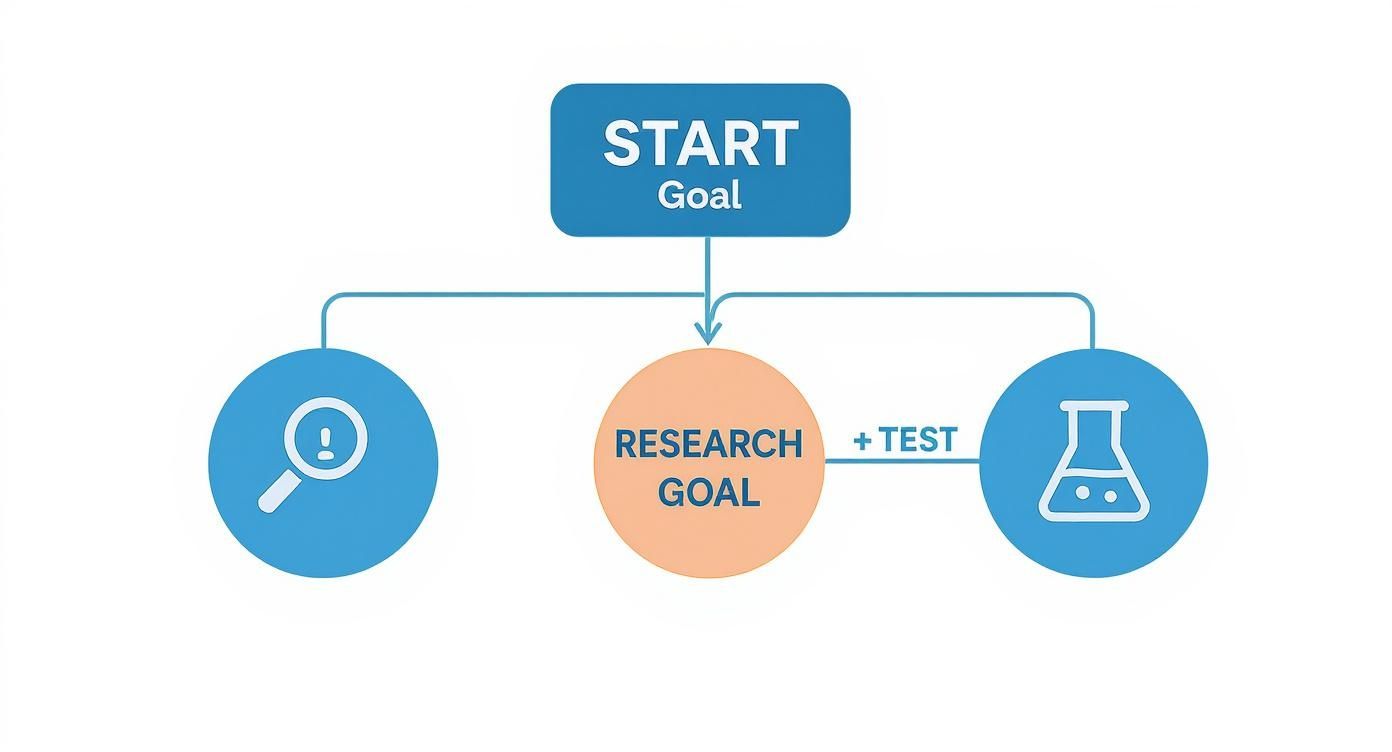
As the chart suggests, it all boils down to one fundamental question: are you trying to explore a phenomenon or test a hypothesis? Answering that one question will usually set you on the right path.
To make this even clearer, let's break down the three main approaches.
Here's a quick comparison table to give you a bird's-eye view before we dive into the details of each one.
Qualitative vs Quantitative vs Mixed-Methods
| Aspect | Qualitative | Quantitative | Mixed-Methods |
|---|---|---|---|
| Primary Goal | To explore ideas, formulate hypotheses, or understand experiences. | To test hypotheses, examine cause-and-effect, and make predictions. | To provide a more comprehensive understanding of a research problem. |
| Data Type | Non-numerical (text, video, audio, observations). | Numerical and statistical data. | A combination of both non-numerical and numerical data. |
| Research Questions | Open-ended ("How?", "Why?"). | Specific, closed-ended ("What?", "Does...?"). | A combination of open-ended and closed-ended questions. |
| Sample Size | Small and non-representative. | Large and representative. | Varies depending on the study's design. |
| Data Analysis | Interpretation of themes, patterns, and narratives. | Statistical analysis, mathematical modeling. | Integration of qualitative and quantitative analyses. |
This table is just a starting point, of course. The best approach for your project will always depend on your specific research questions and objectives.
Diving Into Qualitative Research
Qualitative research is all about depth. It's not concerned with big numbers but with rich, descriptive data that gets at the nuance of people's thoughts, feelings, and actions. It's about seeing the world through your participants' eyes.
You'll know this is the right fit if your research questions start with words like "how" or "why."
- Real-World Scenario: Let's say you want to understand how first-generation college students handle the pressures of their first year. A survey might give you some numbers, but in-depth, one-on-one interviews will uncover personal stories, coping strategies, and the emotional rollercoaster that data points can't ever capture.
The tools of the trade here are all about gathering narratives, not numbers. Common methods include:
- In-depth Interviews: Open, semi-structured conversations that let you explore topics in detail.
- Focus Groups: Guided discussions with small groups to see how people interact and build on each other's ideas.
- Ethnography: Immersing yourself in a community or organization to see how things really work in a natural setting.
The Power Of Quantitative Research
Quantitative research, in contrast, is all about numbers, logic, and objectivity. This is the method you use when you want to turn a problem into measurable data that can be crunched into useful statistics.
It's your go-to when you need to test a hypothesis, look at cause-and-effect relationships, or make predictions. The data is structured, statistical, and allows for broader generalizations.
The real strength of quantitative research is its ability to deliver reliable and generalizable results from a large sample. It provides the hard evidence you need to either back up or challenge existing theories.
- Real-World Scenario: A company wants to know if its new training program actually improved employee performance. A quantitative study is perfect for this. You could measure performance metrics (like sales numbers or productivity scores) for a group that took the training and a control group that didn't. Then, statistical analysis would show if there was a significant difference between the two.
Common tools for this approach include:
- Surveys and Questionnaires: Using closed-ended questions to gather data from a large number of people.
- Experiments: Changing one variable to see how it affects another in a controlled setting.
- Structured Observations: Systematically recording specific, pre-defined behaviors or events.
Embracing The Best Of Both Worlds With Mixed-Methods
Sometimes, one approach just doesn't cut it. That's where mixed-methods research comes in, integrating both qualitative and quantitative data into a single study. This gives you a much more complete picture than either method could alone.
Think of it as adding the "why" to the "what." The quantitative data tells you what's happening, and the qualitative data explains why it's happening.
This approach is incredibly powerful for complex research questions. For example, a study could start with a large-scale survey (quantitative) to spot trends in student well-being. Then, you could conduct follow-up interviews (qualitative) with a small group of those students to dig deeper into the stories behind the numbers.
The combination gives you both statistical weight and rich, human context. Knowing how to write a research methodology that blends these two approaches is a fantastic skill, as it shows a truly sophisticated grasp of research design.
Designing Your Data Collection and Analysis Plan
Alright, you've settled on your methodological approach. Now it’s time to get down to brass tacks—moving from the "why" to the nitty-gritty "how." This is where you outline the exact steps you’ll take to gather your data and, just as importantly, what you'll do with it once you have it.
Think of this section as the operational manual for your study. It needs to be so clear and detailed that another researcher could theoretically pick it up, follow your instructions, and get the same results. That level of detail is what builds trust and makes your findings credible.

Defining Your Population and Sampling Strategy
You can’t study everyone. The first step is to clearly define the specific group your research is about—this is your population. Maybe it's undergraduate students in the U.S., or perhaps it's small business owners in a single city. Whatever it is, be precise.
From that population, you'll select a smaller, manageable group to actually collect data from. This is your sample. How you choose this sample is a huge deal; it directly impacts how broadly you can apply your findings. There are two main ways to go about it.
- Probability Sampling: This is the gold standard for quantitative research. Every single person in the population has a known, non-zero chance of being selected. It’s designed to minimize bias and lets you make confident statistical claims about the whole population. Think simple random sampling, stratified sampling, or cluster sampling.
- Non-Probability Sampling: Here, the selection isn’t random. This is much more common in qualitative work where you're going for depth, not breadth. You might use convenience sampling (grabbing whoever is easiest to reach), purposive sampling (hand-picking people with specific traits), or snowball sampling (getting participants to refer you to others).
Your methodology section must state which technique you used and, more importantly, justify why it was the right fit for your research question.
Crafting Your Data Collection Instruments
Your "instruments" are just the tools you use to gather information. This could be a survey, an interview guide, an observation checklist, or something else entirely. Whatever it is, precision is everything. A sloppy instrument can introduce bias and give you unreliable data, sinking your entire study before it even starts.
For a quantitative study, you might create a survey with Likert scale questions. You’ll need to explain how you came up with the questions, whether you borrowed them from existing validated scales, and how you pilot-tested them to make sure they were clear.
For a qualitative study, your main instrument might be a semi-structured interview guide. This isn't a rigid script but a list of key questions and prompts that allows for flexibility. You should explain the logic behind your questions and show how they tie back to your core research objectives.
The quality of your data is 100% dependent on the quality of your collection instruments. Take the time to pre-test your surveys, refine your interview questions, and properly train anyone helping you collect data. It pays off.
Ensuring your data is solid from the get-go is critical. It’s worth looking into strategies for improving data quality for reliable reporting to shore up the integrity of your results.
Detailing Your Data Analysis Procedures
So, you have your data. Now what? This part of your methodology needs to be incredibly specific. It's not enough to just say you'll "analyze the data." You have to lay out the exact steps you'll follow to make sense of it all.
Naturally, your plan will look completely different depending on your approach.
| Methodological Approach | Common Analysis Techniques | Example Procedure |
|---|---|---|
| Quantitative | Descriptive statistics (mean, median), inferential statistics (t-tests, ANOVA, regression analysis) | "First, we will calculate descriptive statistics for all demographic variables. An independent samples t-test will then be run to compare the mean test scores between the experimental and control groups." |
| Qualitative | Thematic analysis, content analysis, narrative analysis, discourse analysis | "We will analyze interview transcripts using thematic analysis. This process will include familiarization with the data, generating initial codes, searching for themes, reviewing themes, defining and naming them, and then writing the final report." |
| Mixed-Methods | Sequential or concurrent analysis, data integration | "A sequential explanatory design will be used. We'll start by analyzing the quantitative survey data with regression analysis. Afterward, the qualitative interview data will be thematically analyzed to help explain the statistical findings." |
If you're dealing with qualitative data, especially text from interviews or open-ended survey questions, your analysis plan is crucial. If you're new to this, our guide on what is text analysis breaks down the different methods for processing and interpreting unstructured text. It's a great resource for getting a handle on the process.
Weaving Modern Tools into Your Methodology
In today’s research landscape, technology isn’t just an afterthought—it’s baked into almost everything we do. Your methodology needs to be transparent about the tools you’ve used, from specialized software to AI assistants, because these choices directly shape your data, your analysis, and ultimately, your conclusions.
It’s no longer good enough to just name a piece of software. To make your study truly transparent and reproducible, you have to explain how you used these tools. Getting this specific shows you’ve thought critically about your methods and are on top of the modern-day realities of academic work.
Laying Out Your Full Tech Stack
Think of your "tech stack" as a complete list of every digital tool that had a hand in your study. This goes way beyond the obvious statistical packages. It includes all the platforms and apps that are part of a modern researcher’s workflow.
Your methodology should be a clear record of these tools, with a quick justification for why you chose each one.
- Literature Review Tools: Did you use Zotero or Mendeley to wrangle your citations? Maybe you found key papers using a discovery platform like Scite or Elicit. Mentioning these shows you had a system for gathering and organizing your sources.
- Data Collection Platforms: If you sent out a survey, name the platform—Qualtrics, SurveyMonkey, Google Forms, etc. Be sure to detail any special features you used, like logic branching or randomization, since that can influence how people respond.
- Transcription Services: For qualitative interviews, did you lean on an AI-powered service like Otter.ai or Trint? It's essential to state this and also to explain how you double-checked the automated transcripts for accuracy.
This kind of transparency builds credibility. It lets your reviewers see the exact mechanics of your work, leaving no doubt about how you got to your results when writing a research methodology.
The New Role of AI in Research
Artificial intelligence is changing the game, but using it means you have to be extra careful and honest in your documentation. There’s been a big shift in how researchers are applying these powerful tools. While general chatbots were the gateway for many, we're now seeing a move toward more specialized AI features built right into dedicated research platforms.
The data backs this up. One key industry report showed that while 75% of researchers used general AI tools in 2024, that number is expected to drop. At the same time, the use of AI features inside specialized research software is growing. You can dig deeper into these market research trends to see how things are shifting. It’s a clear sign that researchers are starting to prefer purpose-built AI that offers more targeted and methodologically sound help.
When it comes to documenting AI, the guiding principle is simple: could another researcher repeat what you did? It's not about the tool itself. It's about how you prompted it, the settings you used, and which specific version you were working with.
How to Get Specific with Software and Algorithms
When you get to the data analysis part, being specific is non-negotiable. Just saying you used "SPSS" or "R" is lazy and incomplete. Your methodology must include the nitty-gritty details to ensure someone else can replicate your analysis.
Here’s what you need to include for total clarity:
- Software and Version: Always state the specific software and its version number (e.g., "SPSS Statistics version 28" or "R version 4.3.1"). Different versions can have tiny tweaks in their algorithms that might actually change the results.
- Packages or Libraries: If you used a language like R or Python, list every single package or library that was critical for your analysis (e.g.,
ggplot2for visuals orlme4for mixed-effects models). - Specific Procedures and Functions: Name the exact statistical tests or functions you ran. So instead of saying you "ran a regression," you’d specify that you "conducted a multiple linear regression using the
lm()function in R." - Parameter Settings: For more complex models, like in machine learning or structural equation modeling, you have to document the specific parameters and settings you chose. This covers things like convergence criteria, estimation methods, or the specific algorithms you deployed.
Properly documenting your tech toolkit is a hallmark of great research. It shows your readers that you’ve been deliberate and thoughtful at every stage, which makes the foundation of your findings that much stronger. This meticulous approach is central to how to write a research methodology in the modern era.
Coming Clean: Research Limitations and Ethics
A truly great methodology section doesn’t just brag about its strengths—it’s honest about its weaknesses. Acknowledging the boundaries of your study doesn’t make your work look weak. In fact, it does the opposite. It shows you have a sharp, critical eye for your own research design, which builds a ton of trust with your reader.
And on that note, a transparent discussion of your ethics is completely non-negotiable. This is way more than just checking a box for informed consent. It's about thinking deeply about your responsibility to your participants, your data, and the academic world.
Identifying and Framing Your Limitations
Let's be real: every single study has limitations. No matter how perfectly you plan it. Your job is to get ahead of them and explain their potential impact. Pretending they don’t exist is a rookie mistake that can tank your credibility.
Most limitations fall into a few common buckets:
- Sample Size and Generalizability: Maybe your sample was on the small side or pulled from a very specific group (like university students). You just need to state that this means your findings might not apply to everyone, everywhere.
- Methodological Constraints: Did you have to use a convenience sample instead of a truly random one? Did you rely on self-reported data, which can sometimes be skewed? Be upfront about these choices and why you had to make them.
- Scope of the Research: Your study can't answer every question under the sun. Clearly draw the lines around what you investigated and what you didn't.
The trick is to frame these limitations constructively. Don't just say, "The small sample size was a major weakness." Instead, try something like this: "While our findings offer a deep dive into this specific community, future research with a larger, more diverse sample is needed to see if these results hold true for other populations." See that? You just turned a limitation into a launchpad for future research.
Upholding Modern Ethical Standards
Ethics are the absolute foundation of good research. You're there to protect the rights and well-being of the people who trust you with their time and information. It's also critical to remember the serious fallout from academic misconduct. Taking a moment to review historical examples of academic dishonesty can be a powerful reminder of why integrity matters so much; it's worth understanding plagiarism's impact to see what's at stake.
Your methodology has to spell out exactly what ethical steps you took.
Core Ethical Commitments to Detail
Here are the essentials you need to cover:
- Informed Consent: You have to explain how you told participants everything they needed to know—the study's purpose, what they'd have to do, any potential risks, and the benefits—before they agreed to anything. Make it clear that they could walk away at any time without any drama.
- Confidentiality and Anonymity: Get specific about how you protected people's identities. Did you use pseudonyms? How did you scrub the data of personal identifiers? The more detail, the better.
- Data Security and Storage: This is a huge deal today. Where is the data being stored? On encrypted hard drives? In a secure cloud server? Who has the keys? How long will you keep it before you securely destroy it?
With so much research moving online, your ethics section needs to keep up. If you're using tools for remote patient monitoring or sharing health data, you have to talk about modern challenges. That means addressing things like cloud data security and the responsible use of digital platforms.
Ultimately, this part of your methodology is your public promise to do things right. It tells everyone—from your professor to your peers—that your search for answers was as principled as it was rigorous.
Writing a Compelling Methodology Chapter
You've made all the tough decisions about your research design. Now it's time to translate that blueprint into a clear, persuasive methodology chapter. This isn't just a technical report; it's the story of how you conducted your research. Your goal is to guide the reader so seamlessly through your process that they trust your methods before they even see your findings.
The structure should feel logical and intuitive. I always find it best to move from the general to the specific—start by reminding the reader of your overarching research approach, then dive into the nitty-gritty of data collection and analysis. Using clear, descriptive headings is non-negotiable; it breaks down complex information into digestible pieces and makes the whole chapter easier to navigate.

From Blueprint to Narrative
Think of your chapter as an argument. Every single paragraph needs to support the central claim that your methods were the most rigorous and appropriate way to answer your research question. That means writing with precision and clarity. Ditch the jargon when a simpler word will do the job just as well.
The language you choose is critical. It needs to sound confident but not arrogant, and be precise without getting bogged down in technicalities. If you're looking for a deeper dive into effective academic communication, exploring a good academic writing style guide can offer some fantastic insights.
Your reader should finish the chapter with a crystal-clear understanding of what you did, how you did it, and—most importantly—why every decision was the right one for your study. This level of transparency is the bedrock of credible research.
Common Writing Pitfalls to Avoid
Even the most brilliant research design can be let down by sloppy writing. When you're learning how to write a research methodology, knowing the common mistakes can save you a world of trouble.
Keep an eye out for these frequent issues:
- Being Too Vague: Avoid generic phrases like "interviews were conducted." That tells me nothing. Instead, get specific: "We conducted 15 semi-structured, one-hour interviews via Zoom."
- Forgetting to Justify: Never just state what you did; explain why you did it. Why a survey? Why purposive sampling? Why that specific statistical test? Your rationale is just as important as the action itself.
- Overusing the Passive Voice: While the passive voice has its place in academic writing, leaning on it too much makes your writing clunky and unclear. Whenever possible, use the active voice. "We analyzed the data" is much stronger than "The data was analyzed."
- Inconsistent Tense: This one is simple but crucial. Your methodology chapter describes actions you've already completed. Stick to the past tense. Consistency here is key for a professional tone and a smooth narrative.
Frequently Asked Questions About Research Methodology
When you get down to the nitty-gritty of writing your methodology, a few common questions always seem to pop up. Let's tackle some of the most persistent ones head-on so you can move forward with confidence.
What is the Difference Between Methods and Methodology?
This is, without a doubt, the number one point of confusion. I see it all the time.
Think of it this way: methods are the tools you use, while your methodology is the entire strategic blueprint for your research.
- Methods: These are the specific, practical actions you take. Did you run semi-structured interviews? Did you use a Likert scale survey? What about a statistical regression analysis? Those are your methods—the what and how.
- Methodology: This is the big-picture thinking—the why. It's the overarching rationale that explains and defends your chosen approach. It’s where you argue why, for example, a qualitative study was the only way to truly explore your research question.
Your methods are the individual steps you took. Your methodology is the justification for the entire journey.
How Much Detail Should I Include?
Ah, the million-dollar question. You're walking a fine line here. The goal is to give another researcher enough detail to replicate your study, but not so much that you drown your reader in trivial facts.
The best rule of thumb is to ask yourself: "If someone picked this up, could they do exactly what I did and understand why I did it?"
Don't just write "I conducted interviews." That tells me nothing. Instead, get specific: "I conducted 12 semi-structured, 60-minute interviews over Zoom, following a pre-approved interview guide." If you ran a survey, mention the platform (Qualtrics, for instance), the number of items, and the types of scales you used. Transparency is everything.
How Do I Justify My Methodological Choices?
This is where your methodology section really shines. It’s not a diary of what you did; it’s an argument for why your choices were the right ones. Every single decision—from your sampling strategy to your analysis technique—needs a solid defense.
Your justification should always tie directly back to your research objectives. Connect your choices to established academic literature, showing that your approach is both sound and perfectly suited to the goals of your study.
For example, if you chose purposive sampling, don't just state it. Explain that this technique was essential for recruiting participants with the precise expertise needed to answer your research question, and maybe even cite a couple of key studies in your field that did the same.
What If My Methodology Changes During the Study?
First of all, don't panic. Research is messy, and plans change. It’s completely normal for your methodology to evolve, especially in qualitative work where the process is expected to be emergent.
The most important thing is transparency.
If your plan had to shift, document it. Acknowledge what you originally planned to do in your methodology, and then clearly explain what changed and why. Maybe you intended to run in-person focus groups but had to pivot to online interviews due to unforeseen logistical issues. Just explain the rationale for the shift and briefly reflect on how it might have impacted your findings. Being honest about the process only strengthens your credibility.
Ready to turn your AI-generated drafts into polished, human-like text? Natural Write instantly refines your writing, ensuring it bypasses AI detectors with ease. Perfect your essays, reports, and content by visiting https://naturalwrite.com to try it for free.