

In writing, rhetoric is the art of effective or persuasive communication. It's the thoughtful, strategic use of language to inform, persuade, or connect with a specific audience. Think of it less as manipulation and more as the master toolkit every skilled writer uses to make their message land.
Demystifying Rhetoric in Modern Writing

Let's be honest, the word "rhetoric" gets a bad rap. Many people hear it and immediately picture a politician delivering a grand, empty speech.
But in reality, rhetoric is something far more practical and essential to good writing. It’s the conscious craft of choosing your words, structuring your sentences, and framing your ideas to get a specific reaction from your reader.
You actually use rhetoric all the time, probably without even thinking about it.
That email you drafted to your boss asking for a raise? You carefully chose words to project competence and value. That social media post celebrating a friend? You used language to evoke warmth and happiness. Both of those are rhetorical acts.
The Core Purpose of Rhetoric
At its heart, rhetoric is about closing the gap between what you want to say and what your reader actually understands. It's about ensuring your message isn't just sent, but truly received.
When you get it right, rhetoric helps you:
- Build Credibility: You come across as a trustworthy and knowledgeable source.
- Create Connection: Your audience feels seen, understood, and emotionally engaged.
- Drive Action: You can persuade readers to agree with you, buy a product, or take the next step.
- Enhance Clarity: You structure your arguments so they’re easy to follow and accept.
Mastering rhetoric gives you control over how your writing is perceived. It goes way beyond just good grammar and spelling; it’s about deeply understanding your audience, your purpose, and the context you’re writing in.
Rhetoric is the art of ruling the minds of men.
— Plato
That ancient wisdom still holds up. Effective communication is power. It allows you to guide your reader's thoughts and feelings, making your writing not just informative but genuinely influential. The tone you choose is a huge part of this, and you can learn more about what is tone in writing and how it shapes perception.
Ultimately, understanding rhetoric is what turns you from someone who just writes things down into a strategic, intentional communicator.
To really get what rhetoric is all about in writing, we have to go back in time. And no, this isn't just a stuffy history lesson. It's about understanding the timeless principles of persuasion that were hammered out in the public squares of Ancient Greece—ideas that still power the way we write today.
The strategies we use to write a convincing email or a killer blog post didn't just fall out of the sky. They have a long, rich history tied to democracy, debate, and the very human need to be heard and understood. It all began when people realized language wasn't just for stating facts. It was a tool for shaping reality.
The Birth of Rhetorical Study
As an actual field of study, rhetoric got its start back in 5th century B.C. Greece. In a society where citizens had to argue their own cases in court and speak up in political debates, being able to communicate well wasn't just a nice-to-have skill. It was essential for survival.
This real-world need created a market for teachers who started to break down what made a speech persuasive. They began to organize the techniques that worked, essentially creating the world's first communication playbook.
One of the heavy hitters in all this was the philosopher Aristotle. By the 4th century B.C., he’d famously defined rhetoric as “the faculty of observing in any given case the available means of persuasion.” His work on the topic, On Rhetoric, was so fundamental that it’s still influencing writers thousands of years later. You can get a great overview of these early definitions over on Study.com.
From Spoken Word to Written Text
At first, rhetoric was all about public speaking. That makes sense—it was an era of orators, where a single powerful speech could sway a jury, change public opinion, or decide the fate of an entire city.
But as writing became more common, those same principles naturally moved from the podium to the page. The core ideas didn't change:
- Know Your Audience: Who are you actually talking to?
- Have a Clear Purpose: What do you want your words to do?
- Pick the Right Tools: What's the best way to make your point?
Rhetoric is the art of leading the soul by means of words.
— Plato
This ancient wisdom gets right to the point. The goal has always been to connect with the reader on a deeper, more human level. The techniques are old, but their psychological punch is as powerful as ever.
The strategies these early thinkers came up with weren't just abstract theories; they were practical tools for real-world situations. Understanding where they came from helps us see that modern writing advice isn't just a collection of fleeting trends. It's the modern-day evolution of a persuasive tradition that's been proven to work for centuries. This history is the foundation for the powerful appeals and devices we're about to dig into.
The Three Pillars of Persuasive Writing
If you really want to get a handle on rhetoric, you need to meet its three superstars: Ethos, Pathos, and Logos. First pinpointed by Aristotle thousands of years ago, these are the foundational pillars of persuasion. Think of them as a framework for making your message not just heard, but felt and believed.
Mastering these pillars is what separates simple fact-stating from truly effective communication. When you weave them together, you create a balanced, compelling message that connects with readers on every level.
Let's break them down one by one.
Ethos: Building Your Credibility
Ethos is all about establishing your credibility and authority. It’s the reason your audience should trust what you have to say. It quietly answers the reader's unspoken question: "Why should I listen to you?"
You don't just have ethos; you build it by signaling your expertise. Here's how:
- Show Your Experience: Mention your credentials, years in the field, or relevant background.
- Cite Reputable Sources: Back up your claims with data and insights from trusted experts or studies.
- Maintain a Professional Tone: Use clear, confident language that shows you know your stuff and respect your audience.
- Acknowledge Nuance: Admitting there are counterarguments or complexities shows you’ve thought deeply, which builds trust.
When a doctor in a white coat explains a medical procedure, their uniform and title do the heavy lifting to establish ethos. In your writing, well-structured arguments and a confident tone serve the exact same purpose.
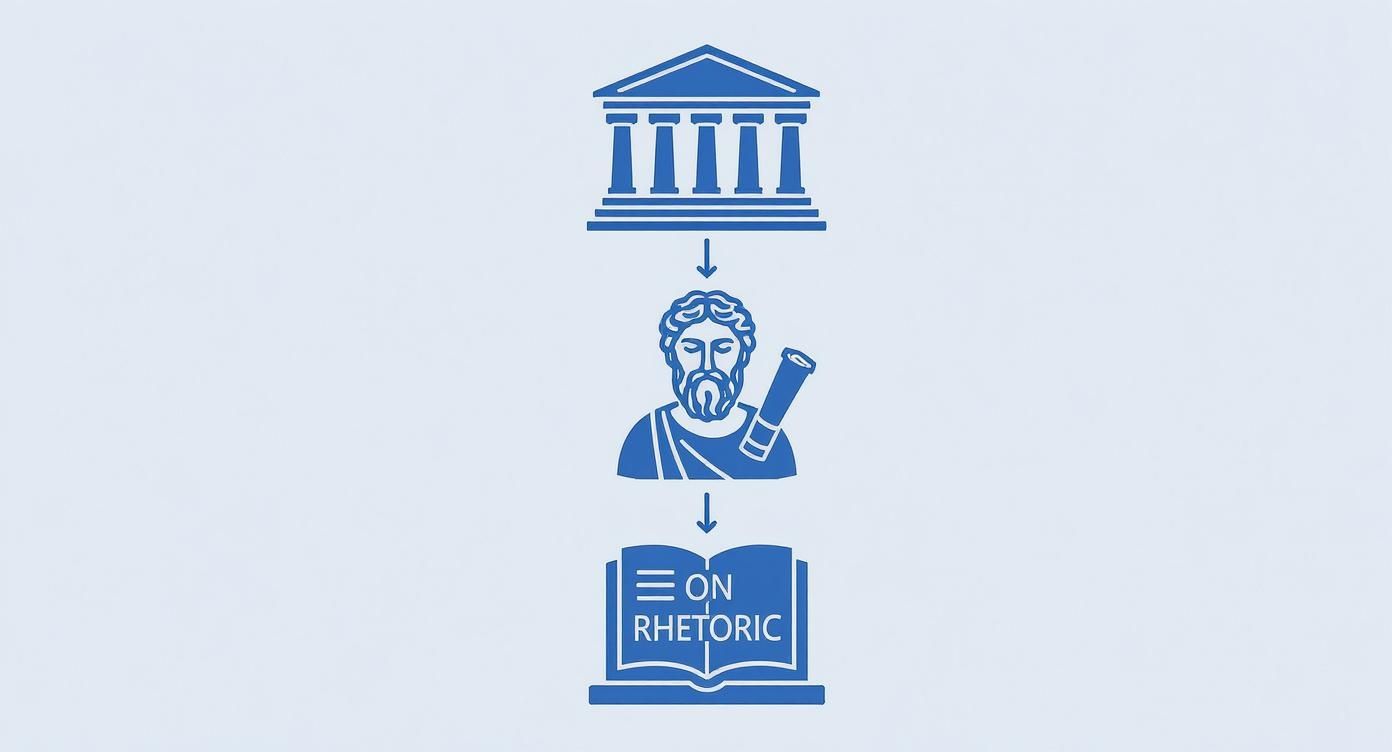
This visual traces a direct line from the philosophical environment of ancient Greece to Aristotle's foundational work, highlighting his central role in defining these concepts.
Pathos: Connecting Through Emotion
While ethos builds trust, pathos forges an emotional connection. This is your appeal to the reader's feelings, values, and beliefs. A message without pathos can feel cold and distant, even if it’s perfectly logical.
Pathos is the engine of engagement. It’s what makes a reader care. You can tap into it by using:
- Storytelling: Narratives and anecdotes create empathy, making abstract ideas feel personal and real.
- Vivid Language: Sensory details and powerful word choices can paint a picture that triggers an emotional response.
- Relatable Examples: Show how your topic affects people in situations your audience can easily understand.
Think about a charity appeal. Instead of just listing statistics, they tell the story of a single person in need. That targeted use of pathos is far more likely to motivate a donation than a dry, factual report. It transforms a reader from a passive observer into an engaged participant.
To get a better feel for this, you can explore a full range of persuasive writing techniques.
Logos: Appealing to Logic and Reason
Finally, logos is the appeal to logic. It’s the solid, rational backbone of your argument, built on clear reasoning and undeniable evidence. If ethos is your credibility and pathos is your emotional hook, logos is the proof that makes your case airtight.
A strong logical appeal leaves little room for doubt. To build it, you should:
- Use Facts and Statistics: Hard data provides concrete, undeniable support for your claims.
- Structure Arguments Clearly: Present your points in a logical sequence that’s easy for the reader to follow.
- Provide Solid Evidence: Use case studies, research findings, and direct quotes to validate your position.
Think of a lawyer in a courtroom. They don’t just claim their client is innocent; they present a timeline, DNA evidence, and witness testimony. This systematic presentation of facts is logos in action, constructing an argument that is not just persuasive but logically compelling.
A good way to remember how each appeal functions is to see them side-by-side.
Comparing Ethos, Pathos, and Logos
This table offers a comparative look at the three rhetorical appeals to help you understand when and how to use each one effectively.
| Appeal | Focus | How It Works | When to Use It |
|---|---|---|---|
| Ethos | Credibility & Trust | By establishing the author's authority, expertise, and good character. | When you need the audience to trust your judgment or believe your information. |
| Pathos | Emotion & Values | By creating an emotional response (e.g., empathy, anger, joy). | When you want to motivate the audience to take action or care about an issue. |
| Logos | Logic & Reason | By using facts, statistics, evidence, and a clear, well-structured argument. | When you need to prove a point or convince a skeptical or analytical audience. |
Understanding these distinctions allows you to choose the right tool for the job. Sometimes a logical argument is all you need, but other times, an emotional story will be far more effective.
The most effective writing doesn't rely on just one appeal. It masterfully weaves all three together, creating a message that is credible (Ethos), emotionally resonant (Pathos), and logically sound (Logos).
By understanding and balancing these three pillars, you gain precise control over your message. You can decide when to build authority, when to stir emotion, and when to present irrefutable facts, turning your writing into a powerful tool of persuasion.
Unlocking Your Toolkit of Rhetorical Devices
Once you’ve got a handle on the big three—ethos, pathos, and logos—it’s time to drill down into the fun stuff: rhetorical devices. These are the specific, tactical tools that give your writing its punch.
If the appeals are your game plan, think of rhetorical devices as the individual plays you call to move the ball down the field. They’re the secret ingredients that make a sentence stick in someone's head long after they've finished reading.
Strategies Versus Devices: What's the Difference?
Before we dive in, let’s clear something up. A rhetorical strategy is your overall approach, while a device is the specific tool you use to pull it off.
- Strategy: You want to make a complex idea easier to grasp by comparing it to something familiar.
- Device: You use an analogy or a metaphor.
It’s like building a house. Your strategy is to create an open, airy feeling. The devices are the specific choices you make—large windows, light paint, vaulted ceilings—to bring that feeling to life.
A rhetorical device is a precise technique that uses words in a specific way to create a desired effect. Mastering these tools gives you granular control over your writing's tone, rhythm, and persuasive power.
Let's unpack a few of the most common and effective devices you can start using right away.
Creating Vivid Comparisons with Analogy and Metaphor
Our brains are wired to learn by connecting new ideas to things we already understand. That’s what makes analogies and metaphors so powerful. They build instant bridges for your reader, turning abstract concepts into something tangible.
An analogy explains one thing by comparing it to another, often to clarify a process or relationship.
- Example: "Explaining a joke is like dissecting a frog. You understand it better, but the frog dies in the process." – E.B. White
- Impact: This perfectly captures why overanalyzing humor kills it. The familiar (and slightly grim) image of a dissection makes an abstract idea instantly clear.
A metaphor is more direct. It states that one thing is another thing, creating a poetic and often emotional connection.
- Example: "All the world's a stage, and all the men and women merely players." – William Shakespeare
- Impact: This isn't just a comparison; it’s a complete reframing of life itself. It packs a massive philosophical idea into a single, unforgettable line.
Amplifying Your Point with Hyperbole
Hyperbole is just a fancy word for intentional exaggeration. You don't mean it literally; you're just turning up the volume to make a point or get a laugh. It’s a great way to grab attention.
- Example (Marketing): "Red Bull gives you wings."
- Impact: Nobody expects to actually sprout wings. But the hyperbole creates a potent, memorable link between the drink and feelings of energy, freedom, and empowerment.
Use it sparingly. A well-placed exaggeration can jolt a reader to attention, but overdo it and you’ll just sound insincere.
Engaging the Reader with Rhetorical Questions
A rhetorical question isn’t asked to get an answer. It’s asked to make a point and get the reader thinking. It’s a simple trick that pulls your audience into the conversation, making them feel like active participants.
When you ask something like, "Can we really afford to ignore this problem any longer?" you’re not waiting for a response. You're nudging the reader to silently agree with the obvious answer: of course we can't.
Rhetorical questions work because they:
- Create a feeling of shared understanding.
- Guide the reader toward your conclusion.
- Make your argument feel like their own discovery.
Creating Rhythm and Structure with Parallelism
Parallelism is about creating balance by using a similar grammatical structure for a series of words, phrases, or clauses. It feels incredibly satisfying to the human brain and makes your ideas clear, rhythmic, and easy to remember.
- Example: "We shall pay any price, bear any burden, meet any hardship, support any friend, oppose any foe..." – John F. Kennedy
- Impact: The repeated "…any [noun]" structure creates a powerful, relentless rhythm. It hammers home the feeling of unwavering commitment and makes the entire line sound epic and definitive.
Among your toolkit of rhetorical devices, understanding "what is a Call to Action (CTA)" is essential for guiding your audience to the next step. A CTA often uses parallelism to create a clear, compelling instruction, such as "Sign Up, Start Exploring, and See the Difference." This structured phrasing makes the action feel simple and logical. By learning to use these devices consciously, you transform your writing from a simple transfer of information into a carefully crafted experience for your reader.
Seeing Rhetoric in Action Across Different Fields
Rhetoric isn’t some dusty concept locked away in a philosophy textbook. It’s a living, breathing tool that quietly shapes the world around us—from the dry precision of a scientific journal to the snappy copy in a social media ad.
Once you know what you're looking for, you start seeing it everywhere. By pulling apart real-world examples, we can move past the abstract theory and see how these techniques actually work. Let’s look at how academic, marketing, and creative writers all use rhetoric to hit completely different targets.
Rhetoric in Academic Writing
Academic writing might seem like the last place for persuasive art, but it’s packed with rhetoric. The entire goal is to convince a highly skeptical audience that a study is both valid and important. To do that, writers lean heavily on Ethos (their credibility) and Logos (their logic).
Just look at the abstract of any scientific paper. It's a masterclass in precision.
- Building Ethos: The writer immediately signals expertise by using formal language, citing existing research, and laying out a clear methodology. This isn't just jargon; it's a way of saying, "I'm a professional, and I've followed the rules."
- Constructing with Logos: The abstract follows a deliberate, logical path: here's the problem, here's how we studied it, here's what we found, and here's what it means. Each sentence is a brick in a carefully built argument.
In academia, rhetoric isn't about flair. It's about building an airtight case. The persuasive power comes from the sheer weight of the evidence and the projection of scholarly authority.
It’s persuasion through proof and professionalism, all designed to convince other experts that the research is sound and deserves a place in the conversation.
Rhetoric in Marketing and Advertising
If academic writing is a temple to Ethos and Logos, then marketing is the kingdom of Pathos. The goal isn’t just to inform someone; it’s to spark a desire that leads to action. Marketers know we often make decisions with our hearts and justify them with our heads later.
Think about a typical ad for a luxury car. It follows a classic formula:
- The Emotional Hook (Pathos): The ad won't start with horsepower specs. It opens with a feeling: a shot of the car gliding down a breathtaking coastal highway, driven by someone who looks happy and successful. It’s selling freedom, status, and joy.
- The Logical Justification (Logos): After you’re hooked on the feeling, the ad will slide in the features—"advanced safety systems," "best-in-class fuel efficiency." These facts give your brain the permission it needs to want the car.
- The Implied Credibility (Ethos): The brand’s strong reputation, the high-quality cinematography, or even a celebrity endorsement all work to build trust. You’re not just buying a car; you’re buying into a brand you can rely on.
This blend is incredibly potent. Pathos creates the want, Logos provides the reason, and Ethos seals the deal with a sense of security.
Rhetoric in Creative Writing
In novels and poetry, rhetoric is all about pulling the reader into another world. Writers are masters of using rhetorical devices to make their stories feel real and their characters’ struggles hit home. The whole thing is an exercise in applied pathos.
A novelist doesn't just write, "The character was sad." That’s telling, not showing. Instead, they use rhetoric to make the reader feel the sadness.
- Metaphor: "A curtain of grief fell over him." This creates a far more tangible image than a simple description.
- Imagery: "The rain traced lonely tracks down the cold windowpane, mirroring the single tear that escaped her eye." This uses sensory details to dial in a specific mood.
- Personification: "The old house groaned under the weight of his sorrow." Giving human qualities to an object amplifies the emotional atmosphere.
These devices weave together a world that feels emotionally true, forging a powerful connection between the reader and the characters. The persuasion here isn't about a product or a scientific claim; it’s about getting you to believe in the reality of the story and invest in its outcome.
By the 20th century, the study of rhetoric had expanded to recognize its role in nearly all communication. It's now understood that almost 100% of human discourse involves these persuasive elements. You can read more about this evolution on Britannica.com.
A Practical Framework for Your Writing Process
https://www.youtube.com/embed/abEDdhZLf2A
Knowing the theory behind rhetoric is one thing. Actually weaving it into your work is where the real magic happens. Getting from theory to practice takes a clear, repeatable process, so let’s break down how to build a rhetorical mindset into every stage of your writing.
Think of this less as a rigid set of rules and more as a mental checklist. Each step builds on the last, making sure your final piece isn’t just well-written, but built for impact.
Phase 1: Define Your Rhetorical Situation
Before a single word hits the page, you have to map out your rhetorical situation. This first step is all about asking the right questions to figure out your mission. Without this clarity, your writing is just aimless.
Start by nailing down these core elements:
- Audience: Who are you really writing for? Go beyond basic demographics. What do they already know? What do they value, what are their pain points, and what do they expect from you?
- Purpose: What's your primary goal here? Are you trying to inform, persuade, entertain, or get someone to do something? Be specific. "Convince skeptical managers to approve a budget increase" is a much better goal than just "be persuasive."
- Context: Where and when will someone read this? Is it a formal report, a casual blog post, or a quick email? The context shapes everything from your tone to your word choice.
Answering these questions first keeps you from writing in a vacuum. It forces you to be reader-centric from the get-go.
Phase 2: Select Your Persuasive Appeals
Once your situation is defined, you can strategically choose your blend of persuasive appeals—Ethos, Pathos, and Logos. The right mix depends entirely on the audience and purpose you just identified.
For example, if you're writing a technical guide for experts, you’ll lean heavily on Logos (clear data, logical steps) and Ethos (showing you know your stuff). Pathos might be minimal. But if you're crafting a fundraising email, Pathos (emotional stories, value-driven language) takes the lead, supported by Logos (stats on impact) and Ethos (your organization’s credibility). For more on this, our article on how to write a persuasive essay offers great examples of balancing these appeals.
A common mistake is leaning too hard on just one appeal. An argument based only on logic can feel cold. One based only on emotion can feel manipulative. A balanced approach is almost always the way to go.
Phase 3: Deploy Rhetorical Devices
Now it's time to get tactical. You'll choose the specific tools—the rhetorical devices—that bring your appeals to life. This is where you zoom in from broad strategy to sentence-level choices.
Based on your goals, you might pick:
- Analogies and metaphors to make complex ideas feel simple and relatable.
- Parallelism to give key sentences a memorable rhythm and a little punch.
- Rhetorical questions to get the reader engaged and guide their thinking.
- Hyperbole to add emphasis or a bit of humor to a marketing claim.
As writers bring AI into their workflow, the ability to guide these tools becomes a new rhetorical skill. In that sense, mastering the craft of effective writing prompts for ChatGPT is now a core part of a modern writer’s toolkit. Your prompt is the new rhetorical instruction.
Phase 4: Revise Through a Rhetorical Lens
Okay, your first draft is done. Now, the revision process is your chance to sharpen every rhetorical choice you made. Don't just check for grammar and spelling; try to read your work from your audience's perspective.
Ask yourself these critical questions as you edit:
- Credibility Check (Ethos): Have I given the reader a reason to trust me? Is my tone confident and professional?
- Emotional Check (Pathos): Does this connect with my reader's values or feelings? Is the story I'm telling actually compelling?
- Logic Check (Logos): Is my argument clear, well-supported, and easy to follow? Are there any obvious gaps in my reasoning?
- Device Check: Are my rhetorical devices doing their job, or do they just feel forced and awkward?
This final, deliberate review is what turns a decent draft into a powerful piece of communication. It ensures every single word is working toward your ultimate purpose.
Ready to ensure your AI-assisted drafts sound authentically human? Natural Write instantly refines robotic text, enhances clarity, and helps your writing bypass AI detection with a single click. Polish your work with confidence and precision. Humanize your content for free at https://naturalwrite.com.