

Analytical writing is all about taking a topic, pulling it apart to see the pieces, and then explaining how and why those pieces fit together. It’s not about just listing facts; it’s about interpreting them to build a solid argument backed by evidence.
Beyond the Surface What Analytical Writing Really Means
Think of yourself as a detective, not just a reporter.
A reporter simply states the facts: "Company sales fell by 15% last quarter." An analytical writer, the detective, digs deeper to uncover the story behind the numbers: "The 15% sales decline is a direct result of a major shift in consumer behavior, which coincided with two new competitors entering the market."

The real goal is to get past simple description and offer an interpretation or conclusion. You’re answering the "So what?" question for your reader, giving them a reason to care about the information you’ve presented.
Understanding the Core Function
Analytical writing is a critical skill, whether you’re in a university lecture hall or a corporate boardroom. It’s a structured way of thinking that helps you make sense of complex information. It really comes down to four key actions:
- Deconstruction: Breaking a big, complicated subject into its smaller, more digestible parts.
- Examination: Investigating how all those smaller parts relate to one another.
- Interpretation: Explaining what those relationships actually mean in the bigger picture.
- Argumentation: Building a clear, evidence-based claim (your thesis) and defending it with logic.
This skill isn’t new; it’s long been a cornerstone of higher education. Its importance was officially cemented when the GRE introduced its Analytical Writing section back in 1994, which still tests students' ability to 'Analyze an Issue' and 'Analyze an Argument' on a 6-point scale. If you're curious, you can find more on writing styles from this academic guide by the University of Reading.
Good analysis explains how something works, not just that it works. It reveals the engine's inner mechanics rather than simply stating that the car moves forward.
How It Differs From Other Writing
It’s easy to mix up analytical writing with other styles, so let's clear that up.
Descriptive writing just states what is. It paints a picture with facts but doesn't dig into their meaning. Critical writing, on the other hand, takes things a step further by evaluating or judging the subject—is it good, bad, effective, or flawed?
Analytical writing sits right in the middle. It’s all about explaining the 'how' and 'why' without necessarily passing judgment. For instance, you could analyze a marketing campaign’s structure and its impact on audience engagement without arguing whether the campaign was ultimately "good" or "bad."
To make this even clearer, here’s a quick breakdown of the key differences.
Key Differences In Writing Styles At A Glance
| Writing Style | Primary Goal | Core Question It Answers |
|---|---|---|
| Descriptive | To inform and present facts. | What happened? What is it? |
| Analytical | To explain and interpret relationships. | How and why does it work? |
| Critical | To evaluate and judge effectiveness or quality. | Is it good or bad? Is it effective? |
As you can see, each style serves a different purpose. Analytical writing forms the foundation for good critical writing, but it stops short of making a final judgment call.
If you’re interested in taking that next step into evaluation, check out our guide on how to write a critical analysis, which builds directly on the skills we’re covering here.
The Building Blocks of Powerful Analysis
A strong piece of analytical writing is a lot like a well-built house. It needs distinct, sturdy parts all working together. Without these essential pillars, even the most brilliant ideas can fall flat. If you want to construct a powerful, convincing analysis every time, you have to start by understanding these building blocks.

Think of these components as a reliable blueprint you can follow for any analytical task, whether you're writing a single paragraph or a ten-page report.
The Thesis: Your Foundational Claim
The thesis statement is the single most important sentence you'll write. It's the foundation of your entire structure—the one clear, specific, and debatable claim that your whole analysis is designed to support. It isn’t a fact or a simple observation; it’s your unique interpretation.
A weak thesis is generic and obvious, like saying, "The industrial revolution was important." A strong one is specific and gives you something to prove: "The industrial revolution's impact was most significant not in its technological advancements, but in its restructuring of the nuclear family." That’s a claim you can really dig into.
Evidence: Your Raw Materials
If the thesis is your foundation, evidence is the brick, steel, and wood you use to build your argument. This is the raw, factual information that shows your thesis holds up. Evidence can come in many shapes and sizes:
- Data and Statistics: Hard numbers that show trends or scale.
- Direct Quotes: Specific lines from a text that back up your reading of it.
- Historical Facts: Established events that give your argument context.
- Case Studies: Concrete examples that prove a broader point.
But just dropping facts into your paragraphs won't cut it. Evidence without explanation is just a pile of materials sitting on a construction site. And that’s where the real magic happens.
Analysis: The Mortar Holding It Together
Analysis is the intellectual work—it’s you connecting the evidence back to your thesis. It’s the mortar binding the bricks together, explaining how and why a piece of evidence supports your main claim. This is where you answer the "So what?" question for your reader.
For every piece of evidence you use, you have to explain its significance. You’re breaking down complex ideas to show the reader your thought process. This skill is critical everywhere, especially in fields like education, where tasks like writing effective lesson objectives require you to explain the why behind the what.
The core of all analytical writing lies in interpretation. It's not about what the evidence is, but what the evidence means. Good analysis transforms raw data into a compelling argument.
Structure and Tone: Your Architectural Design
Finally, your structure and tone are the architectural design—they determine how the final piece looks and feels. A logical structure guides your reader smoothly from one point to the next. Each paragraph should build on the last, led by a clear topic sentence. If you want to nail this, our guide on crafting strong topic sentences for body paragraphs is a great place to start.
Your tone should be objective, formal, and confident. Steer clear of emotional language or personal feelings ("I feel," "I believe"). Instead, frame your analysis as a logical conclusion drawn from the evidence. This creates a voice of authority that readers will trust.
How Analytical Skills Drive Real-World Success
Getting good at analytical writing isn’t just about acing your next exam—it’s about building a skill that universities and employers are desperate to find. In school, it’s what separates a student who can only repeat facts from one who can build a powerful argument and earn top marks.
But the real magic happens when you see how this skill translates directly into a successful career.
It’s the engine behind so many promotions and breakthroughs. Think about a marketer who does more than just dump campaign data into a report. Instead, they deliver an analysis explaining why certain ads worked, connecting audience behavior to specific creative choices, and laying out a data-backed strategy for the next quarter. That’s a game-changer.
Or picture a consultant who doesn't just hand over a generic list of services. By analyzing a client’s biggest operational headaches, they can show exactly how each proposed solution solves a specific pain point, making their pitch incredibly persuasive.
From the Classroom to the Corner Office
The link between sharp analytical writing and academic success is undeniable. It's the hallmark of top-tier students because it forces them to connect the dots and explore what the evidence actually means, not just spit it back out.
For instance, a huge 2021 meta-analysis covering over 150,000 students found that skill in analytical writing was a major predictor of a higher overall GPA. It showed a much stronger correlation than descriptive writing ever could. What this tells us is that the ability to interpret and explain complex information is a clear sign of academic achievement.
And this is precisely what businesses are looking for. Employers need problem-solvers, and you can’t solve a problem until you’ve properly analyzed it.
"The ability to analyze a situation, identify the core issue, and communicate a logical solution is invaluable. It’s the difference between an employee who follows instructions and one who drives innovation and growth."
Real-World Applications Across Industries
Strong analytical writing opens doors everywhere. The core principles—breaking down information, finding the signal in the noise, and presenting a logical conclusion—are universal, no matter what field you're in.
Here are just a few examples of how this plays out on the job:
- Financial Analysts don't just report stock prices. They write reports analyzing market trends, competitor moves, and economic signals to justify their "buy" or "sell" calls.
- Healthcare Administrators analyze patient data to spot bottlenecks in hospital workflows, proposing evidence-based changes to improve patient care and cut costs.
- Software Engineers write technical documents that break down a system's architecture, explaining how all the pieces fit together so other developers can maintain and improve the code.
For anyone looking to formalize these skills, a business analysis certification can be a powerful step toward building a career on strategic thinking.
At the end of the day, analytical writing isn't some niche academic exercise. It’s a fundamental skill for making smart, informed decisions in any professional context.
A Step-by-Step Guide to Writing an Analysis
Knowing the theory is one thing, but actually doing it is how you build confidence. Staring down an analytical writing task can feel intimidating, but breaking it down into a structured process makes it so much more manageable. Think of this as your roadmap.
Instead of just telling you what to do, I'm going to show you how. Follow these steps, and you'll move from a blank page to a polished, persuasive analysis much more smoothly.
Step 1: Unpack the Question
Before you write a single word, you have to be absolutely certain you understand the assignment. So many weak analyses start with a simple misreading of the prompt. Take a minute to pull the question apart. What are the key verbs and concepts?
Are you being asked to "examine," "compare," "evaluate," or "interpret"? Each of those words signals a different kind of task. Getting this crystal clear from the jump ensures your entire analysis stays on track and actually answers the question.
Step 2: Gather Your Evidence
Okay, now that you know your mission, it's time to gather your raw materials. This is the fact-finding stage—the part where you collect the data, quotes, stats, or examples you'll need. Think of yourself as a detective building a case file.
Your goal isn't just to hoard information. You're looking for specific pieces of evidence that will anchor your argument. Keep an eye out for patterns, interesting connections, or even contradictions in what you find. And as you go, make sure you document everything correctly. Knowing how to cite sources in a research paper from the start will save you a massive headache later on.
Step 3: Develop a Working Thesis
With your evidence in front of you, it's time to form your central claim. A working thesis is basically your first-draft answer to the main question. It doesn’t have to be perfect yet, but it does need to be a specific, debatable statement you can build on.
For instance, a working thesis might be: "The new marketing campaign flopped because it targeted the wrong demographic." That's a clear, arguable point that gives you a direction for the rest of your paper.
A strong thesis is the backbone of your analysis. It's the one central idea that all your evidence and arguments must logically support from beginning to end.
Step 4: Outline Your Argument
Seriously, don't skip the outline. This is where you organize your thoughts and build the logical skeleton of your paper. A simple outline is all you need: an intro, your main body paragraphs (each with a key point and supporting evidence), and a conclusion.
Each point in your outline acts like a mini-argument that helps prove your main thesis. This step keeps your writing focused, ensures a logical flow, and saves you from getting lost in the weeds when you start drafting.
Step 5: Write Your First Draft
Your outline is your guide, so now it's time to just write. The goal here is to get your ideas down on the page. Don't stress about perfect wording or grammar—that comes later. Just focus on explaining your analysis.
For each body paragraph, state your point, present your evidence, and then—this is the most important part—explain why that evidence proves your point. Keep asking yourself, "So what?" That question forces you to move beyond simply describing something and into the realm of true analysis.
Step 6: Revise for Clarity and Impact
No one’s first draft is their final draft. Revision is where the magic happens. This is your chance to sharpen your arguments, clean up your language, and make sure everything flows. I always recommend reading your work aloud; it’s the fastest way to catch awkward phrasing and check for a confident tone.
Make sure every single sentence has a job to do. Your goal is to make your analysis clear, concise, and compelling. This is how you take a good draft and turn it into something great.
Common Analytical Writing Mistakes to Avoid
Even seasoned writers can fall into a few common traps that weaken their analysis. But once you know what they are, you can sidestep them and start crafting arguments with more precision and authority. Getting this right is what makes your writing clear, logical, and ultimately, persuasive.
The most frequent mistake? Summarizing instead of analyzing. A summary just repeats the facts: "The report shows a 10% decrease in engagement." Analysis, on the other hand, tells you what it means: "This 10% decrease correlates directly with the new algorithm, suggesting our content strategy is no longer effective." Always ask yourself, "So what?" That’s the question that pushes you past description and into genuine insight.
Another classic pitfall is dropping evidence into your text without connecting it back to your thesis. It’s like presenting a puzzle piece without showing where it fits. You can’t just throw in a quote or a statistic and move on, leaving your reader to guess why it matters. You have to be the guide, explicitly explaining how and why each piece of evidence backs up your main claim.
This whole process—from forming a question to drafting and refining—is a core part of the analytical workflow.
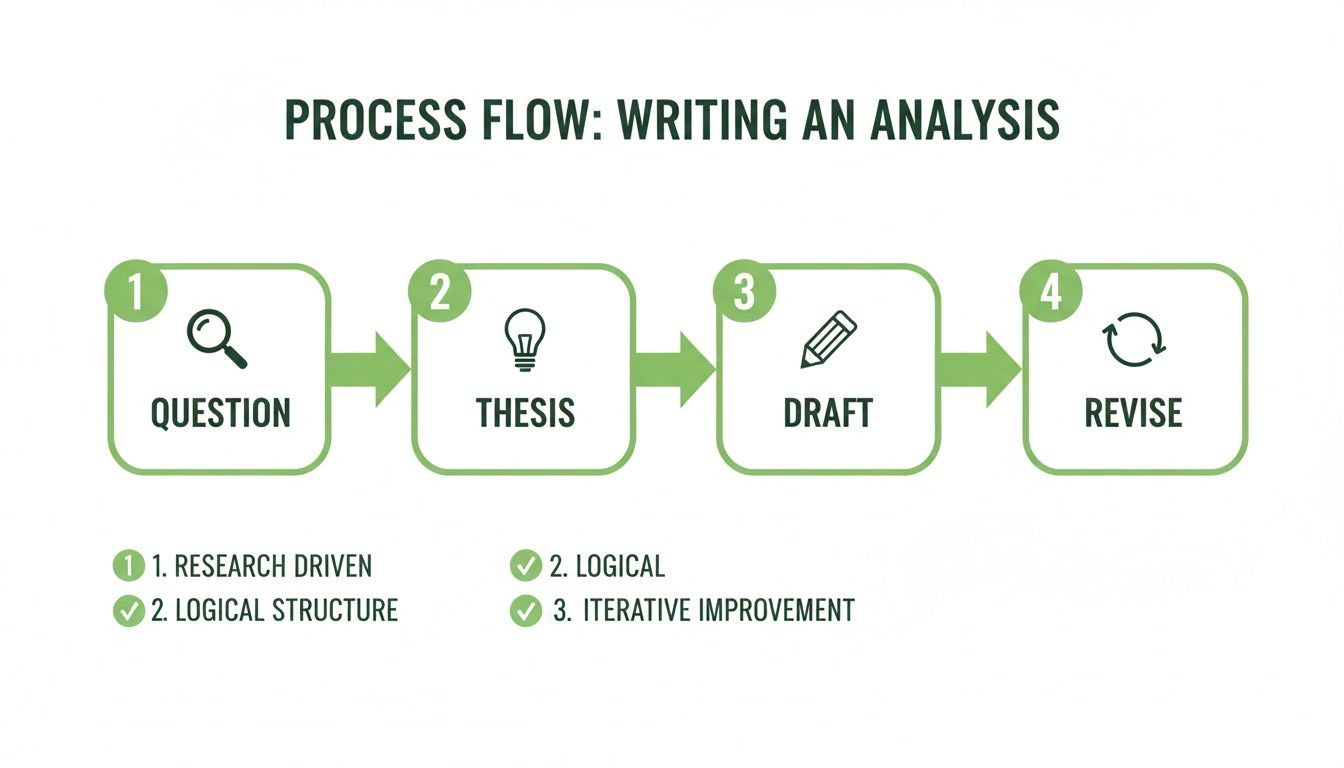
As you can see, analysis isn’t just one action but a cycle. Revising your work is just as critical as writing the first draft—it’s where you really sharpen your points.
Weak Foundations and Flawed Tone
A weak or vague thesis statement will sink your paper before it even sets sail. An argument built on a flimsy foundation like, "Technology has changed society," is just too broad to prove anything. It goes nowhere.
A strong thesis, however, makes a specific, debatable claim: "The adoption of smartphones has fundamentally altered interpersonal communication by prioritizing brevity over depth." Now that gives your writing a clear direction and a focused purpose.
Finally, getting the tone wrong can seriously damage your credibility. Analytical writing should feel objective and confident. You want to avoid overly emotional language or personal opinions phrased as "I feel" or "I believe." Instead, let the evidence do the talking and build your conclusions on that, not on gut feelings.
Key Takeaway: The strongest analytical writing avoids summary, explains all evidence, rests on a specific thesis, and maintains an objective tone.
In today's world, these skills matter more than ever. With the rise of AI writing tools, the value of true human analysis has become crystal clear. One study revealed a pretty stunning difference: raw text from ChatGPT was flagged as AI-written 96% of the time. But when that same text was refined with a solid analytical structure—a strong thesis, clear evidence, and "why/how" explanations—the detection rate dropped to just 4%. You can learn more about these findings by exploring how analytical structure impacts AI detection.
A Few Common Questions About Analytical Writing
As you get the hang of analytical writing, a few questions almost always come up. It's totally normal. Think of this as a quick FAQ to clear up any lingering confusion and sharpen the skills we’ve covered. Nailing these distinctions is what separates good analysis from great analysis.
We'll keep these answers short and to the point, giving you the clarity you need to dive into your next analytical task with confidence.
What’s the Real Difference Between Analytical and Critical Writing?
This is a big one. While they're definitely related, the key difference comes down to their ultimate goal.
Analytical writing is all about taking something apart to explain how it works. Imagine you’re a mechanic taking apart an engine. You’re not judging it; you’re just showing someone how the pistons, gears, and cylinders all fit together to make the car go. You're explaining the system.
Critical writing takes that a step further. It uses the analysis to evaluate the thing's quality or effectiveness. In our engine analogy, a critical take would be judging whether that engine is efficient, poorly designed, or a masterpiece of engineering. Analysis is about understanding; criticism is about judgment.
Can I Use "I" in Analytical Writing?
In most academic or professional settings, the answer is a firm no.
Using phrases like "I think" or "I believe" can accidentally weaken your argument. It frames your conclusion as just a personal opinion instead of a conclusion backed by evidence. The whole point is to sound objective and authoritative.
Let your evidence do the talking. Instead of writing, “I think the data shows a significant trend,” just state, “The data reveals a significant trend.” It’s a small change, but it shifts the tone from a personal feeling to a factual finding. That’s how you build credibility.
Strong analytical writing presents interpretations as logical conclusions that flow from the evidence, not as personal feelings. This objectivity is what makes your argument persuasive.
How Can I Get Better at This... Fast?
Real improvement comes from practice. There’s no shortcut, but you don't have to write a 10-page paper every time you want to get better. The key is consistent, focused effort.
Here are a few things you can start doing right now:
- Read Like a Writer: When you read an article or a report, don't just consume it. Actively hunt for the author's thesis. Pinpoint the evidence they use and, most importantly, track how they connect that evidence back to their main argument.
- Practice in Paragraphs: You don’t need to write a whole essay. Just take one quote, one statistic, or one small idea and write a single, solid paragraph explaining its significance. This builds the core muscle of analysis without being overwhelming.
- Always Ask "So What?": This is the single most powerful question you can ask. Every time you present a piece of evidence, stop and ask yourself, “So what?” and “Why does this matter?” Answering those two questions is what forces you to move past just describing something and into genuine analysis.
Turn these into regular habits, and you'll see a huge improvement in how you think and write.
Ready to turn your AI drafts into polished, human-sounding text? Natural Write is a free tool that refines your writing for clarity and impact, making sure it gets past all major AI detectors. Perfect your essays and reports with a single click. Try it now at https://naturalwrite.com.