
To outline a research paper, you start by nailing down a clear thesis statement. From there, you break it down into the main arguments you'll use to prove that thesis, and finally, you slot in the specific evidence you've gathered to back up each point. Think of this process as creating a strategic blueprint—it guarantees your paper will be logical, coherent, and well-supported before you even start writing full paragraphs.
The Blueprint for a Better Research Paper

Before you write a single sentence, you need a plan. Your outline is the architectural foundation for your entire paper. It's so much more than a simple to-do list; it’s the strategic framework that turns a huge, intimidating project into a series of manageable, logical steps.
A solid outline is what ensures every argument connects, your evidence is placed where it will have the most impact, and your narrative flows smoothly from introduction to conclusion without getting sidetracked.
It's tempting to skip this step. Many students do, eager to just dive into the writing. But that’s a classic mistake that often leads to writer's block and messy, disorganized drafts. The real magic of an outline is how it forces you to clarify your own thinking. By mapping out your ideas first, you can spot logical gaps or find areas where you need more evidence—long before you’ve sunk hours into writing yourself into a corner.
The Proven Impact of Outlining
The benefits here aren't just a matter of opinion; the data backs it up. A 2018 survey involving over 5,000 university students found that those who created detailed outlines finished their papers 35% faster on average. Even better, they scored grades 22% higher than their peers who skipped outlining.
In fact, 78% of high-achieving undergraduates said they rely on outlines as their main planning tool. It's a clear indicator of how important this step is for academic success. You can see more on global trends in research and education to understand the bigger picture.
There are some big psychological wins here, too. Staring at a blank page is daunting for anyone. An outline gives you a clear, actionable roadmap, breaking down the massive task of "writing a research paper" into smaller, less scary goals. This alone can cut down on anxiety and help you build momentum.
An outline is your first line of defense against a rambling, unfocused paper. It forces you to prove your argument to yourself before you try to prove it to your professor.
Your Guide to Academic Integrity
Today, with AI tools that can spit out ideas in seconds, a human-refined outline is more critical than ever. It becomes your unique intellectual fingerprint on the project. This ensures the final paper is a true reflection of your own critical thinking and sounds genuinely authentic.
Taking the time to build a strong outline is fundamental for maintaining academic integrity and producing a final draft that truly showcases your analysis and perspective. By following these core principles, you’re setting yourself up for a much smoother, more successful writing journey. For a deeper dive, you can also check out our comprehensive guidelines for writing a research paper for more tips.
Building Your Outline from the Ground Up
Every great research paper starts with a single, powerful idea. That idea is your thesis statement. Think of it as the North Star for your entire project—a clear, declarative sentence that crystallizes the core argument you’re going to prove.
Before you even think about sections or sub-points, you have to nail this down. A vague idea like "Social media affects teenagers" just won't cut it. A real thesis has teeth: "The daily use of image-based social media platforms correlates with a significant increase in body dissatisfaction among teenage girls aged 14-17." Now that's an argument you can build a paper around.
From Thesis to Main Arguments
With a solid thesis in hand, you can start building the main pillars that will support it. What are the 2-4 major points you absolutely must prove to convince a skeptical reader that your thesis is true? These will become the main sections of your paper.
Let's stick with our social media example. The core arguments to support that thesis might look something like this:
- The psychological impact of curated online personas.
- Direct evidence linking platform usage time to negative self-perception.
- A comparative analysis of image-based versus text-based platforms.
Suddenly, a daunting research paper becomes a series of smaller, more manageable arguments. You've just created a logical roadmap that guides your reader straight from your initial claim to your final conclusion.
Your outline’s main sections are essentially mini-theses. Each one makes a smaller claim that, when combined with the others, logically proves your main thesis statement.
Fleshing Out the Details with Evidence
Now it’s time to get granular. Under each of those main arguments, you'll start slotting in the evidence—the specific data, examples, key studies, and citations you’ve collected. This is where your abstract ideas connect with hard facts.
As you do this, you'll need to decide on a format. Most writers lean toward one of two styles:
- Topic Outline: This uses short phrases and keywords. It's fast, flexible, and perfect for the early brainstorming phase. (e.g., "Anxiety correlation - Smith 2021 study").
- Sentence Outline: This uses complete sentences for every point. It takes more upfront effort but forces you to clarify your thinking early on, which makes the actual writing process incredibly smooth. (e.g., "Smith's 2021 study revealed a 40% increase in anxiety symptoms for teens with daily platform use.").
For serious academic work, the sentence outline is almost always the better choice. It makes you do the heavy lifting of forming coherent thoughts before you're staring at a blank page. This upfront investment ensures your literature review, methodology, and discussion all work together seamlessly.
If you’re having trouble getting that initial anchor set, our guide on how to write a strong thesis statement is the perfect place to start.
Choosing the Right Outline for Your Paper
Let's be honest—not all research papers are cut from the same cloth. So why would their outlines be? Trying to force a theoretical argument into the rigid structure of an empirical study is a recipe for disaster. It just won’t work. The real secret to a strong paper is picking a structure that actually fits your research goal from the very beginning.
Every academic format, from a hard science lab report to a humanities literature review, has its own set of rules and reader expectations. When you choose the right blueprint before you start writing, you save yourself massive headaches down the road and give your ideas a logical path to follow.
This simple flowchart shows how a solid outline works. It all starts with your thesis, which then branches out into core arguments, each supported by specific, concrete evidence.
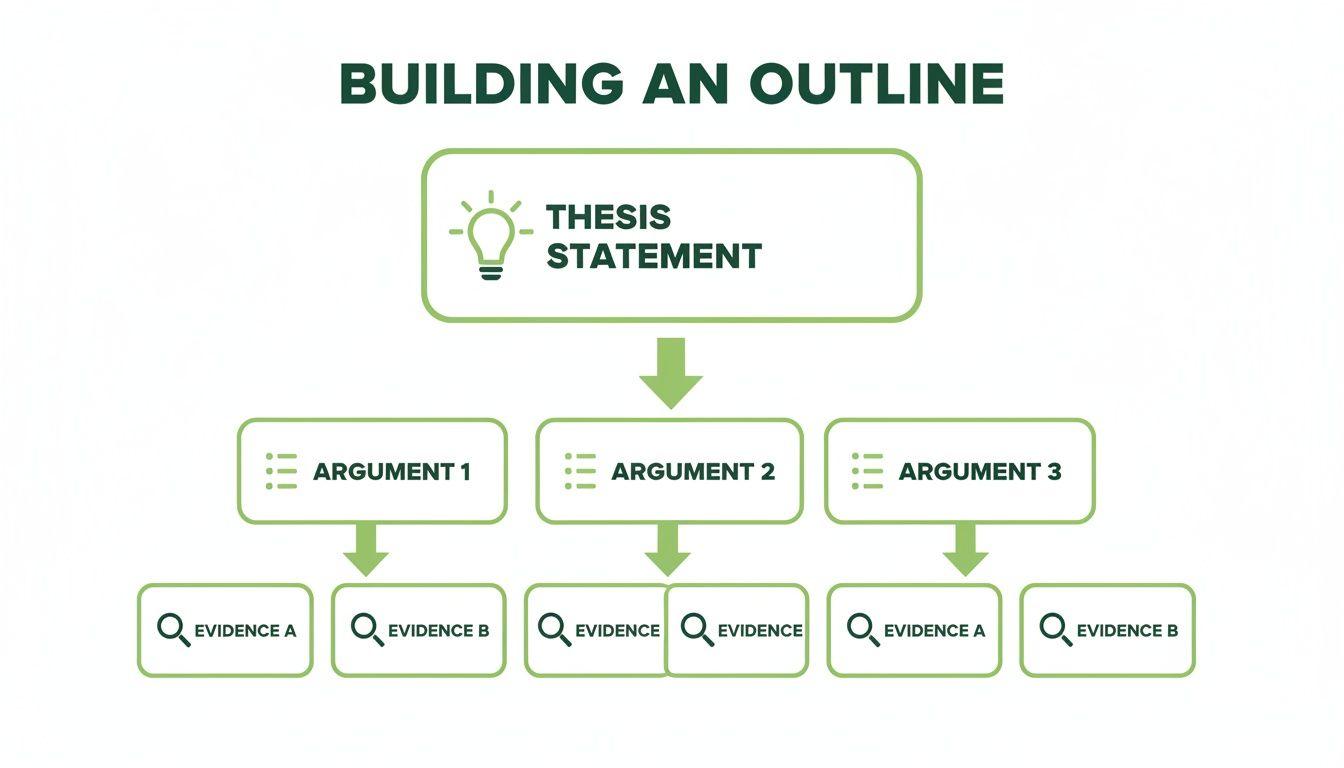
As you can see, every single point in your outline needs to connect back to and serve that main thesis. That’s how you build a powerful, cohesive argument.
Before we dive into the specifics of each type, this table gives you a quick side-by-side look at how the structures differ.
Comparison of Research Paper Outline Structures
| Section | IMRaD Paper (Empirical) | Literature Review Paper | Theoretical Paper |
|---|---|---|---|
| Introduction | States research question, hypothesis, and significance. | Defines the topic's scope and states the review's purpose or argument. | Presents the central thesis or new theoretical proposition. |
| Main Body | Methods: Details the study's design and procedure. Results: Presents objective data findings. |
Thematic Sections: Organizes existing research by common themes, debates, or methodologies. | Argumentative Sections: Builds a logical case, premise by premise, using existing literature as evidence. |
| Analysis | Discussion: Interprets the results, discusses implications, and notes limitations. | Synthesis & Analysis: Analyzes patterns, identifies gaps in the literature, and critiques existing work. | Synthesis & Implications: Connects logical premises to prove the thesis and explores the theory's impact. |
| Conclusion | Summarizes the study's key findings and suggests future research directions. | Summarizes the synthesis and proposes a new perspective or future avenues for inquiry. | Restates the theoretical argument and underscores its significance for the field. |
This comparison highlights why you can't just use a one-size-fits-all template. Now, let's break down when and how to use each of these structures.
The IMRaD Structure for Empirical Studies
Did you run an experiment, collect survey data, or conduct a statistical analysis? If you have original data, the IMRaD format is your best friend. It’s the universal standard in the sciences for a reason: it presents your work in a clear, linear way that makes it easy for others to understand, critique, and even replicate.
A proper IMRaD outline breaks down like this:
- Introduction: This is where you set the stage. What’s your research question and hypothesis? Give enough background so your reader understands why this study matters.
- Methods: Get specific. Describe exactly what you did, step-by-step. The goal here is transparency—another researcher should be able to read this and replicate your study precisely.
- Results: Stick to the facts. Present your findings objectively using clear language, tables, and figures. No interpretation or "what it means" commentary belongs here.
- Discussion: Now you get to interpret. What do your results actually mean? How do they fit into the bigger picture? Be sure to also acknowledge any limitations of your study.
This structure deliberately separates what you found (Results) from what you think it means (Discussion). This division is a cornerstone of scientific integrity.
A well-executed IMRaD outline isn't just about formatting; it's about presenting your original research with clarity and rigor. It gives your findings the credibility they need to be taken seriously.
The Thematic Approach for Literature Reviews
A great literature review is so much more than a book report that lists who wrote what and when. The real goal is to synthesize everything that's been said on a topic to identify patterns, point out gaps, or offer a completely new perspective. For that, a thematic outline is your most powerful tool.
Forget organizing your sources by author or publication date. Instead, you should be grouping them by:
- Common themes or concepts
- Recurring academic debates
- Different methodological approaches
This shifts your paper from a passive summary to an active, critical analysis. It shows you’re not just reading the material—you’re thinking about it.
A thematic outline might look something like this:
- Introduction: Define the topic and the scope of your review. What’s the central argument you’re building toward?
- Theme 1: Foundational Theories: Cover the core concepts and historical work that everyone in the field builds upon.
- Theme 2: Major Debates & Controversies: Analyze the main points of disagreement. Where do scholars clash?
- Theme 3: Emerging Trends & Gaps: What’s new? Highlight recent developments and, most importantly, identify what’s still missing from the conversation.
- Conclusion: Tie it all together. Summarize your synthesis and suggest specific directions for future research to fill those gaps you found.
The Argument-Driven Framework for Theoretical Papers
A theoretical paper isn't about new data; it’s about a new idea. You’re building a logical argument from the ground up to propose a new theory, critique an old one, or explore a familiar concept in an unfamiliar way. Because of this, your outline is your argument. Every section must build directly and logically on the one before it.
Think of your outline as a step-by-step proof you’re presenting to your reader.
- Introduction: State your central thesis or theoretical proposition clearly and confidently right from the start.
- Laying the Foundation: Define your key terms. You also need to introduce the existing theories you plan to challenge, build upon, or engage with.
- Constructing the Argument Part 1: Present your first major premise. Back it up with logical reasoning and evidence pulled from existing literature.
- Constructing the Argument Part 2: Introduce your next premise, explicitly showing how it connects to and builds upon the first one.
- Synthesis and Implications: This is the climax. Bring your premises together to show how they inevitably lead to your thesis. Then, zoom out and discuss the broader implications of your new theory.
- Conclusion: Restate your core argument and drive home its significance. Why does this new way of thinking matter?
Using AI to Brainstorm and Humanize Your Outline
Let's be honest, staring at a blank page is one of the most intimidating parts of writing a research paper. This is where AI tools can be a lifesaver, acting as an intelligent partner to get the ball rolling.
A simple prompt like, "Generate a topic outline for a research paper on [your thesis statement]," can spit out a functional structure in seconds. The goal here isn't to have the AI do the work for you. Think of it as getting a quick, basic sketch from a collaborator before you, the lead researcher, step in to add the real substance.
The raw output from an AI is just a starting point—a skeleton. It's often generic, predictable, and completely lacks the nuanced perspective and critical depth that your own research provides. Your job is to flesh it out with your unique insights and intellectual rigor.
From Robotic to Refined
The most important work begins after the AI gives you that first draft. The first thing I always do is check the logic. Does the flow of ideas actually make sense for my argument? Sometimes an AI will propose a standard, textbook structure when your research really demands something more creative or unconventional to make its point.
Next, you need to inject your own expertise. Go through the AI's suggestions point by point and ask yourself:
- What critical piece of evidence or data is missing here?
- How can I rewrite this section heading to be more specific to my argument?
- Where is the perfect spot to introduce a counterargument that the AI completely overlooked?
This is how you move beyond a generic template and start building an outline that truly represents your work. And if you're looking for different ways to generate ideas, exploring various AI content creation tools can give you a real edge.
Preserving Academic Integrity and Voice
Transforming a generic AI outline into something that’s genuinely yours is non-negotiable for academic integrity. This means swapping out robotic, placeholder phrases for the precise, academic language that reflects your own writing style and critical thinking.
This refinement isn't just about sounding better; it has a real impact. A longitudinal analysis of 2.5 million articles from 2010-2022 found that papers with well-structured outlines incorporating statistical data achieve 40% higher citation rates. Humanizing an AI draft helps you build that solid structure while ensuring your unique analysis shines through.
The Goal of AI in Outlining: Use AI to conquer the blank page and get a basic structure down. Then, take over completely to apply critical analysis, add your unique insights, and ensure the final blueprint is 100% your own intellectual work.
At the end of the day, AI is a research assistant, not the lead researcher. It can organize information, but you are the one who provides the narrative, the analysis, and the voice. If you're looking to make this crucial refinement process smoother, you can learn more about our AI humanizer tool to help polish your drafts.
Common Outlining Mistakes to Avoid

A flawed outline can quietly sabotage your research paper before you even type the first word of your draft. It’s often the root cause of disorganized arguments, logical gaps, and frustrating dead ends that send you back to the drawing board. Honestly, knowing what not to do is just as important as knowing what to do.
I've seen countless researchers fall into one of two traps. The first is being far too vague. You jot down one-word placeholders like "Background" or "Data," thinking you'll fill in the details later. The problem is, this offers zero real direction, leaving you to do all the heavy intellectual lifting during the already stressful drafting phase.
The second trap is the complete opposite: creating an outline so detailed and rigid it feels like a legal contract. While a solid structure is essential, treating your outline as an unchangeable set of rules can completely suffocate the discovery process. Some of your best insights will surface while you're writing, and a flexible plan is what allows you to weave them in seamlessly.
Finding the Right Balance
The sweet spot is a structure that gives you a clear roadmap without putting your ideas in a creative straitjacket. A classic error is creating an outline with poor logical flow, where points don't build on each other naturally. Even worse is when a point has no direct connection to your thesis statement. Every single entry in your outline should serve one primary purpose: to help prove your central argument.
Here are a few other all-too-common missteps to watch for:
- Putting way too much information in the outline. Remember, this isn't a first draft. Its job is to organize your ideas and arguments, not to house every single detail, quote, and citation.
- Completely forgetting who you're writing for. Your outline's structure must align with the conventions of your academic field and the specific expectations of your target journal or professor.
- Creating a lopsided, unbalanced structure. If one of your main sections has ten sub-points and another has only one, that’s a red flag. It usually means you need to rethink the weight and scope of your main arguments.
The Outline as a Living Document
Perhaps the single biggest mistake is treating your outline as a one-and-done task you check off a list. A truly effective outline is a dynamic tool, not a static monument carved in stone.
As your research deepens and your writing progresses, you're going to uncover new connections, find stronger evidence, and refine your arguments. It’s absolutely essential to revisit your outline and update it to reflect these new insights. This back-and-forth process is what keeps your final paper coherent and tightly structured, even as your ideas evolve.
This isn't just a modern tip; it's a proven powerhouse method. A 1952 Carnegie Foundation study revealed that dissertations developed with an outline were successfully defended 55% more often. For today’s researchers, a flexible outlining process builds clarity and credibility from start to finish. You can discover more insights about global research trends to see how these foundational principles still hold up.
A static outline is a missed opportunity. A great outline evolves with your research, capturing your best thinking at every stage and ensuring your final paper is as strong as it can be.
By steering clear of these common errors, your outline transforms from a simple to-do list into a powerful strategic asset. It becomes the flexible blueprint that guides you toward a more compelling, logical, and ultimately more successful research paper.
Frequently Asked Questions
Even with a great plan, a few questions always come up when you're figuring out how to outline a research paper. It’s a process that's part science, part art, and getting your approach just right is what separates a decent paper from a great one. Let's dig into some of the most common things researchers ask.
How Detailed Should My Research Paper Outline Be?
You're looking for the sweet spot: detailed enough to guide your writing, but flexible enough to allow for new ideas. A good rule of thumb is that another researcher should be able to read your outline and grasp the entire logical flow of your paper.
That means including your thesis statement, the main sections, the key points within each section, and even notes on the specific evidence you'll use to back them up.
For most academic papers, I strongly recommend a sentence outline. Instead of just jotting down keywords, you write each point as a complete sentence. This forces you to think through your arguments early on, which saves a ton of time and frustration when you start drafting the actual manuscript. It builds a strong skeleton for your paper without putting it in a creative straitjacket.
Can I Change My Outline After I Start Writing?
Not only can you, you absolutely should. Think of your outline as a living document, not a contract set in stone. It's a map for your research journey, and sometimes you discover a better route once you're on the road.
As you get deeper into the writing and analysis, you'll uncover new connections, find a game-changing piece of evidence, or realize one of your arguments would land with more impact if you moved it. That's a natural part of the research process.
Revisiting and refining your outline isn't a sign of bad planning. It's the mark of a thoughtful writer who is actively engaged with their topic. It shows your ideas are getting sharper.
How Can an Outline Help Me Avoid Plagiarism?
This is a big one. An outline is one of your best defenses against accidental plagiarism, right from the start. As you build it, you're consciously deciding where every piece of information from your sources will live within your own argument.
This process naturally pushes you to paraphrase early. When you have to summarize a source's main point in your own words to fit it into your outline, you’re already doing the heavy lifting of proper citation.
I always suggest embedding citations directly into the outline itself. It creates a clear record before you've even written a full paragraph. It might look something like this:
- Main Point: Argue that sleep deprivation directly impacts cognitive performance.
- Supporting Evidence: Pull the specific statistical data from Table 3 of Smith's 2021 study to show this correlation.
- Counter-Argument: Need to address the conflicting findings from Jones (2022), which found a much weaker link.
This approach acts as an organizational safety net. It ensures you're always giving credit where it's due and helps you sidestep the trap of accidentally presenting someone else's idea as your own.
Ready to turn that well-structured outline into a polished, human-sounding paper? Natural Write can help you refine AI-assisted drafts, making sure your unique voice and critical analysis shine through while bypassing AI detectors. Transform your text with a single click.