Diction is all about the words you choose. It's one of the most powerful tools a writer has. Think of it like a chef picking out ingredients—the right combination can create something incredible, while the wrong one can ruin the entire meal.
What Is Diction and Why Does It Matter?
At its heart, diction is the deliberate choice of words to create a specific tone, style, and meaning. This isn't about finding the biggest, most complicated words you can. It’s about picking the most effective ones. Every single word you put on the page adds up, shaping the final piece whether you're writing a quick email, a dense technical report, or a page-turning novel.
Good diction does so much more than just pass along information. It quietly builds your unique writing voice, helps you connect with your readers, and makes sure your message is received exactly the way you want it to be. This careful attention to language is what elevates writing from flat and generic to something that feels alive and full of purpose.
The Ever-Changing World of Words
Diction isn't set in stone; it's constantly changing with culture and time. If you look at historical data, you can see some fascinating shifts. For example, between 1800 and 2000, optimistic words like 'progress' became more common until the 1960s, then their usage dropped by nearly 60% by the year 2000.
At the same time, forward-looking words like 'future' saw a steady increase, which just goes to show how our language adapts to the mood of society. This constant evolution highlights why it's so important to choose words that are not just precise, but also culturally resonant right now.
Diction is the art of choosing the right word for the right reason. It’s the difference between telling someone a house is "cozy" versus "cramped"—both describe its size, but they paint entirely different pictures for the reader.
Mastering diction is also a stepping stone to hitting other crucial writing goals. Strong word choice, for instance, is directly tied to your ability to write with clarity and punch. Without it, your message can get tangled and confusing. To explore this connection further, check out our guide on what is clarity in writing. In the end, every word has a job to do, and learning how to choose them with intention is the first real step toward becoming a more effective writer.
The Four Main Flavors of Diction
To really get a handle on diction, it helps to think of it as a spectrum of formality. These aren't rigid, separate boxes; they're more like different settings on a dial you can adjust depending on who you're talking to and what you're trying to achieve. Every word choice, whether it's from a dusty textbook or a viral tweet, sends a very specific message to your reader.
Before we dive into the types, look at how diction acts as the engine for your writing's tone, style, and meaning.
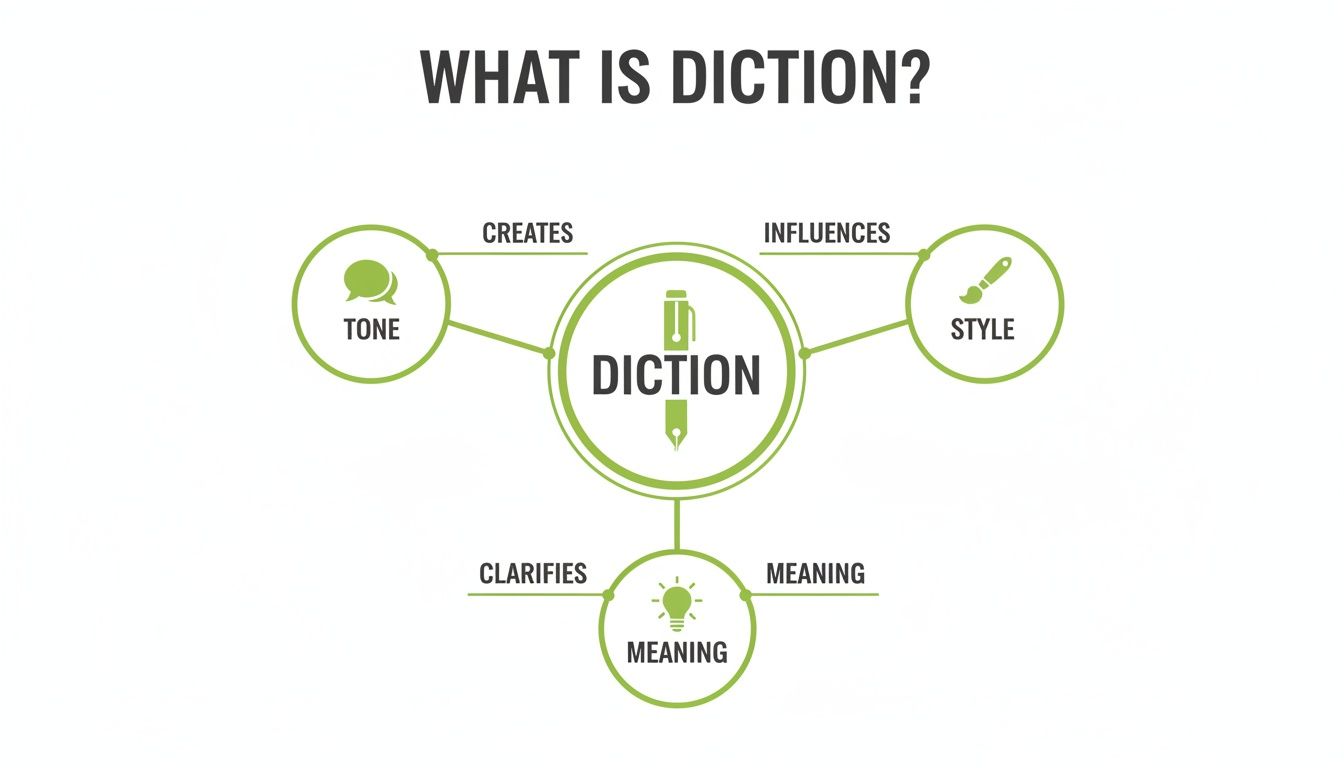
This really drives home the point: the words you choose aren't just decorative. They're the building blocks of your entire message and how people feel about it.
Formal Diction
Think of formal diction as the language of professionalism and precision. It’s buttoned-up, technically accurate, and often uses more complex sentences and a sophisticated vocabulary. You won't find contractions, abbreviations, or overly emotional language here—it’s all about objectivity and clarity. This is the natural habitat for academic papers, legal contracts, and official business reports.
Let's look at the difference in action:
- Formal: To facilitate the project's success, it is imperative that all personnel adhere to the established protocols.
- Informal: So the project doesn't fail, everyone needs to stick to the rules.
The first sentence leans on words like "facilitate," "imperative," and "personnel" to build a serious, authoritative tone. The second gets the same idea across, but in a much more straightforward, everyday way.
Formal diction projects authority and credibility. It signals to the reader, "Pay attention. This information is serious, well-researched, and should be taken at face value."
Informal Diction
This is the language we use every day. Informal diction is conversational, friendly, and personal. It’s marked by simpler words, common contractions (like "don't" or "it's"), and a more direct, get-to-the-point sentence structure. This is the go-to style for most blog posts, personal emails, and social media updates.
The goal here is to create a sense of connection. By writing this way, you make your content feel accessible and relatable. It’s the difference between asking a colleague to "commence an activity" and just saying, "let's get this started."
Colloquial Diction and Slang
Pushing even further into casual territory, we find colloquialisms and slang. These can inject a ton of personality and authenticity into your writing, but you have to know your audience. Used incorrectly, they can backfire and leave readers confused or feeling excluded.
Colloquial Diction: This covers all the common phrases, regional sayings, and idioms that aren't quite "proper" English but are understood by almost everyone. Think of expressions like "y'all," "gonna," or complaining that something "costs an arm and a leg." These little touches make writing feel grounded and human.
Slang: This is where things get very specific. Slang is made up of hyper-informal, often trendy words that are popular within a certain social group, subculture, or generation. Words like "lit," "ghosting," or "salty" are perfect examples. Slang is powerful for connecting with a very niche audience, but it can become dated almost overnight and will likely go over the heads of anyone outside that specific group.
Picking the right type of diction is a strategic choice, not an accident. A legal document needs formal language to be taken seriously. A lifestyle blog, on the other hand, thrives on informal and colloquial terms to build a community. When you choose your words with intention, you gain complete control over how your reader experiences your message.
How Word Choice Creates Tone and Authorial Voice
If the components of diction are the individual threads, then tone and voice are the tapestry you weave with them. This is where your careful word choices really come to life, creating a specific feeling and a personality that readers can connect with.
Tone is simply your writing's attitude toward the subject and the reader. Think about the massive difference between a witty tweet and a formal legal notice. One uses snappy, informal words to sound exciting, while the other leans on formal, authoritative diction to convey absolute seriousness. The words you pick are directly responsible for setting that mood.
Think of it this way: your consistent diction choices create your authorial voice—your unique fingerprint as a writer. This voice is what makes your writing sound like you and nobody else.
Developing a strong, recognizable voice is essential for building trust, whether you're a blogger, a marketer, or an academic. Consistent word choice makes your writing feel reliable, helping readers connect more deeply with your message. Getting a handle on various rhetorical device examples can also give you a powerful toolkit for shaping your voice.
From Words to a Recognizable Writing Voice
Your unique authorial voice isn't built on a single word; it's the cumulative effect of thousands of them. A writer who consistently chooses precise, analytical words will naturally develop an academic voice. On the other hand, someone who favors playful, imaginative language will cultivate a more creative one.
Let's look at a couple of quick examples:
- A Brand's Social Media: To sound youthful and exciting, they might use trendy slang like "game-changer" or "epic." This builds a voice that feels modern and relatable to their target audience.
- A Scientific Journal: To establish credibility, it will use formal terms like "methodology" and "quantitative analysis." This creates a voice of expertise and objectivity.
Understanding this link is the real secret to mastering diction. It’s all about being intentional with every single word to shape how your audience perceives not just your message, but you as the writer. For a deeper look at this, check out our guide on what is voice in writing and how it all fits together.
Diction in the Digital Age
In today's fast-paced online world, diction is more important than ever. The language itself is constantly evolving, with dictionaries adding 800-1,200 new words every year, often driven by AI analyzing sentiment across billions of online conversations. Diction is no longer static.
For students trying to hit a 99% Turnitin pass rate or marketers aiming to boost click-through rates by 40% with the right tone, the pressure is on. This is where tools like Natural Write become so valuable, helping you instantly humanize AI-generated text and refine your word choice to be both effective and authentic.
Practical Strategies to Improve Your Diction
Knowing what diction is is one thing. Actually improving it is where the magic happens. Honing your word choice isn’t about swallowing a dictionary whole; it’s about being deliberate and conscious about the words you pick to get your message across.
The best part? You don’t need a special course to get started. A few focused habits can make a world of difference, expanding your vocabulary and giving you a much deeper feel for how certain words land with a reader.
Read Actively and Widely
The single best way to improve your diction is to read. A lot. But don’t just read to get to the end—read like a writer. When a sentence really grabs you, stop and figure out why. What specific word made it so powerful, funny, or vivid?
- Jump Between Genres: Pay attention to the stark difference between the precise language in a scientific journal and the rich, sensory words in a novel. You'll quickly see how each field develops its own unique diction.
- Keep a Word Journal: When you stumble upon a great word, write it down. Note its definition and, more importantly, the sentence where you found it. This builds a personal toolkit of words you can pull from later.
This kind of active reading trains your brain to spot what works, making it so much easier to do it yourself. You start to develop an intuitive sense for the rhythm and flow of a well-put-together sentence.
Use Your Thesaurus Thoughtfully
The thesaurus can be your best friend or your worst enemy. It’s not a tool for finding "smarter" words; it’s for finding more accurate ones. One of the most common diction mistakes is using a big word incorrectly, which instantly chips away at your credibility.
Instead of just swapping words, think about their connotation—the vibe or cultural baggage a word carries. Sure, "confident," "arrogant," and "proud" might all show up as synonyms, but they paint entirely different pictures in your reader's mind.
Your goal should always be clarity, not complexity. Pick the word that lands your exact meaning with the right emotional tone, even if it’s a simple one.
When you focus on precision, every word pulls its weight, strengthening your message instead of muddling it.
Humanize and Refine with Smart Tools
Let’s be honest, a lot of content starts with an AI draft these days. That makes the ability to polish robotic text into something genuinely human more valuable than ever. Tools like Natural Write are built for this very task, helping you move past basic grammar and focus on the subtle choices that make writing feel authentic.
The numbers back this up. Research shows that AI detection platforms flag robotic patterns in 92% of initial AI-generated drafts. But after a human touch refines the diction and varies the vocabulary, those same pieces pass detectors like Turnitin 98% of the time. Better yet, academic papers with a sophisticated, humanized diction see citation rates that are 22% higher. You can explore the full findings on vocabulary tools in modern writing for a deeper dive.
Running your work through a tool like this helps you catch the repetitive phrasing and bland word choices your own eyes might miss. It can point you toward better alternatives, adding a natural rhythm and clarity that makes your writing connect with people, not just algorithms. It's that final polish that takes a draft from just "done" to truly exceptional.
Common Diction Mistakes and How to Avoid Them
Even the most seasoned writers fall into diction traps. We all do. The key is learning to spot these pitfalls in your own work so you can edit with a sharp eye and make sure your message lands exactly as intended. While great diction often goes unnoticed, mistakes stick out like a sore thumb.
Let's break down some of the most common blunders and, more importantly, how to fix them.
Overwriting with Purple Prose
You’ve probably seen it before—writing that tries so hard to sound smart that it ends up saying very little. That's purple prose. It’s the stuff of long, winding sentences and ten-dollar words used for their own sake. The result? The reader gets tangled in the language and loses sight of the actual point.
- Before: The cerulean firmament, a boundless celestial canvas, was melancholically punctuated by the aqueous exhalations of somber, niveous clouds.
- After: Gray clouds drifted across the blue sky.
The "after" version is simple, direct, and actually creates a clearer picture in the reader's mind. Communication, not showing off, is always the goal.
The best diction doesn't draw attention to the words themselves; it draws attention to the ideas they represent. Always prioritize clarity over complexity.
Relying on Clichés and Vague Language
Clichés are the zombies of the writing world—phrases that have been used so often they've lost all life and meaning. When you write "think outside the box" or "at the end of the day," you’re using a shortcut that signals a lack of original thought.
Vague words are just as bad. Words like "good," "nice," "bad," or "interesting" are placeholders. They tell the reader next to nothing and are a missed opportunity to be more descriptive and persuasive. Instead of saying the report was "good," show why.
- Vague: The presentation was good.
- Specific: The presentation's data-driven insights and clear visuals made its conclusions highly persuasive.
Get specific. It makes all the difference.
Mismatching Tone and Audience
This one is a classic. It’s about using language that just doesn't fit the situation. Dropping slang and emojis into a formal business proposal can instantly damage your credibility. On the flip side, using dense, academic jargon in a friendly blog post will send readers running.
Before you even start writing, take a moment to ask yourself three simple questions:
- Who am I writing for? (A group of experts? The general public? A potential client?)
- What is my purpose? (To inform, persuade, entertain?)
- What tone will connect best? (Formal, conversational, funny, serious?)
Nailing this down from the start is half the battle. When your diction aligns with your audience and purpose, your writing becomes exponentially more effective.
Your Actionable Diction Improvement Checklist
Knowing what diction is and actually putting it into practice are two different things. The good news is that turning theory into skill just takes a little intentional effort. Great diction isn’t about using the most complicated words you can find; it’s about choosing the right words to create clarity and impact.
Think of this checklist as your pre-flight routine before you send your writing out into the world. It’ll help you see your own work with fresh eyes and turn a solid draft into something that truly connects.
Your Pre-Publishing Diction Review
Before you hit publish, take a few minutes to run through these simple questions. It's a quick habit that pays off big.
Analyze Your Audience: Is my language a good fit for my reader? Am I using formal, informal, or slangy language that they'll understand and appreciate? A language mismatch is one of the fastest ways to alienate someone.
Check for Vague Words: Scan for weak, generic words like "good," "nice," or "interesting." Challenge yourself to replace each one with a more precise and evocative alternative that paints a picture instead of just stating a fact.
Hunt for Clichés: Do one final read-through just to spot tired, overused phrases. You know the ones. Swapping them out for original language immediately makes your writing feel more alive and authoritative.
Confirm the Tone: Try reading a few sentences out loud. Does the feeling behind the words—the tone—match your overall goal? Hearing your own writing is a fantastic trick for catching clunky phrasing and tonal missteps.
Refine and Humanize: If you used an AI tool to get started, have you gone back and smoothed out the robotic edges? Focus on adding your own rhythm and personality to make a genuine connection with your audience.
Making this process a habit is what separates good writers from great ones. For an even deeper dive into refining your work, our comprehensive self-editing checklist is the perfect next step to polish every last detail.
Got Questions About Diction? We've Got Answers.
As you start paying closer attention to word choice, a few common questions tend to pop up. Let's clear up some of the finer points so you can master this whole diction thing.
What’s the Difference Between Diction and Syntax?
It's easy to mix these two up because they work so closely together. The best way to think about it is with a LEGO analogy.
- Diction is all about the individual bricks you choose—the specific words themselves. Are you picking a red 2x4 or a transparent blue one?
- Syntax is how you stack those bricks to build something. It's the structure of your sentences and paragraphs.
You could use formal diction ("procure," "ascertain") but arrange it in a short, punchy sentence. The two combine to create your unique writing style.
How Do I Develop a More Formal Diction for Academic Writing?
Shifting to a formal, academic tone is all about precision and objectivity. A great first step is to simply read academic papers and journals in your field. You'll start to naturally absorb the right vocabulary and style.
The key is to avoid contractions (like "can't" or "it's"), slang, and emotional language. Instead, focus on specific, unambiguous words that lend your arguments clarity and scholarly weight.
Building this kind of vocabulary takes practice, but it's what gives your academic writing real credibility.
Does Poor Diction Actually Affect SEO?
You bet it does. Search engines aren't English teachers grading your vocabulary, but poor diction creates a poor user experience. If your writing is confusing or clunky, readers will get frustrated and leave.
That "bounce" sends a strong signal to Google that your page isn't helpful. On the flip side, clear and precise diction makes your content more readable, keeping people on your page longer and showing search engines you’re delivering value. It's a huge part of matching what you wrote to what the user was actually searching for.
How Can a Tool Like Natural Write Help Me With Diction?
AI-generated text is notorious for sounding... well, robotic. It often falls back on repetitive phrasing and awkward word choices.
A tool like Natural Write is specifically designed to fix that. It acts like a human editor, spotting that unnatural language and suggesting better alternatives that flow more smoothly. It helps you swap out bland vocabulary, adjust the tone, and make sure your writing truly connects with a human reader—all while helping it feel less like it came from a machine.
Ready to turn your drafts into something that sounds like it was written by a person, for a person? Natural Write can instantly clean up your diction, sharpen your clarity, and perfect your tone with just one click. Give it a try for free and see the difference for yourself.