Knowing how to write a good summary is about more than just shortening a text. It's about capturing the very essence of a message in your own words, creating a concise, accurate, and objective look at the original material's main ideas. You have to leave out the fluff and your own opinions, which takes a surprising amount of skill.
Why Writing a Great Summary Is a Superpower

Let's be real—the phrase "write a summary" probably gives you flashbacks to tedious book reports. But out here in the professional world, it’s a game-changer. We're drowning in data, endless reports, and novel-length email threads. The ability to cut through all that and deliver the core message cleanly is a genuine superpower.
This isn’t just about trimming words. It's about preserving the soul of the original text for a very specific reason. A sharp, well-written summary can make or break things in high-stakes situations.
Where This Skill Truly Matters
Think about the last project proposal you saw. Did you really read every single word? Or did you jump straight to the executive summary to get the gist? That little paragraph is everything. It can hook a stakeholder or lose them completely in a matter of seconds.
Here are just a few places where a great summary makes all the difference:
- Winning a Proposal: A potential client skims your summary to decide if you’re even worth their time.
- Clarifying Team Goals: A project manager boils down a meeting into clear action items so everyone is on the same page.
- Landing a New Job: Your resume's professional summary is the first—and sometimes only—thing a recruiter reads.
- Making Informed Decisions: An analyst condenses market research so executives can act without getting lost in the weeds.
This skill is so valuable that entire services are built around it. Take the global resume writing market—it’s all about summarizing professional experience. That market was valued at $2.31 billion and is on track to hit $3.42 billion by 2029. That's a lot of money riding on concise communication. You can dig into these workforce trends over at EIN Presswire.
A great summary doesn’t just repeat information; it provides clarity. It cuts through the noise and delivers the core message with precision, saving time and preventing misunderstandings.
Ultimately, mastering the art of the summary makes you a better, more effective communicator. It proves you understand the material, respect your audience’s time, and know how to drive action. This guide will walk you through a practical process for building this superpower, from your first read-through to the final polished draft.
First Things First: Truly Understand the Material
You can't summarize what you don't understand.
This sounds obvious, I know. But it’s the single most common reason summaries fail. Too many people jump straight into writing, yanking out sentences that seem important. That approach almost always creates a disjointed mess that misses the point entirely.
Before you write a single word of the summary, your goal is to become a temporary expert on the original text. This means switching from a passive skimmer to an active, critical reader. You're not just absorbing words; you're dissecting the author's argument, mapping its structure, and figuring out what’s essential versus what’s just noise.
This deep comprehension is the bedrock of a good summary. It’s a skill in high demand—the global essay writing service market, valued at around USD 1.97 billion, is projected to hit USD 4.35 billion by 2032. What are those services really selling? The ability to understand complex material first, then create original content from it. You can see the full essay writing service market analysis on dataintelo.com for a deeper look.
Adopt an Investigative Mindset
The best way to start is to approach the text like a detective on a case. You're not just reading from start to finish; you're on a mission to uncover the author's true intent.
As you read, ask yourself these questions:
- What’s the one big idea here? Try to nail down the single sentence—the thesis—that holds the entire piece together.
- Who is this written for? Knowing the intended audience helps you understand the tone, language, and purpose.
- What's the author trying to do? Are they trying to inform, persuade, entertain, or argue? This tells you which details matter most.
Answering these questions gives you a framework for everything that follows. You’re not just collecting facts; you’re getting the why behind them. This initial deep dive is a form of pre-analysis. For a closer look at this process, check out our complete guide on what is text analysis.
A summary should be a miniature blueprint of the original text. If you can't visualize the author's structural plan—the introduction, the key supporting pillars, and the conclusion—you haven't understood it deeply enough to summarize it.
Map the Argument's Structure
Once you've got a handle on the main idea, your next job is to map out the structure. Every well-written piece has a logical flow, and it’s your job to trace it. Forget about randomly highlighting phrases. Instead, focus on identifying the distinct building blocks of the argument.
Think of it like building with LEGOs. The thesis is the baseplate. Each main point is a major structural block built on top of it. The smaller details, anecdotes, and stats? Those are the decorative pieces—they make it look good, but they aren't essential to its stability.
Here's a practical way to map it out:
- Find the Thesis: Locate that one core sentence stating the central claim. Write it down separately.
- Pinpoint the Topic Sentences: Go through each paragraph and find the sentence that introduces its main idea. These are your key supporting points.
- Note the Key Evidence: For each key point, jot down the main piece of evidence the author uses to back it up.
- Ignore the Fluff: Be ruthless. Actively disregard tangents, repetitive examples, and filler. This is what keeps your final summary tight and focused.
When you’re done, you should have a clean, skeletal outline of the original work. This isn't your summary—it's the raw material you'll use to build it. Having this map ensures your summary will accurately reflect the original's flow and emphasis, giving you a solid foundation for the drafting process.
From Notes to a Coherent First Draft
Alright, you’ve done the heavy lifting. You've dissected the original text and have a solid outline. Now it's time to translate that understanding into a clean, concise first draft. This is where your notes and structure start to look like a real summary.
The trick is to build it methodically, starting with a strong foundation and layering on the details.
Start with One Powerful Sentence
Before you write anything else, boil the entire text down to a single, powerful sentence. This isn't just a topic sentence; it's the thesis of your summary. It needs to capture the author’s core argument or the absolute main takeaway of the piece.
Think of this as your North Star. Every other sentence you write from here on out will directly support or expand on this one core idea. Nailing this anchor sentence forces you to be decisive and prevents you from getting bogged down in secondary details.
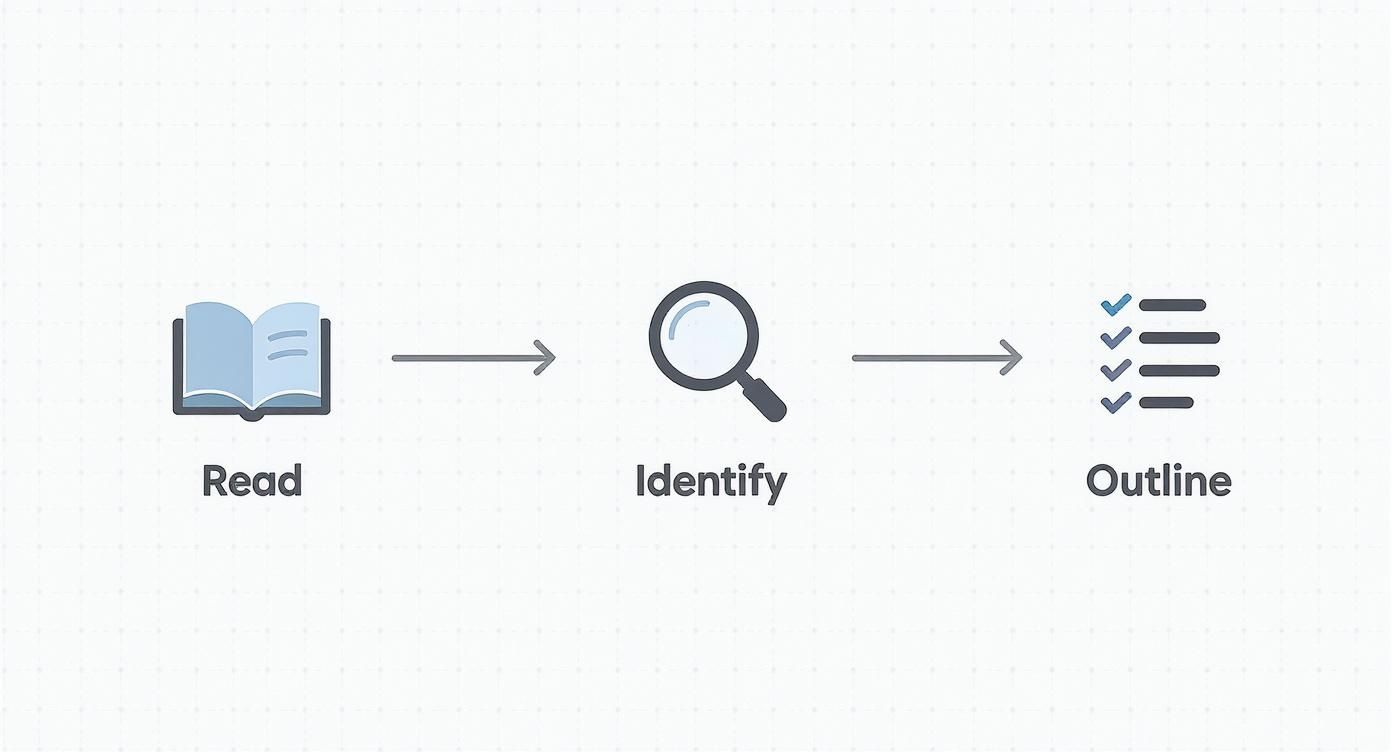
This is the whole point of the pre-writing work: read, identify, and outline. That process gives you the clarity you need to even attempt writing that all-important anchor sentence.
Build Out from Your Anchor
Once your anchor sentence is locked in, start building the body of your summary. Grab the outline you made—the one with the main points and key evidence—and use it as your guide. The goal is to weave these points together in a way that mirrors the original text’s flow.
Start by writing one sentence for each major point from your outline. These should follow your anchor sentence, creating a logical progression. Make sure each new point connects smoothly to the one before it. This is what makes your summary feel like a unified piece, not just a jumbled list of facts.
The real test of a good summary is its flow. A reader should be able to follow the argument from start to finish without needing to reference the original text. It must stand on its own.
The Art of Effective Paraphrasing
Now for the most critical skill in summarizing: paraphrasing. Simply copying and pasting key sentences isn't summarizing; it's plagiarism. True paraphrasing means you've actually processed the information and can restate it entirely in your own words.
And it’s more than just swapping a few words for synonyms. It’s about restructuring the sentence to convey the original idea with your own voice.
Let’s look at an example:
- Original: "The proliferation of digital communication platforms has fundamentally altered the socio-political landscape, enabling rapid mobilization for grassroots movements while also posing significant risks related to misinformation."
- Weak Paraphrasing: "The increase of digital media has changed the socio-political world, allowing for quick mobilization of movements but creating big risks from false information."
- Strong Paraphrasing: "Digital communication tools have reshaped modern politics by empowering grassroots movements to organize quickly, though they also introduce serious threats from the spread of misinformation."
See the difference? The strong example completely changes the sentence structure and word choice but keeps the original meaning and nuance perfectly intact. That’s the goal.
Weave It All Together
As you build out the draft, the final touch is making sure all the pieces connect seamlessly. This is where you sprinkle in transitional words and phrases to guide the reader. Words like "consequently," "additionally," or "however" act as signposts, clarifying the relationships between ideas.
Your goal is a draft that’s not just accurate, but also effortless to read. A smooth flow helps the reader absorb the information without struggling to connect the dots. You can learn more about this in our guide on what is cohesion in writing.
If you want a technological head start, you can learn how to make an AI summary of your Google Doc. AI can generate a decent first pass, but remember that the best summaries always need a human touch to nail the accuracy, tone, and flow.
With that, your first draft is done—a solid foundation ready for the next step: revision.
How to Polish and Refine Your Summary
Your first draft isn’t the finish line; it’s the starting block. The real magic happens during the revision process, where you sharpen a decent collection of ideas into a powerful, clear summary. This is where you polish your work until it shines.
I like to think of it like a sculptor with a rough block of marble. Your first draft has the basic shape, but now it’s time to chip away the excess, smooth the edges, and reveal the final form. It takes a critical eye, but this is what separates a forgettable summary from a truly effective one.
First, Verify Every Detail for Accuracy
This is the absolute, non-negotiable rule: your summary must be truthful to the original source. Any misrepresentation, no matter how small, undermines its entire purpose.
Before you touch anything else, put your summary and the original text side-by-side and play detective. Did you capture the author's argument correctly? Have you accidentally twisted a key finding or taken a supporting detail out of context? This is your most important quality check.
Here’s what to look for:
- The Thesis: Does your first sentence perfectly reflect the source’s main claim?
- Key Points: Are all the main supporting arguments there and represented correctly?
- Original Tone: Does your summary capture the author's intent—whether it's persuasive, informative, or critical?
- No New Opinions: Have you kept your own thoughts out of it? A summary must be objective.
A summary is a promise to your reader that you’re delivering the essence of the original work faithfully. Breaking that promise with inaccuracies makes it worthless.
Next, Cut Ruthlessly for Brevity
Once you’re sure it’s accurate, your next job is to make it as concise as possible. Every single word has to earn its place. Wordiness is the enemy of a good summary; it just clouds the core message with fluff.
Start by hunting down and eliminating filler words and redundant phrases. These are weak words that add length but zero value.
Look at this example:
- Wordy: "It is generally believed by many experts that the primary factor that is causing the problem is basically due to a lack of resources." (25 words)
- Concise: "Experts believe a lack of resources is the primary cause of the problem." (12 words)
See how much stronger that is? You've nearly halved the word count without losing an ounce of meaning. That's the goal. For a deeper dive into trimming your own writing, a good self-editing checklist can give you a structured way to tighten things up.
Finally, Enhance Flow for Total Clarity
Okay, it’s accurate and it’s brief. Now, is it readable? A great summary should guide the reader smoothly from one point to the next. If the sentences are choppy or the connections feel clunky, the reader has to work too hard to follow your logic.
This is my favorite trick: read your summary out loud. It’s incredibly effective at revealing awkward phrasing and jarring transitions. Does it flow naturally? Do the ideas connect in a logical sequence?
Use transition words to build bridges between ideas. Simple words like "however," "therefore," "in addition," and "consequently" act as signposts, showing the reader how your points relate to one another. This creates a cohesive narrative that’s easy to follow.
To help with this final polish, I use a simple checklist to make sure I haven't missed anything. It's a great way to systematically review your work.
Summary Revision Checklist
Use this practical checklist to review and refine your draft, making sure it's accurate, concise, and clear.
| Checklist Item | What to Look For | Action to Take |
|---|---|---|
| Accuracy Check | Mismatches between your summary and the source material's main points, data, or tone. | Place both texts side-by-side. Correct any detail that doesn't perfectly align with the original. |
| Brevity Check | Filler words ("basically," "in order to"), redundant phrases, and sentences that can be combined. | Hunt for and delete unnecessary words. Rephrase long sentences to be more direct. |
| Clarity Check | Awkward phrasing, confusing connections between ideas, or a lack of logical flow. | Read the summary aloud. Add transition words (e.g., "however," "therefore") to link ideas smoothly. |
| Objectivity Check | Any personal opinions, interpretations, or insights that weren't in the original text. | Remove any trace of your own voice or judgment. The summary must be a neutral reflection. |
This final pass helps ensure your summary is not just good, but great—a true and useful reflection of the original.
The Essential Human Touch
AI tools can be fantastic for getting a first draft on the page or spotting redundancies. But that final polish? That needs a human.
AI can struggle with nuance, tone, and the subtle context that a person grasps instantly. Think of it as a powerful assistant, but you always need to be the final editor. You’re the one who ensures the summary is not just accurate and concise, but truly clear and coherent.
Common Summary Writing Mistakes to Avoid
Even experienced writers can hit a snag when summarizing. It’s a skill that seems straightforward on the surface, but it's packed with subtle traps. Learning what not to do is just as important as following the right steps, because a few common mistakes can tank the credibility of your work.
Think of this as your troubleshooting guide. We're going to walk through the most frequent errors I see and, more importantly, how to catch and fix them. Developing that critical eye is what will elevate your summaries from just "good enough" to genuinely great.
Mistake 1: Injecting Your Own Opinion
This is the cardinal sin of summary writing. A summary needs to be an objective reflection of the original text—nothing more, nothing less. Your job is to report what the author said, not what you think about it.
It's surprisingly easy to let your own biases creep in, especially when you have a strong reaction to the source material. Watch out for red-flag phrases like "The author correctly points out..." or "Unfortunately, the study fails to consider..." That language instantly shifts the focus from the author's message to your own analysis.
- What it looks like: "The article makes an unconvincing argument that urban green spaces are essential for public health, failing to provide enough hard data."
- How to fix it: "The article argues that urban green spaces are essential for public health, citing community wellness surveys and environmental reports as evidence."
See the difference? The second version sticks to the facts, neutrally presenting the author’s claim and their evidence without passing judgment.
Mistake 2: Getting Lost in the Weeds
A summary is a highlight reel, not a play-by-play. A very common misstep is packing it with too many minor details, specific examples, or secondary stats. Those things are great in the original text—they add color and depth—but in a summary, they just create clutter and hide the main points.
Your goal is to capture the skeleton of the argument, not every single piece of supporting tissue. If you find your summary is creeping up in length and starting to rival the original, you're almost certainly bogged down in unnecessary details.
A great summary provides a bird's-eye view of the landscape, not a ground-level tour of every single tree. If a detail doesn't directly support a main pillar of the argument, it probably doesn't belong.
This skill is incredibly valuable. The content writing services market, valued at around USD 22.63 billion, is projected to hit USD 35.63 billion by 2032. Why? Because businesses need people who can distill big ideas into clear, effective content. To learn more, check out these insights into the content writing services market.
Mistake 3: Sticking Too Close to the Original Phrasing
This one is tricky because it walks a fine line between lazy paraphrasing and accidental plagiarism. When you summarize, you must digest the ideas and then re-state them entirely in your own words. Just swapping out a few words or shuffling the sentence order around doesn't cut it.
This usually happens when a writer hasn't fully grasped the material. They cling to the author's original phrasing because they aren't confident enough to explain the concepts on their own. A well-written summary is proof of comprehension, and that proof comes from your ability to articulate the ideas in a fresh way.
Let's look at an example:
- Original Sentence: "The corporation's strategic pivot towards sustainable energy sources was primarily motivated by escalating investor pressure and new governmental regulations."
- Too Close for Comfort: "The company's strategic change to sustainable energy was mostly motivated by rising investor pressure and recent government rules."
- Effective Paraphrase: "Mounting pressure from investors, combined with new government mandates, drove the corporation to shift its strategy toward sustainable energy."
The final version shows true understanding. It completely restructures the sentence while keeping the core meaning intact. By consciously steering clear of these common errors, you'll ensure your summary is accurate, objective, and a powerful reflection of your comprehension.
Got Questions About Writing Summaries? We’ve Got Answers.
Even with a solid plan, you'll eventually run into those tricky "what if" moments. It happens. Learning how to write a good summary means knowing how to handle these common roadblocks.
Think of this section as your go-to guide for those nagging questions that pop up mid-draft.
How Long Should a Summary Be?
This is, without a doubt, the number one question. The honest answer? It depends entirely on the context. There's no magic word count that fits every situation. The right length is always dictated by why you're writing the summary and how long the original text is.
A good starting point is to aim for about 10-25% of the original text's length, but treat that as a flexible guideline, not a hard rule.
Here’s how it plays out in the real world:
- An executive summary for a hefty 50-page report might just be a single page.
- A summary of a novel for a book report could easily be 500 words.
- An abstract for a scientific paper often has a strict cap, usually around 250 words.
The most important thing is to follow instructions. If your boss asks for one paragraph, give them one killer paragraph. Always let the specific requirements of the task override any generic advice.
What If I Disagree With the Author?
It’s completely normal to have a strong reaction to something you read. But a summary is not the place to pick a fight.
Your job is to act as a neutral messenger, not a critic. Your personal feelings—whether you agree or disagree—are irrelevant here. The goal is to represent the author’s ideas and arguments as faithfully as possible.
When you inject your own opinion, you're no longer writing a summary. You're writing a critique or a response, which are totally different things.
Your task as a summarizer is to be an impartial reporter, not a commentator. Accurately convey the original message, even if you think it's completely wrong. Save your own analysis for a different assignment.
Stick to neutral, descriptive phrasing. Instead of saying, "The author makes a weak claim," you should write, "The author claims..." This simple shift keeps the focus right where it belongs: on the source material.
Can I Use Direct Quotes?
The short answer is: sparingly, if at all.
A summary is your chance to prove you understand the material by explaining it in your own words. Leaning too heavily on direct quotes can look like a crutch, suggesting you haven't fully digested the concepts yourself.
That said, there are a couple of rare exceptions where a short, powerful quote might be the best choice:
- When a term is unique: If the author coined a specific phrase that’s central to their point.
- For powerful phrasing: If the author’s wording is so precise and memorable that trying to rephrase it would weaken the impact.
If you decide to use a quote, keep it brief and weave it smoothly into your own sentence. Never let quotes do the heavy lifting for you.
And while mastering the art of writing a summary by hand is a powerful skill, it can be helpful to see how different tools approach the task. Exploring something like the shortgenius summarization platform can give you new perspectives on how to get to the core of a text. Ultimately, knowing how to do this well gives you a massive advantage in any field.